What Are Combination Circuits and How Do They Work?
TL;DR
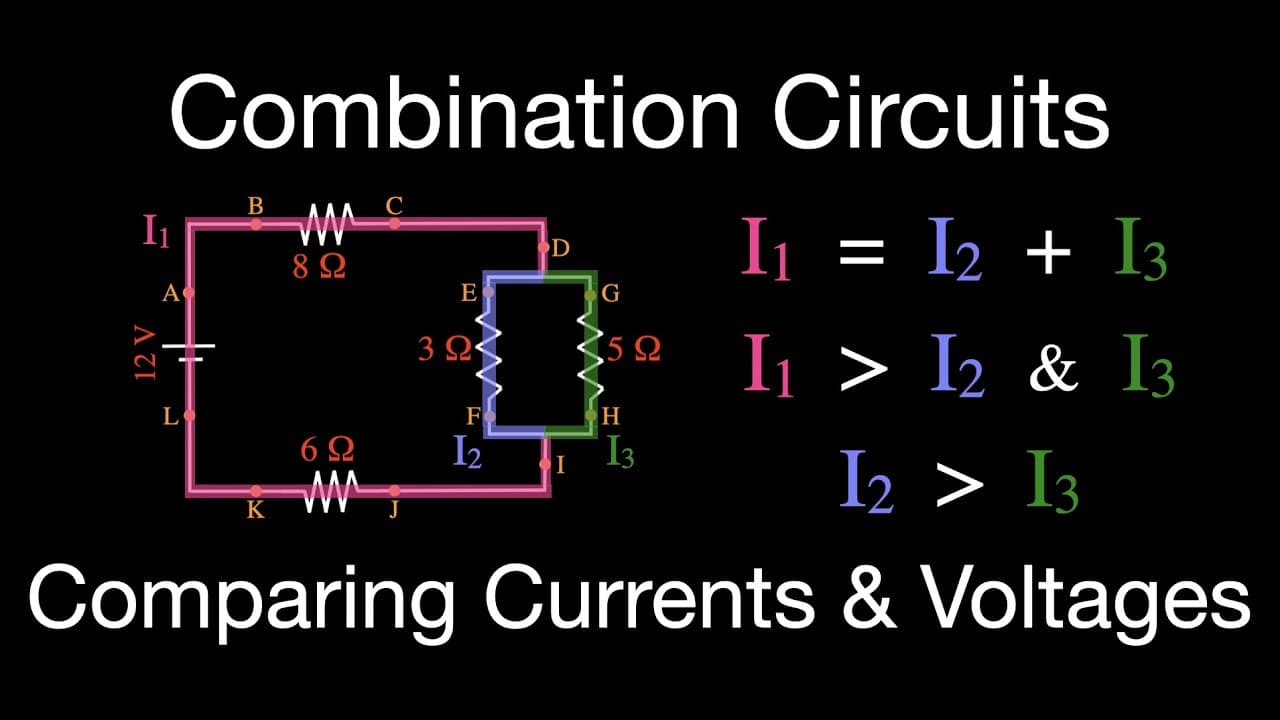
Combination circuits consist of series and parallel resistors, where the total current splits at junction points, resulting in varying currents through different branches. Higher resistances lead to greater voltage drops across those resistors. Understanding these principles is essential for qualitatively analyzing circuit behavior without calculations.
Transcript
in today's video we are going to go over comparing the currents and the voltage drops for two different kinds of combination circuits now before we get started please don't forget to subscribe to our channel step by step sites when i look at my youtube analytics i see that so many people who watch have not subscribed to our channel please subscribe... Read More
Key Insights
- ❓ Total current splits in series-parallel circuits, affecting currents in different branches.
- ⚡ Voltage drops are influenced by resistor resistances, with higher resistances causing higher drops.
- 🆘 Recognizing current variations in circuits helps in understanding current distributions effectively.
- 💦 Parallel circuit elements exhibit equal voltage drops due to the same potential difference.
- 💦 Knowledge of Ohm's Law is essential in calculating voltage drops accurately.
- 💦 Currents and resistances play crucial roles in determining voltage drops across circuit elements.
- 💐 Understanding how current flows and divides in circuits is fundamental for qualitative analysis.
Install to Summarize YouTube Videos and Get Transcripts
Explore YouTube Video Summarizer or Get YouTube Transcript Extractor
Questions & Answers
Q: How does the total current split in a series-parallel circuit?
The total current splits into two branches in a series-parallel circuit, with each branch carrying a portion of the total current. It is crucial to understand how currents divide in different branches.
Q: What factors determine the voltage drop across resistors in a circuit?
The voltage drop across resistors is influenced by their resistance value. Higher resistance results in a higher voltage drop, while lower resistance leads to a lower voltage drop. Understanding Ohm's Law is crucial in calculating voltage drops.
Q: How does the current vary at different points in a circuit?
Current distribution in a circuit depends on the resistance values in different branches. Lower resistance paths will have higher currents, while higher resistance paths will have lower currents. Recognizing current variations is essential in analyzing circuits.
Q: Why are voltage drops across parallel circuit elements the same?
In parallel circuits, voltage drops are the same across elements because they experience the same potential difference. Understanding the behavior of parallel circuit elements helps in predicting voltage differences effectively.
Summary & Key Takeaways
-
Examines circuit currents and voltage drops qualitatively without mathematical calculations.
-
Compares currents at different points in two circuit combinations.
-
Studies voltage drops across various circuit elements and provides insights based on resistances.
Read in Other Languages (beta)
Share This Summary 📚
Summarize YouTube Videos and Get Video Transcripts with 1-Click
Try YouTube Summary with ChatGPT & Claude or YouTube Transcript Generator
Explore More Summaries from Step by Step Science 📚


Summarize YouTube Videos and Get Video Transcripts with 1-Click
Try YouTube Summary with ChatGPT & Claude or YouTube Transcript Generator