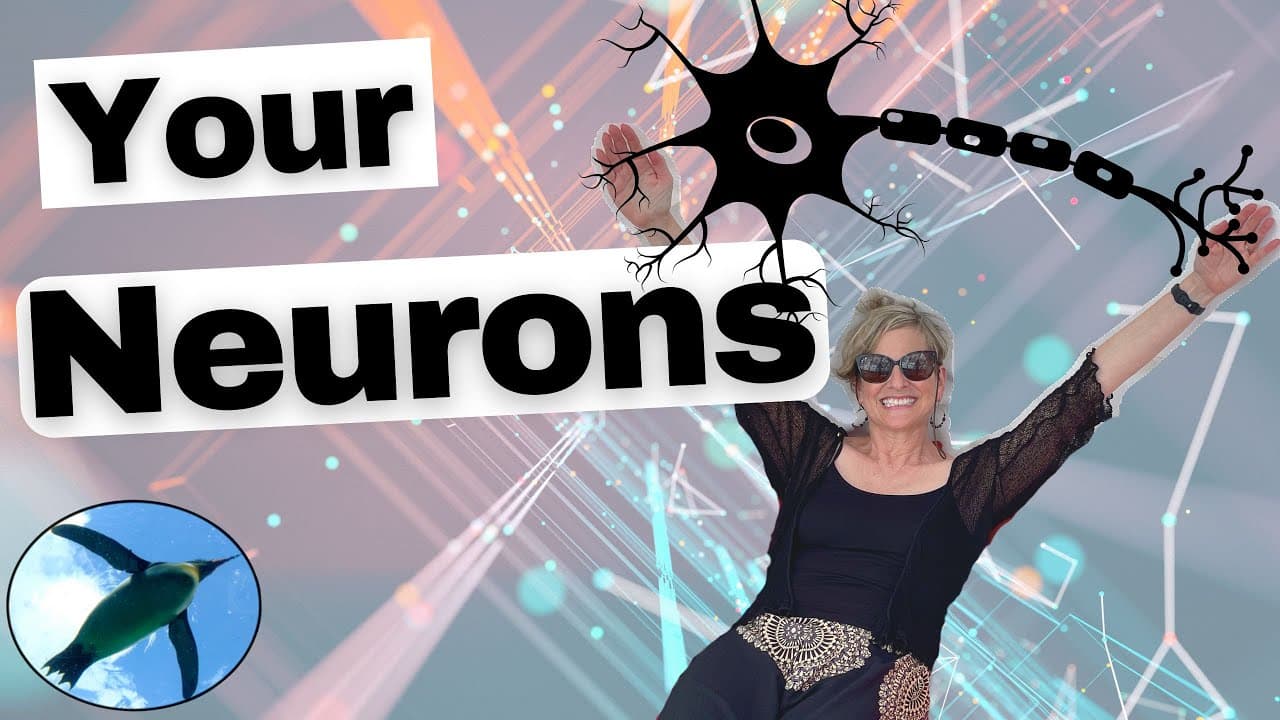
What Are Neurons and How Are They Classified?
TL;DR
Neurons are classified based on their shape into four types: anaxonic, bipolar, pseudounipolar, and multipolar, and by function as sensory, interneurons, and motor neurons. Key anatomical parts include dendrites, the cell body, axon hillock, axon, and terminal, with myelin playing a critical role in signal insulation and speed, produced by Schwann cells in the peripheral nervous system and oligodendrocytes in the central nervous system.
Transcript
Hello, and welcome to The Penguin Prof channel. In today's episode, we're going to get into the neuron, all things neuron. As you jump into the nervous system, you want a good, solid foundation. You want to stay tuned. We're going to talk about all of this good stuff -- how we classify neurons, the parts of a neuron, why they're such a big deal ... Read More
Key Insights
- 🧑🦼 Neurons can be classified based on shape (anaxonic, bipolar, pseudounipolar, multipolar) and function (sensory, interneurons, motor).
- ❓ The anatomy of a neuron includes dendrites, cell body, axon hillock, axon, and terminal.
- 💨 Myelin is important for insulation and faster transmission of signals in neurons.
- 😟 Schwann cells and oligodendrocytes are the two types of glial cells that produce myelin in the peripheral and central nervous system, respectively.
- 👾 Neurons communicate through synapses, where signals are transmitted across a small space.
- 📡 Convergence and divergence are important concepts in neuronal communication, referring to the merging and spreading of signals, respectively.
- ❓ Diseases such as multiple sclerosis can affect the myelin sheaths in neurons.
Install to Summarize YouTube Videos and Get Transcripts
Explore YouTube Video Summarizer or Get YouTube Transcript Extractor
Questions & Answers
Q: How are neurons classified based on shape?
Neurons can be classified into anaxonic, bipolar, pseudounipolar, and multipolar based on the number and orientation of their processes.
Q: What are the different classifications of neurons based on function?
Neurons are classified as sensory, interneurons, and motor neurons, depending on whether they carry information from the periphery to the central nervous system, within the central nervous system, or from the central nervous system to the periphery, respectively.
Q: What are the main parts of a neuron?
The main parts of a neuron include dendrites, which receive information; the cell body or soma, which integrates the received information; the axon hillock, which decides whether the neuron will fire; the axon, which carries the signal away from the cell body; and the terminal, which contains neurocrines that transmit the signal to the target cell.
Q: What is the role of myelin in neurons?
Myelin serves as insulation in the nervous system, allowing for faster transmission of signals. Neurons with myelin can transmit signals up to 100 meters per second, compared to only one meter per second in naked axons.
Summary & Key Takeaways
-
The video discusses the classification of neurons based on their shape, including anaxonic, bipolar, pseudounipolar, and multipolar neurons.
-
Neurons are also classified based on their function as sensory, interneurons, and motor neurons.
-
The anatomy of neurons is explained, including the parts such as dendrites, cell body, axon hillock, axon, and terminal. The role of myelin in insulating and facilitating faster transmission of signals is also highlighted.
Read in Other Languages (beta)
Share This Summary 📚
Summarize YouTube Videos and Get Video Transcripts with 1-Click
Try YouTube Summary with ChatGPT & Claude or YouTube Transcript Generator
Explore More Summaries from ThePenguinProf 📚





Summarize YouTube Videos and Get Video Transcripts with 1-Click
Try YouTube Summary with ChatGPT & Claude or YouTube Transcript Generator