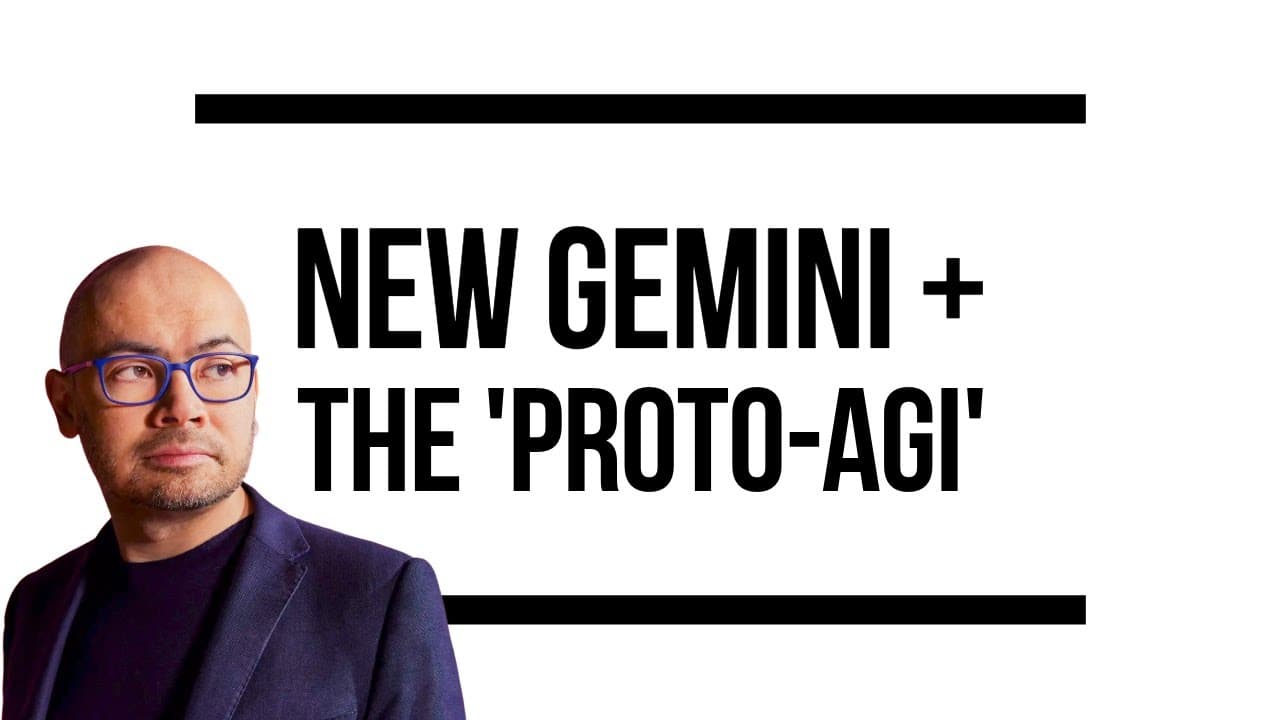
How Does Gemini 3 Flash Point Toward Proto-AGI?
TL;DR
Gemini 3 Flash delivers faster, cheaper performance that exceeds Gemini 2.5 Pro across many reported benchmarks, but it frequently gives incorrect answers instead of admitting uncertainty. Demis Hassabis envisions a proto-AGI emerging by combining Gemini with image, video, world-simulation, and embodied-agent systems, although current models still approximate basic physics and specialized releases can regress on particular tasks.
Transcript
In the last 48 hours, we have had two major model releases and about 10 hours worth of interviews from top leaders about them. The insights of which I will try to condense into just 15 minutes or so. Because Gemini 3 flash is Google's attempt at finally convincing you to switch from chatbt or claude and the results look incredible. I'll go through ... Read More
Key Insights
- Gemini 3 Flash is a fast model that reportedly exceeds Gemini 2.5 Pro across academic reasoning, visual reasoning, scientific knowledge, coding, mathematics, chart analysis, video analysis, and agent tasks, despite Gemini 2.5 Pro having been the state-of-the-art Google model earlier that year.
- Gemini 3 Flash achieved 95.2% on the cited AIME mathematics benchmark without tools, compared with 88% for Gemini 2.5 Pro. The result roughly halves the remaining error rate while illustrating how a quicker model can outperform an earlier, heavier system.
- Benchmark accuracy can hide whether a model responsibly acknowledges uncertainty. On a 6,000-question knowledge benchmark, 91% of Gemini 3 Flash's unsuccessful responses were incorrect answers, while only 9% were refusals or partial answers, creating a significant confabulation risk.
- GPT 5.1 handled unsuccessful factual questions differently from Gemini 3 Flash, with an approximately 50/50 division between admitting uncertainty and answering incorrectly. This comparison shows that slightly lower aggregate accuracy may accompany more cautious behavior when the model lacks sufficient knowledge.
- Gemini 3 Flash scored 61.1% on SimpleBench, placing it near substantially slower models such as Claude Opus 4.5 and GPT 5 Pro. The private benchmark uses hundreds of trick questions, often involving spatial reasoning, and its results were averaged across multiple runs.
- Specialization can improve targeted capabilities while reducing performance elsewhere. GPT 5.2 underperformed GPT 5.1 and GPT 5 on SimpleBench, while GPT 5.2 Codex scored 10% on an internal machine-learning-engineering benchmark compared with 17% for GPT 5.1 Codex Max.
- Current AI physics understanding is approximate, according to Demis Hassabis. Google DeepMind is developing tests based on accurate game engines and simple experiments, such as balls rolling down tracks, to determine whether systems have precisely captured basic principles like Newton's three laws of motion.
- Hassabis' proto-AGI vision is based on combining complementary systems rather than relying solely on a language model. The discussed components include Gemini 3, Nano Banana Pro for images, Veo 3.1 for video, Genie 3 for simulated worlds, and Simmer 2 for planning and action.
Install to Summarize YouTube Videos and Get Transcripts
Explore YouTube Video Summarizer or Get YouTube Transcript Extractor
Questions & Answers
Q: How does Gemini 3 Flash compare with Gemini 2.5 Pro?
Gemini 3 Flash reportedly outperforms Gemini 2.5 Pro across academic reasoning, visual reasoning, scientific knowledge, coding, mathematics, chart and table analysis, video analysis, and agent tasks. This is notable because Flash is designed to answer quickly, while Pro models typically spend much longer reasoning. On the cited AIME mathematics benchmark without tools, Flash scored 95.2%, compared with Gemini 2.5 Pro's 88%.
Q: What is the main weakness of Gemini 3 Flash?
Gemini 3 Flash's main weakness is its tendency to provide an incorrect answer instead of acknowledging uncertainty. On a benchmark containing 6,000 knowledge and factual-recall questions, 91% of its unsuccessful responses were incorrect answers. Only 9% were unanswered or partially answered. The model can therefore achieve high aggregate accuracy while still posing a substantial hallucination risk whenever it does not know the answer.
Q: Why can model accuracy benchmarks be misleading?
Accuracy benchmarks often count correct answers without sufficiently rewarding a model for saying it does not know. Companies are therefore incentivized to make systems keep trying, think longer, self-correct, and eventually provide an answer. Two models with similar accuracy can behave very differently on failures: one may decline uncertain questions, while another confidently supplies false information. Users should examine both correctness and failure behavior.
Q: Does strong benchmark performance mean Gemini 3 Flash was trained on the answers?
Strong public benchmark performance does not by itself establish that Gemini 3 Flash memorized the answers. The transcript cites external and private evaluations, including SimpleBench, which contains hundreds of trick questions with frequent spatial-reasoning elements. Gemini 3 Flash scored 61.1% there, comparable with heavier models. The presenter argues that, unless Google violated the benchmark's terms, this result represents genuine capability rather than benchmark gaming.
Q: Why can a specialized AI model perform worse on some tasks?
Specialized post-training can improve performance in a chosen domain while producing weaker results on unrelated evaluations. Gemini 3 Flash received special post-training for software engineering, which may help explain why it outperformed Gemini 3 Pro on coding measures. Similarly, GPT 5.2 focused on coding and science but underperformed earlier GPT models on SimpleBench, a test built around trick questions and spatial reasoning rather than its primary specialization.
Q: How well do current AI models understand physics?
Current models understand physics only approximately, according to Demis Hassabis. Their generated environments may look realistic during casual inspection while still violating basic physical rules. Google DeepMind is developing a physics benchmark using accurate game engines and simple laboratory-style scenarios, such as rolling balls down different tracks, to test whether models have precisely captured foundational concepts including Newton's three laws of motion.
Q: What roles do Genie 3 and Simmer 2 play in Google's AI research?
Genie 3 is designed to simulate interactive environments, including gaming worlds, while remembering actions taken within them for at least a minute. Simmer 2 is a separate gaming companion and agent that can play, reason, learn, construct longer-term plans, and execute commands inside virtual 3D worlds. Together, they represent complementary world-generation and action capabilities that could eventually be connected with Gemini.
Q: What does Demis Hassabis mean by a proto-AGI?
Hassabis' proto-AGI appears to be a combined system built from several specialized forms of intelligence. The discussed components include Gemini 3 for broad language and reasoning, Nano Banana Pro for generating images, Veo 3.1 for turning images into video, Genie 3 for creating interactive simulated worlds, and Simmer 2 for planning and acting within those worlds. Current physics limitations remain an important obstacle.
Summary & Key Takeaways
-
Gemini 3 Flash reportedly surpasses the earlier Gemini 2.5 Pro across academic reasoning, visual reasoning, scientific knowledge, coding, mathematics, chart analysis, video analysis, and agent tasks. Its speed and low token cost allow extended reasoning, while specialized post-training helps explain unusually strong software-engineering results, including performance above the heavier Gemini 3 Pro.
-
The model's central weakness is poor uncertainty handling. On a 6,000-question factual-recall benchmark, 91% of its unsuccessful responses were incorrect answers, while only 9% were refusals or partial attempts. GPT 5.1 showed a roughly even split, illustrating why conventional accuracy scores can conceal materially different hallucination risks for users.
-
Hassabis describes current physical understanding as approximate rather than exact. Google DeepMind is separately developing Genie 3 for interactive world simulation, Simmer 2 for planning and acting inside virtual worlds, Nano Banana Pro for image creation, and Veo 3.1 for image-to-video generation. Combining such systems could form his envisioned proto-AGI.
Read in Other Languages (beta)
Share This Summary 📚
Summarize YouTube Videos and Get Video Transcripts with 1-Click
Try YouTube Summary with ChatGPT & Claude or YouTube Transcript Generator
Explore More Summaries from AI Explained 📚



Summarize YouTube Videos and Get Video Transcripts with 1-Click
Try YouTube Summary with ChatGPT & Claude or YouTube Transcript Generator