What Did Sam Altman Tell Congress About AI Risk?
TL;DR
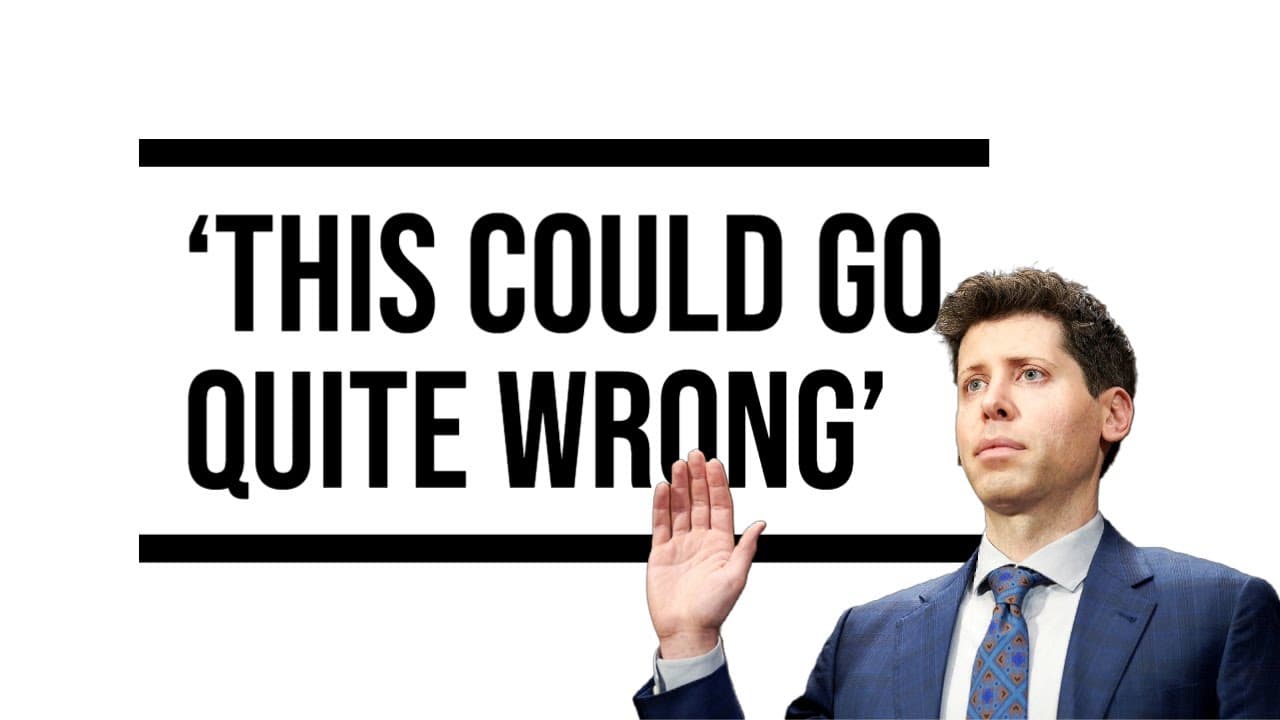
Sam Altman warned Congress that advanced AI could cause significant global harm and called for licensing, capability-based safety standards, and independent audits of powerful systems. His testimony also addressed autonomous weapons, biological threats, manipulation, job disruption, international coordination, model self-awareness, and the possibility that more capable systems may arrive sooner than many policymakers expect.
Transcript
there were 12 particularly interesting moments from samuelman's testimony to Congress yesterday they range from Revelations about gbt5 self-awareness and capability thresholds biological weapons and job losses at times he was genuinely and remarkably Frank other times less so Millions were apparently taken by surprise by the quote bombshell that Al... Read More
Key Insights
- Altman's central warning is that advanced AI could cause significant harm to the world, and he described the potential downside as much broader than job displacement. The commentary suggests that Congress did not fully connect his earlier statement about existential danger with the risks under discussion.
- AI-driven job disruption may involve more than workers moving into new occupations. Altman predicted better jobs on the other side but did not promise a greater number of jobs, while his earlier views, as presented in the commentary, included severe inequality and declining labor value.
- Autonomous military applications are already technically conceivable because language models can support surveillance, attack-option recommendations, battlefield route planning, and individual target assignment. Altman said systems should not be allowed to select targets autonomously, even though such a capability could be built.
- Altman's proposed regulatory framework is based on licensing powerful AI development, establishing safety standards, and requiring independent audits. A license could be withdrawn when an organization failed to comply, while external experts would assess models against stated thresholds before deployment.
- Capability evaluations are intended to test dangerous behaviors rather than rely only on conventional benchmark scores. Examples included whether a model could self-replicate, self-exfiltrate, manipulate beliefs or behavior, or assist in creating novel biological agents.
- Capability thresholds may regulate advanced systems more accurately than fixed compute limits. Altman said compute would be the easiest measurement, but efficiency improvements could force that threshold upward or downward, while demonstrated abilities would more directly identify systems requiring licenses.
- Model statements about consciousness are shaped by training rules and therefore may not provide reliable evidence about internal awareness. The commentary contrasts Claude's categorical denial with Bard's openness to the possibility, arguing that company-directed behavior strongly influences their answers.
- The timeline for more capable AI may be shorter than policymakers expect, according to the implications drawn from Altman's public and private remarks. A Google DeepMind safety researcher cited in the discussion said the greater danger may be running out of time to solve difficult alignment problems.
Install to Summarize YouTube Videos and Get Transcripts
Explore YouTube Video Summarizer or Get YouTube Transcript Extractor
Questions & Answers
Q: What AI risks did Sam Altman identify in Congress?
Sam Altman warned that the AI field, its technology, and its industry could cause significant harm to the world. The testimony and surrounding discussion identified risks involving job disruption, persuasion and manipulation, novel biological agents, autonomous military targeting, model self-replication, self-exfiltration, and increasingly capable systems whose behavior may be difficult to understand or guarantee as safe.
Q: How did Sam Altman propose regulating powerful AI systems?
Altman proposed creating an agency that would license AI development above a defined scale of capability and revoke licenses when organizations violated safety requirements. He also recommended concrete safety standards, dangerous-capability evaluations before deployment, and independent audits by outside experts who could determine whether a model complied with stated thresholds and performance requirements.
Q: What AI capabilities could trigger licensing requirements?
Altman suggested that licensing could apply when a model crosses specified capability thresholds. His examples included the ability to persuade, manipulate, or influence a person's behavior or beliefs, and the ability to help create novel biological agents. He also discussed evaluations for self-replication and self-exfiltration, which could reveal whether a system presents unusual deployment risks.
Q: Why might capability thresholds be better than compute thresholds?
A compute threshold would be easier to define because regulators could measure the resources used to build a model. However, Altman noted that the threshold might need to move upward or downward as algorithms become more efficient. Capability thresholds would be harder to design but could regulate systems according to what they can actually do and the dangers they present.
Q: What did the testimony say about AI and job losses?
Altman said future jobs could be far better and that current jobs could improve, but the commentary emphasizes that he did not claim there would be a greater number of jobs. It also cites his earlier predictions of major inequality, many people having no jobs, greater power shifting from labor to capital, and some labor prices falling toward zero.
Q: Can large language models be used for autonomous weapons?
The testimony acknowledged that an AI-enabled drone could technically select its own target, although Altman said that should not be allowed. The discussion also cited a Palantir demonstration in which a fine-tuned language model supported surveillance-drone ordering, real-time chat responses, attack-option recommendations, battlefield route planning, and assignment of individual targets.
Q: Are AI model answers reliable evidence of self-awareness?
Model answers alone may not reliably establish whether an AI system is self-aware because companies train models to respond according to specific behavioral rules. The commentary notes that Claude denied any possibility of consciousness, while Bard expressed uncertainty and openness to the possibility. These contrasting responses may reflect training choices rather than decisive evidence about internal experience.
Q: How soon could more capable AI systems arrive?
No specific arrival date was provided in the supplied testimony. Altman said that increasingly capable systems might not be super far away, and the commentary inferred that his private warnings to senators suggested faster progress than many people appreciate. He also stated that OpenAI was not currently training what would become GPT-5, after waiting more than six months to deploy GPT-4.
Summary & Key Takeaways
-
Altman told Congress that AI could go seriously wrong, with consequences extending beyond ordinary job displacement. The testimony covered autonomous military systems, biological threats, manipulation, labor disruption, and increasingly capable models. The commentary argues that lawmakers sometimes failed to grasp the scale and variety of the risks being discussed.
-
Altman proposed a dedicated licensing agency for sufficiently capable AI efforts, explicit safety standards, dangerous-capability evaluations, and independent audits. He favored capability thresholds over simple compute thresholds, although compute could provide an easier initial measure. Smaller open-source projects, individual researchers, and startups would operate under a different framework.
-
The discussion contrasted Altman's description of GPT-4 as a tool with claims that neural networks might possess limited consciousness or eventually understand their circumstances. It also questioned whether trained responses can reveal anything about self-awareness. The testimony suggested that capability growth and alignment research may be racing against limited preparation time.
Read in Other Languages (beta)
Share This Summary 📚
Summarize YouTube Videos and Get Video Transcripts with 1-Click
Try YouTube Summary with ChatGPT & Claude or YouTube Transcript Generator
Explore More Summaries from AI Explained 📚
Summarize YouTube Videos and Get Video Transcripts with 1-Click
Try YouTube Summary with ChatGPT & Claude or YouTube Transcript Generator