How does GPT 5.2 perform on real benchmarks and cost
TL;DR
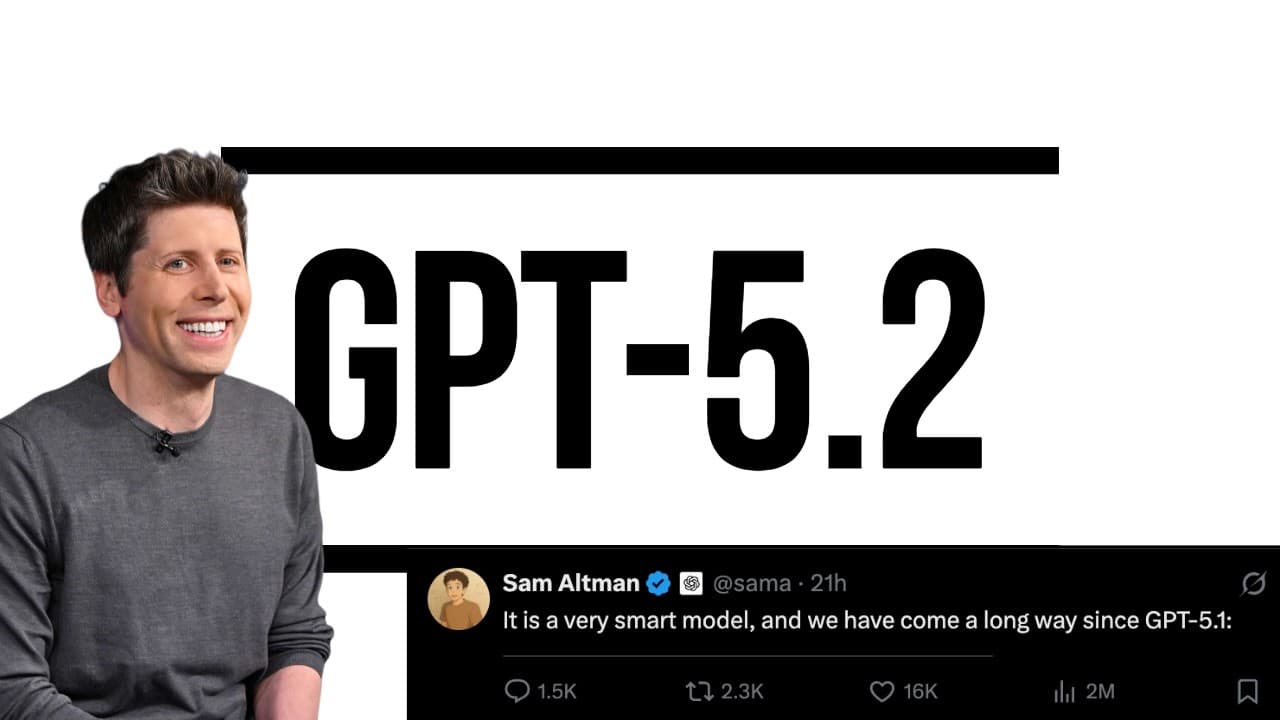
GPT 5.2 shows strong performance on professional tasks and benchmark tests, but gains vary with thinking time and token budgets. Results depend on benchmark choice, task type, and cost constraints, with OpenAI comparisons sometimes not including all competing models. The video discusses the nuance between headline scores and real world usefulness across domains.
Transcript
In the last 24 hours, OpenAI have released a new model and plenty of record-breaking results. GPT 5.2 might not be a Christmas miracle, however, as to get Frontier performance, it often needs to spend more tokens thinking, but just setting tokens aside for one moment, GPT 5.2 is in many benchmarks among the best language models out there. For me, t... Read More
Key Insights
- GPT 5.2 achieves top or near top performance on several benchmarks and real world professional use claims.
- Performance is influenced by test time compute, i.e., the amount of thinking time and tokens allocated.
- Benchmark selection and how tests are designed significantly shape perceived model capability.
- Some benchmarks isolate digital tasks and exclude non digital ones, affecting comparability.
- Across benchmarks, more tokens often lead to higher scores, but efficiency and cost rise similarly.
- Different benchmarks can yield conflicting results for the same model, highlighting evaluation noise.
- SimpleBench type tests can reveal weaknesses not captured by mainstream benchmarks.
- The cost efficiency of GPT 5.2 improves over time despite higher token budgets in advanced tests.
Install to Summarize YouTube Videos and Get Transcripts
Explore YouTube Video Summarizer or Get YouTube Transcript Extractor
Questions & Answers
Q: What does GPT 5.2 claim to perform at a human expert level on GDP Val?
GPT 5.2 is described as performing at or above a human expert level on GDP Val in 71 percent of comparisons according to expert judges, and it is touted as the best model yet for real world professional use. The claim is tied to a well specified knowledge work task evaluation across 44 occupations, with caveats about task context and digital focus.
Q: How does test time compute affect benchmark results according to the video?
Test time compute refers to the amount of thinking time or tokens used to answer benchmark questions. The video explains that results improve as more tokens or time are allocated, because more training data permutations and ideas can be tried. This makes fair comparisons difficult when budgets differ between models.
Q: Why is benchmark selection a problem when comparing models?
Benchmark selection matters because different tests measure different abilities, and models can outperform others on some benchmarks while underperforming on others. The video notes that even when tests aim to measure the same capability, results can vary due to design, context, and the inclusion of or exclusion of certain tasks.
Q: What is SimpleBench and what did GPT 5.2 Pro scoring show there?
SimpleBench is a private benchmark designed for trick questions with spatio temporal reasoning. The video states GPT 5.2 Pro scored 57.4 percent, with humans around 84 percent. Gemini 3 Pro outperformed GPT 5.2 in this benchmark, illustrating how different tests reveal different weaknesses and strengths.
Q: How do token budgets influence and distort model comparisons?
Token budgets influence comparisons because higher budgets allow more exploration of answers, which can inflate performance metrics relative to models with smaller budgets. The video highlights that providers can achieve better results by spending more tokens, complicating isolated score comparisons across models.
Q: What caveat is raised about the ARGI1 benchmark and thinking time?
The video notes that ARGI1 results tend to improve the more dollars or tokens are spent on thinking, making it a poor independent measure of general capability unless token cost is considered. This emphasizes how resource allocation shapes what the benchmark actually captures.
Q: How do external benchmarks like Charxiv affect conclusions about GPT 5.2?
Charxiv results show GPT 5.2 performing strongly on realistic chart understanding tasks, with higher scores on certain subtasks compared to other models. The video uses this to illustrate that some specialized benchmarks can reveal strengths, while others may not reflect broad capabilities, reinforcing the need for diverse tests.
Q: What does the video say about progress in AI benchmarks overall?
The video suggests progress in AI benchmarks is tied to increased thinking time and budget, but efficiency is also improving as models become more economical with tokens. It highlights that benchmark rankings can shift with new tests, and that real world usefulness depends on many factors beyond single-number scores.
Summary & Key Takeaways
-
GPT 5.2 achieves high scores on several benchmarks and in professional task evaluations, but impressive results are partly driven by token budgets and thinking time.
-
Benchmarks differ in how they measure capability, with some tests favoring longer thinking and others highlighting specific skills like chart analysis or reasoning.
-
The presenter cautions against taking single benchmark results at face value and emphasizes cross benchmark comparisons and practical costs when judging model performance.
Read in Other Languages (beta)
Share This Summary 📚
Summarize YouTube Videos and Get Video Transcripts with 1-Click
Try YouTube Summary with ChatGPT & Claude or YouTube Transcript Generator
Explore More Summaries from AI Explained 📚






Summarize YouTube Videos and Get Video Transcripts with 1-Click
Try YouTube Summary with ChatGPT & Claude or YouTube Transcript Generator