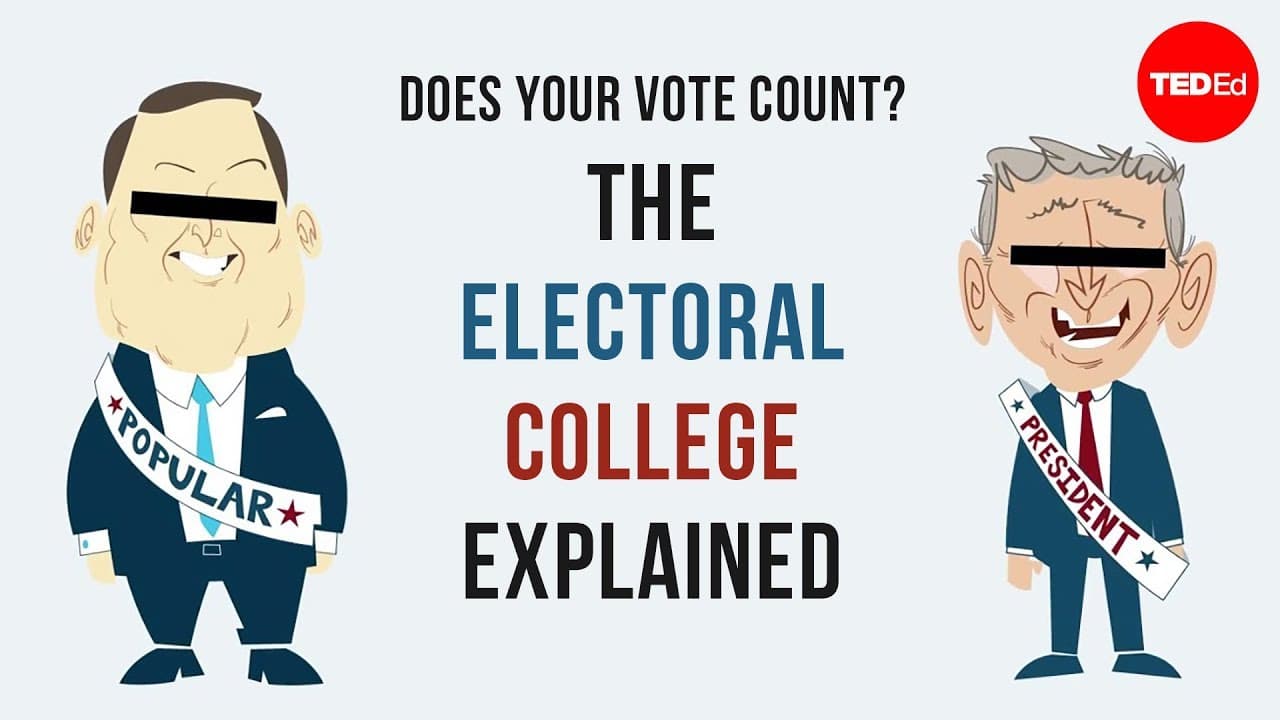
Does your vote count? The Electoral College explained - Christina Greer
TL;DR
The Electoral College is a system used in U.S. presidential elections where candidates need to secure at least 270 out of 538 electoral votes to win. Each state is allocated electors based on its population, and winning a state's popular vote typically awards all its electoral votes to the candidate. This system can lead to a situation where the popular vote winner does not become president.
Transcript
Translator: tom carter Reviewer: Bedirhan Cinar Most people have heard of the Electoral College during presidential election years. But what exactly is the Electoral College? Simply said, it is a group of people appointed by each state who formally elect the President and Vice President of the United States. To understand how this process began and... Read More
Key Insights
- ❓ The Electoral College comprises electors from each state determining the US President.
- 🪡 Candidates need to secure 270 out of 538 electoral votes to win the presidency.
- 🖐️ Swing states play a critical role in elections, being hotly contested and influential.
- 🌥️ Critics argue that the system gives unfair advantages to states with larger populations.
- 🛩️ The system ensures small states are not overlooked, maintaining a balance in representation.
- 🥳 Safe states consistently vote for a particular party, while swing states shift between parties.
- 🥺 Every ten years, the census may lead to changes in electoral votes based on population shifts.
Install to Summarize YouTube Videos and Get Transcripts
Explore YouTube Video Summarizer or Get YouTube Transcript Extractor
Questions & Answers
Q: How does the Electoral College function in US elections?
The Electoral College consists of electors from each state who officially elect the President and Vice President based on electoral votes, requiring a candidate to secure 270 out of 538 votes.
Q: Why do some critics argue against the Electoral College system?
Critics believe the Electoral College gives unfair advantages to states with larger populations, potentially allowing a candidate to win the presidency without securing the popular vote.
Q: What are swing states, and why are they significant in elections?
Swing states are crucial in elections as they can shift between political parties, making them highly contested and influential in determining the final electoral outcome.
Q: How does the Electoral College impact small states in US elections?
The Electoral College ensures that small states are not ignored by candidates, as every electoral vote counts, protecting the interests of states with smaller populations.
Summary
The Electoral College is a group of people appointed by each state to formally elect the President and Vice President of the United States. The number of electors each state has is determined by the Constitution of the United States. The Democratic and Republican candidates aim to accumulate at least 270 electoral votes to win the presidency. States receive a specific number of electoral votes based on their population size, which may change after each census. There is a possibility for a candidate to win the popular vote but fail to gain 270 electoral votes, leading to debates about the fairness of the system. Some argue that the Electoral College gives an advantage to states with large numbers of electoral votes, while others contend that it protects small states and those with small populations. Safe states consistently vote for a particular party, while swing states have a history of switching between parties.
Questions & Answers
Q: What is the Electoral College?
The Electoral College is a group of people appointed by each state to formally elect the President and Vice President of the United States.
Q: How is the number of electors determined?
The number of electors is determined by the Constitution, specifically article two, section one, clause two of the Constitution. Since 1964, there have been 538 electors in each presidential election, which is equal to the total voting membership of the United States Congress.
Q: How do the Democratic and Republican candidates win the presidency?
The Democratic and Republican candidates aim to accumulate at least 270 electoral votes, which is just over half of the 538 votes. They do so by trying to add up the electors in every state.
Q: How do states receive electoral votes?
Each state receives a specific number of electoral votes based on their population size. This number may change after each census, which is conducted every 10 years.
Q: What happens if a candidate wins the popular vote but doesn't gain 270 electoral votes?
In rare cases, a candidate can win the popular vote but fail to reach the 270 electoral vote threshold. This means that the winning candidate may have won and collected their electoral votes by small margins in just enough states, while the losing candidate may have captured large voter margins in the remaining states.
Q: Why do critics argue against the Electoral College?
Critics of the Electoral College argue that the system gives an unfair advantage to states with large numbers of electoral votes. They believe it is possible for a candidate to be elected president by winning the popular vote in just 11 states, even if they didn't receive a single vote in 39 other states or the District of Columbia.
Q: What is the argument for the Electoral College?
On the other hand, proponents of the Electoral College argue that it protects small states with smaller populations. They believe that this system prevents candidates from completely ignoring these states, as in a close election, every electoral vote counts.
Q: What are "safe states"?
"Safe states" are states that consistently vote for a particular party. For example, in the past four election cycles, states like Oregon, Maryland, Michigan, and Massachusetts have consistently voted for Democratic candidates.
Q: What are "swing states"?
"Swing states" are states that have a history of switching between parties. In the past four election cycles, states like Ohio and Florida have been considered swing states, providing electoral votes for both Democratic and Republican candidates.
Q: How can individuals determine the status of their own state?
Individuals can determine the status of their own state by considering whether it is a safe state or a swing state, and by looking at the voting patterns of neighboring states. They can also examine whether the population in their state is increasing or decreasing.
Takeaways
The Electoral College is a unique system used in the United States to elect presidents. It has advantages and disadvantages, with critics arguing that it can be unfair and proponents claiming it protects smaller states. Understanding the role of swing states, safe states, and population trends can provide insights into the dynamics of presidential elections. Ultimately, the goal for candidates is to secure at least 270 electoral votes, as this is the number needed to win the presidency.
Summary & Key Takeaways
-
The Electoral College is a group of people from each state who elect the US President.
-
Each state has a set number of electors based on population size.
-
Winning the presidency requires surpassing 270 out of 538 electoral votes.
Read in Other Languages (beta)
Share This Summary 📚
Summarize YouTube Videos and Get Video Transcripts with 1-Click
Try YouTube Summary with ChatGPT & Claude or YouTube Transcript Generator
Explore More Summaries from TED-Ed 📚






Summarize YouTube Videos and Get Video Transcripts with 1-Click
Try YouTube Summary with ChatGPT & Claude or YouTube Transcript Generator