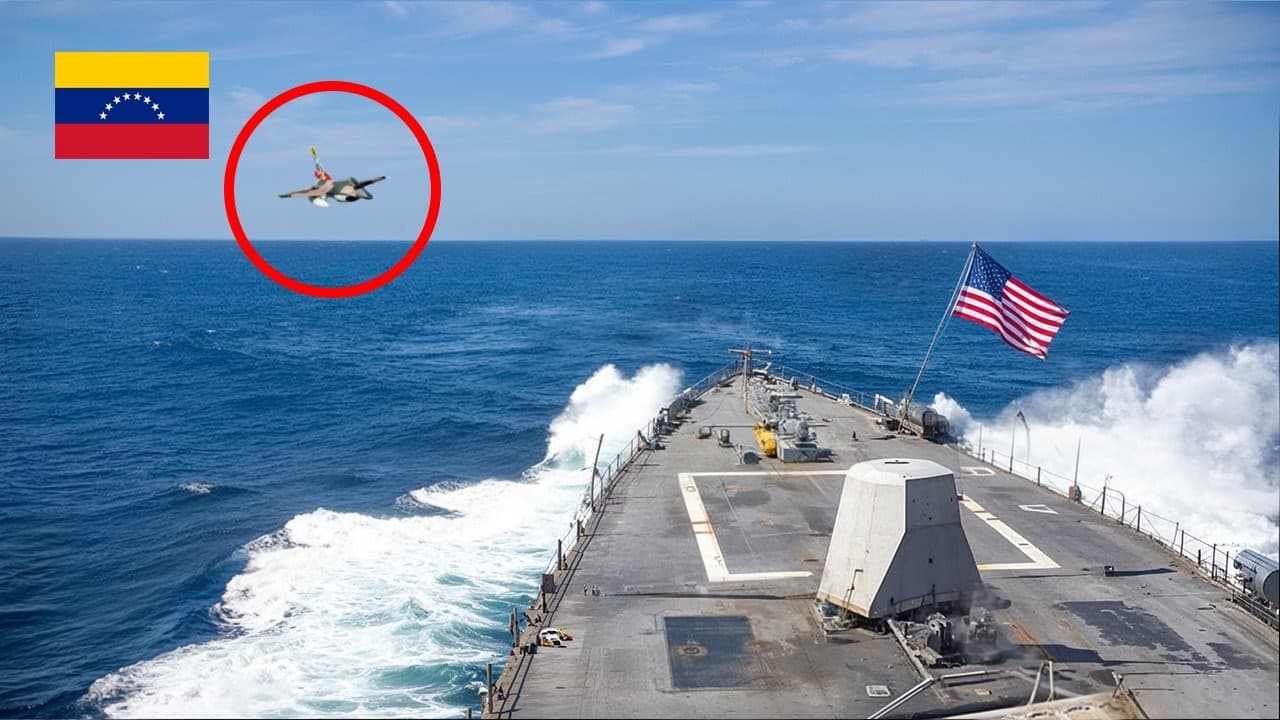
Why Couldn’t Venezuelan F-16s Threaten the USS Jason Dunham?
TL;DR
Venezuela’s Block 15 F-16s could not credibly threaten the USS Jason Dunham because their weapons, sensors, communications, and maintenance condition were inadequate for attacking the destroyer. Their AIM-9L Sidewinders could not lock onto its cooler heat signature, while the APG-66 radars struggled with sea clutter and electronic jamming. The destroyer could track both jets and engage 18 targets simultaneously. Read on to see how each technological mismatch undermined the attack.
Transcript
At 1514 hours on September 4th, two Venezuelan F-16s punched through the cloud deck at 5,000 ft, executing what fighter pilots call a hook attack. The lead pilot rolled inverted and yanked his stick back hard. The airspeed indicator, an analog dial from 1983, spun past 550 knots as he drove toward the USS Jason Dunham stern. His wingman broke left,... Read More
Key Insights
- The Venezuelan F-16s were Block 15 aircraft equipped with 1980s-era sensors, computers, weapons, and communications. Their technological age limited target detection, weapon compatibility, information sharing, and reliability during low-altitude approaches against the USS Jason Dunham.
- The AIM-9L Sidewinder was unsuitable for attacking the destroyer because its infrared seeker searched for jet exhaust in the 3 to 5 micron range. The transcript states that ship stacks emitted at 8 to 12 microns and therefore did not provide the programmed target signature.
- The APG-66 radar could search or track, but not perform both tasks simultaneously. When the lead pilot attempted to track the destroyer, he lost the wider air picture, while sea clutter at low altitude caused waves and the ship to appear inconsistently on the display.
- The Aegis defensive system could distribute different tracks among multiple weapons instead of choosing only one target. The transcript says the destroyer could engage 18 targets simultaneously, making a two-aircraft bracket attack ineffective as a method of dividing its defensive attention.
- The SLQ-32 system disrupted the F-16s’ fixed-frequency radars by inserting false contacts. Displays reportedly showed changing numbers of destroyers, disappearing targets, and contacts moving in impossible directions, preventing the pilots from forming a dependable picture of the ship’s location.
- The aircraft lacked an effective anti-ship arsenal because they had no targeting pods, GPS integration, AGM-84 Harpoon capability, radar-suppression missiles, or compatible precision-guided bombs. Their available guns and AIM-9L Sidewinders did not provide a credible method for striking the destroyer.
- The F-16s’ maintenance problems affected nearly every stage of the encounter. Reported deficiencies included corroded warning-receiver connections, intermittent radar altimeters, navigation drift, hydraulic leakage, structural fatigue, degraded canopy seals, unreliable instruments, and an overused engine that suffered a compressor stall.
- The repeated approaches gave American forces detailed intelligence without producing a successful attack. The transcript says the intelligence team cataloged aircraft emissions, frequencies, communications, and tactical errors while radar, submarine, and drone assets monitored the second mission from its beginning.
Install to Summarize YouTube Videos and Get Transcripts
Explore YouTube Video Summarizer or Get YouTube Transcript Extractor
Questions & Answers
Q: Why couldn’t the Venezuelan F-16s threaten the USS Jason Dunham?
The Block 15 F-16s lacked weapons and sensors suited to attacking the destroyer. Their AIM-9L Sidewinders could not detect its heat signature, their APG-66 radars struggled with sea clutter and jamming, and they lacked targeting pods, GPS integration, anti-ship missiles, radar-suppression weapons, and Link 16. Meanwhile, the USS Jason Dunham could continuously track both aircraft and coordinate layered defenses.
Q: Why couldn’t the AIM-9L Sidewinder lock onto the destroyer?
The AIM-9L searched for jet exhaust in the 3-to-5-micron wavelength range at about 1,000°C. The destroyer’s stacks emitted at 8 to 12 microns and about 200°C, so they did not present the heat signature the missile was programmed to detect. The pilot therefore received no targeting tone or lock.
Q: How did the USS Jason Dunham track both F-16s at once?
The destroyer’s four fixed SPY radar arrays maintained continuous coverage, with radar information updated 30 times per second. Its combat system assigned each aircraft to an appropriate defensive weapon system instead of focusing on only one target. Both CIWS mounts achieved locks simultaneously, and the destroyer could engage 18 targets at once.
Q: Why did the APG-66 radar struggle near the ocean surface?
At low altitude, sea clutter overwhelmed the APG-66’s older processor, causing waves and the destroyer to appear inconsistently on the display. The radar lacked a sea-surface search mode and Doppler processing capable of filtering that clutter. It also forced the pilot to choose between searching and tracking, so attempting a lock eliminated the wider radar picture.
Q: How did the SLQ-32 electronic warfare system disrupt the F-16s?
The SLQ-32 exploited the APG-66 radars’ fixed 9.3 GHz operating frequency and lack of frequency agility. It inserted false information that made destroyers appear, disappear, or move in impossible directions. The pilots therefore could not form a dependable picture of the ship’s position.
Q: What anti-ship capabilities were the Venezuelan F-16s missing?
The aircraft had no AGM-84 Harpoon capability because the necessary weapons interface did not exist. They also lacked targeting pods, GPS integration, compatible precision-guided bombs, and radar-suppression missiles. Their available guns and AIM-9L Sidewinders did not provide an effective way to strike the destroyer.
Q: Why did the F-16 bracket attack fail to divide the destroyer’s defenses?
The two pilots attacked from different angles to force the destroyer to choose which aircraft to engage. Aegis instead assigned separate tracks to different weapon systems and could engage 18 targets simultaneously. Two approaching F-16s therefore did not overwhelm or divide its defensive attention.
Q: What maintenance problems weakened the Venezuelan F-16s?
The aircraft reportedly had corroded radar-warning receiver connections, intermittent radar altimeters, navigation drift, hydraulic leakage, structural fatigue, degraded canopy seals, and unreliable instruments. One engine had about 6,800 hours despite a 4,000-hour overhaul requirement and suffered a compressor stall. These faults reduced awareness, navigation accuracy, reliability, and safety during the low-altitude approaches.
Summary & Key Takeaways
-
Two Venezuelan F-16s approached the USS Jason Dunham using low-altitude dives, split-axis attacks, and other tactics associated with older anti-ship operations. Their maneuvers attempted to divide the destroyer’s attention, but its fixed radar arrays continuously tracked both aircraft and assigned each track to an appropriate defensive weapon system.
-
The aircraft’s outdated equipment prevented an effective attack. AIM-9L Sidewinders searched for hot jet exhaust rather than cooler ship stacks, APG-66 radars struggled against sea clutter, and the jets lacked targeting pods, GPS integration, anti-ship missiles, radar-suppression weapons, and Link 16 communication for sharing tactical information.
-
The destroyer combined SPY radar, CIWS mounts, SLQ-32 electronic warfare equipment, and guided missiles into a layered defense. Meanwhile, the Venezuelan aircraft suffered radar-warning blind spots, navigation drift, hydraulic problems, structural fatigue, engine wear, unreliable altitude instruments, and heavy fuel consumption, turning repeated passes into intelligence opportunities for American forces.
Read in Other Languages (beta)
Share This Summary 📚
Summarize YouTube Videos and Get Video Transcripts with 1-Click
Try YouTube Summary with ChatGPT & Claude or YouTube Transcript Generator
Explore More Summaries from Beyond Military 📚

Summarize YouTube Videos and Get Video Transcripts with 1-Click
Try YouTube Summary with ChatGPT & Claude or YouTube Transcript Generator