Schmid factor and resolved shear stress for FCC slip system
TL;DR
This video demonstrates how to determine the Schmidt factor and resulting shear stress in face-centered cubic systems.
Transcript
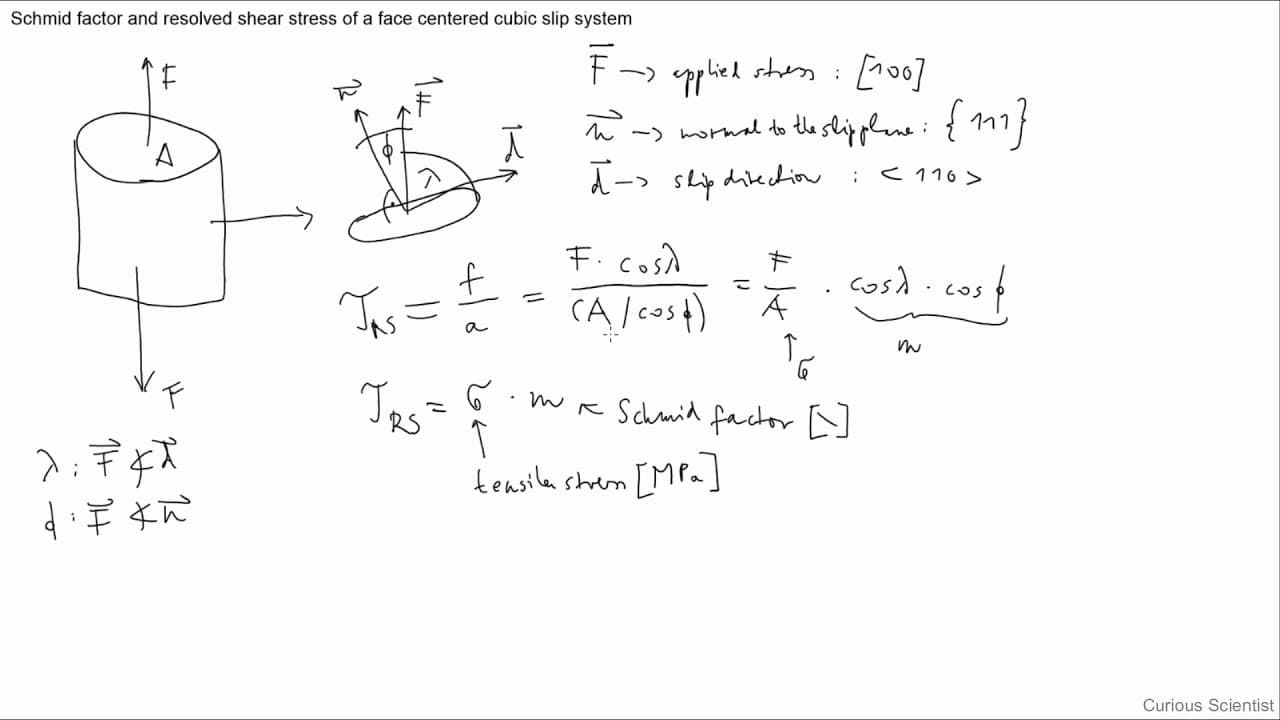
welcome in this video I am going to show you how to obtain the Schmidt factor and the result shear stress for a face centered cubic sleep system so as we know the face centered cubic crystal has 12 independent sleep systems which means that we have four slip planes which is one one one slip plane in different directions and within each slip planes ... Read More
Key Insights
- 😀 Face-centered cubic (FCC) structures effectively accommodate deformation through a variety of slip systems, facilitating ductility.
- 💋 The Schmidt factor is a crucial parameter for assessing how external stresses influence internal slip mechanisms in crystalline materials.
- 💋 Understanding the geometry and interaction of slip systems provides insight into the mechanical behavior of materials under load.
- 👻 The equations derived allow engineers and materials scientists to predict performance and failure under different loading conditions.
- 🈸 The demonstrated method for calculating shear stress is valuable for both theoretical and practical applications in materials engineering.
- 🧑🎓 The video’s example elucidates the application of complex theoretical concepts in a straightforward manner, making it accessible for students and practitioners.
- 🔮 Different crystal structures require tailored approaches, but the fundamental principles of resolving forces remain consistent.
Install to Summarize YouTube Videos and Get Transcripts
Explore YouTube Video Summarizer or Get YouTube Transcript Extractor
Questions & Answers
Q: What are the main components of the face-centered cubic (FCC) crystal structure?
The FCC crystal structure is characterized by 12 independent slip systems comprising four slip planes and three slip directions within each plane. The slip planes correspond to the (111) family of planes, while the slip directions correspond to the (110) family. This structure enables various deformation modes under stress, influencing the mechanical properties of materials.
Q: How do you calculate the resolved shear stress in an FCC system?
Resolved shear stress can be calculated using the equation τ_R = σ * M, where τ_R is the resolved shear stress, σ is the applied tensile stress, and M is the Schmidt factor. The Schmidt factor M is derived from the angles between the applied stress and the slip plane normal, and the slip direction, determined by cos(Φ) and cos(λ).
Q: What is the significance of the Schmidt factor in material deformation?
The Schmidt factor quantifies how effectively an applied tensile stress contributes to the shear stress on a specific slip system. A higher Schmidt factor indicates that more of the applied stress is being resolved into shear stress, driving deformation, which is crucial for understanding how materials behave under stress and predicting failure modes.
Q: Can the methodology described be applied to other crystal structures?
Yes, while the video focuses on FCC systems, the methodology for calculating the Schmidt factor and resolved shear stress can also be applied to other crystal structures like body-centered cubic (BCC) and hexagonal close-packed (HCP) systems. The specific slip planes and directions will differ, but the fundamental principles remain the same.
Q: What role do the angles λ and Φ play in the calculations?
Angles λ (lambda) and Φ (phi) are critical as they determine the orientation of the applied stress relative to the slip direction and the normal to the slip plane, respectively. These angles impact the cosine terms in the Schmidt factor computation, influencing the amount of resolved shear stress experienced in the material.
Q: How do you find the angles for calculating the Schmidt factor?
The angles λ and Φ can be obtained using vector analysis. The cosine of the angles is calculated through the dot product of the relevant vectors (stress, slip direction, and plane normal), divided by the magnitudes of those vectors. This methodology allows for precise determination of the Schmidt factor for any specified slip system.
Summary & Key Takeaways
-
The video explains the concept of the Schmidt factor, specifically in relation to the face-centered cubic (FCC) crystal structure, which has 12 independent slip systems consisting of multiple planes and directions.
-
Through a step-by-step illustration, the video shows how to calculate resolved shear stress using tensile stress, slip planes, and angles between these forces, leading to an understanding of material deformation.
-
A specific example is provided, calculating the resulting shear stress under a given tensile load, illustrating the practical application of theoretical concepts in material science.
Read in Other Languages (beta)
Share This Summary 📚
Summarize YouTube Videos and Get Video Transcripts with 1-Click
Try YouTube Summary with ChatGPT & Claude or YouTube Transcript Generator
Explore More Summaries from Curious Scientist 📚



![Building a coil winder [Part 6] - A few improvements thumbnail](/_next/image?url=https%3A%2F%2Fi.ytimg.com%2Fvi%2F3eyxG_g2iUA%2Fhqdefault.jpg&w=750&q=75)


Summarize YouTube Videos and Get Video Transcripts with 1-Click
Try YouTube Summary with ChatGPT & Claude or YouTube Transcript Generator