How Much Protein Do Adults Need for Healthy Aging?
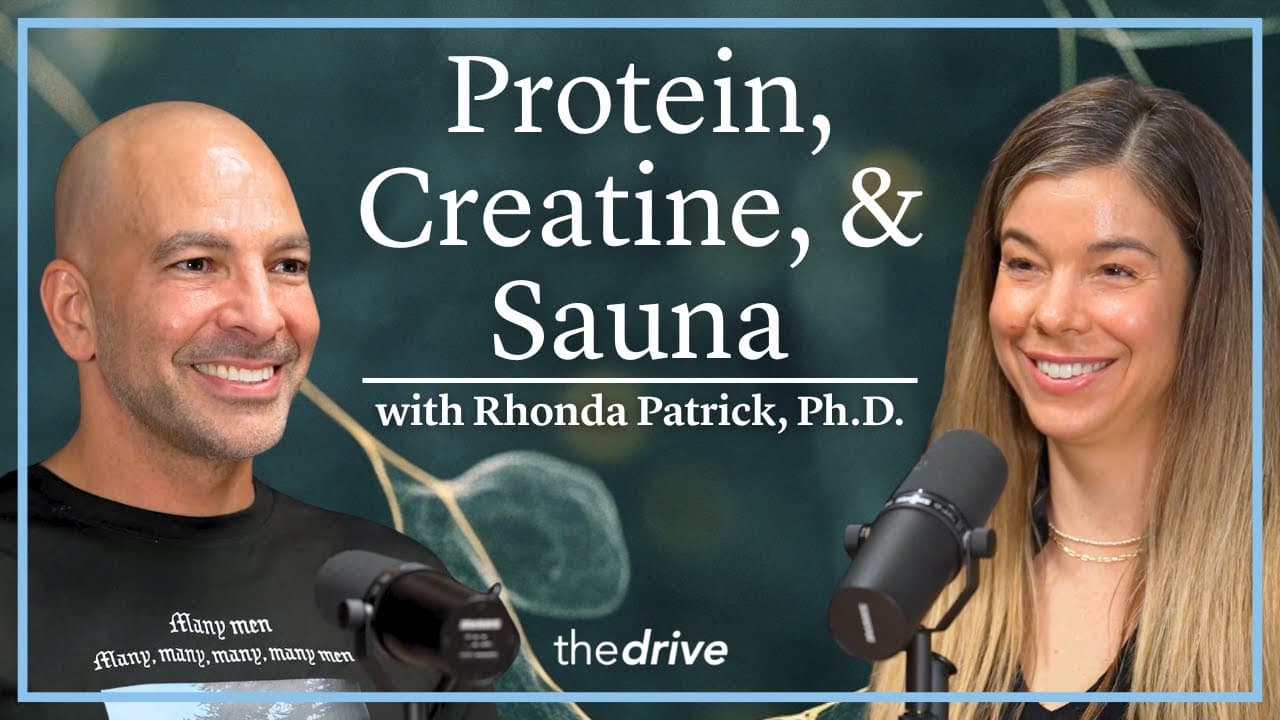
TL;DR
Adults may need about 1.2 grams of protein per kilogram of body weight daily to avoid negative protein balance, roughly 50 percent above the current RDA of 0.8 grams. Adequate intake matters because amino acids are not stored like fat or carbohydrate, so insufficient protein can force the body to break down skeletal muscle, contributing to muscle loss and frailty.
Transcript
Hey everyone, welcome to the Drive Podcast. I'm your host, Peter Aia. Rhonda, so great to see you. And I didn't realize until a few minutes ago that the last time we spoke it was virtual. Yeah, good to see you. We go back a long way. You're still in the in the same our same former neighborhood in San Diego. I know. And I'm thinking that, you know, ... Read More
Key Insights
- The protein RDA is 0.8 grams per kilogram of body weight per day, but the discussion characterizes it as a minimal allowance that people may mistakenly interpret as an optimal intake.
- Traditional nitrogen balance studies are limited by incomplete urine collection, nitrogen losses through routes other than urine, and differing nitrogen-to-protein ratios among protein-containing foods, producing a relatively low signal-to-noise ratio.
- Stable isotope studies use labeled phenylalanine and measure its oxidation through breath, providing a more accurate assessment of protein turnover and the intake required to avoid negative protein balance.
- A daily protein intake near 1.2 grams per kilogram of body weight may be necessary for adults to prevent negative protein balance, representing approximately 30 to 50 percent more than the current RDA.
- Skeletal muscle is the body's principal functional reservoir of amino acids because amino acids are not stored like fatty acids in triglycerides or glucose in glycogen. Insufficient intake therefore prompts muscle catabolism.
- Average adults reportedly consume about 0.9 grams of protein per kilogram daily. Older men consume about 0.9 grams, while older women consume approximately 0.8 grams, placing many people near an intake described as insufficient.
- Anabolic resistance is a reduced sensitivity of muscle tissue to amino acids. The discussion identifies physical inactivity, which commonly increases with age, as a major contributor to this impaired response.
- Higher protein intake is associated with healthier aging outcomes in the cited discussion. About 1.2 grams per kilogram daily may prevent much age-related muscle loss, and older women consuming that amount were reported to be 30 percent less likely to experience frailty.
Install to Summarize YouTube Videos and Get Transcripts
Explore YouTube Video Summarizer or Get YouTube Transcript Extractor
Questions & Answers
Q: How much protein do adults need each day?
Adults may need approximately 1.2 grams of protein per kilogram of body weight per day to avoid negative protein balance. That amount is about 50 percent higher than the current RDA of 0.8 grams per kilogram. The newer isotope tracer studies discussed place the minimum requirement roughly 30 to 50 percent above the existing allowance, although optimal intake may depend on age and activity.
Q: Why might the current protein RDA be too low?
The current RDA relies substantially on nitrogen balance studies that have several measurement problems. Urine collection may be incomplete, nitrogen is also lost through routes other than urine, and foods have different nitrogen-to-protein ratios. These issues reduce measurement accuracy. Newer stable isotope tracer studies indicate that preventing negative protein balance may require closer to 1.2 grams per kilogram daily.
Q: How do isotope tracer studies measure protein requirements?
The newer studies described use phenylalanine labeled with a carbon isotope. Participants consume a known amount of protein containing the tracer, and researchers measure the labeled phenylalanine's oxidation through breath after it is metabolized. This approach provides a more accurate way to quantify protein turnover and estimate the minimum daily intake needed to avoid a negative protein balance.
Q: Why does inadequate protein intake cause muscle loss?
The body does not maintain a dedicated amino acid reserve comparable to fat stored as triglycerides or carbohydrate stored as glycogen. Skeletal muscle therefore acts as its primary functional amino acid reservoir. When dietary protein does not provide enough amino acids for daily needs, the body can break down muscle tissue to obtain them, making insufficient intake an avoidable contributor to muscle loss.
Q: What is anabolic resistance in older adults?
Anabolic resistance is a condition in which muscle tissue becomes less sensitive to amino acids, weakening its response to protein intake. The discussion identifies physical inactivity, which tends to increase with age, as a major contributor. Age-related muscle decline can also involve inadequate protein and insufficient resistance training, so aging alone does not explain the entire loss of skeletal muscle.
Q: How much protein do older adults typically consume?
The nutritional surveys discussed suggest that adults generally consume about 0.9 grams of protein per kilogram of body weight each day. Among older adults, men reportedly consume about 0.9 grams per kilogram, while women consume about 0.8 grams. These amounts are close to the current RDA but below the approximately 1.2 grams proposed as a better minimum.
Q: Can higher protein intake help prevent age-related muscle loss?
The studies discussed indicate that older adults consuming about 1.2 grams of protein per kilogram of body weight per day can prevent much of the muscle loss associated with aging. Protein is only one part of the picture, since physical inactivity, anabolic resistance, and inadequate resistance training also contribute. Still, raising intake from the current RDA is presented as a meaningful preventive measure.
Q: How is protein intake related to frailty in older women?
Older women consuming approximately 1.2 grams of protein per kilogram of body weight per day were reported to be 30 percent less likely to experience frailty in old age. This association supports the argument that the current RDA of 0.8 grams may be inadequate. Preserving skeletal muscle is important because frailty can profoundly affect health and quality of life during aging.
Summary & Key Takeaways
-
The protein RDA of 0.8 grams per kilogram of body weight per day should be understood as a minimum rather than an optimal target. The nitrogen balance studies used to establish it have important measurement limitations, while newer isotope tracer studies indicate that adults may require approximately 1.2 grams per kilogram daily.
-
Amino acids must be supplied regularly because the body does not store them in a dedicated reserve comparable to triglycerides or glycogen. Skeletal muscle effectively serves as the principal amino acid reservoir, so inadequate protein intake can cause muscle breakdown to provide materials required for the many proteins performing essential bodily functions.
-
Older adults face muscle loss through several interacting factors, including physical inactivity, anabolic resistance, insufficient resistance training, and low protein intake. Raising daily protein consumption to about 1.2 grams per kilogram may prevent much of age-related muscle loss, while older women consuming that amount were reported to have a lower likelihood of frailty.
Read in Other Languages (beta)
Share This Summary 📚
Summarize YouTube Videos and Get Video Transcripts with 1-Click
Try YouTube Summary with ChatGPT & Claude or YouTube Transcript Generator
Explore More Summaries from Peter Attia MD 📚






Summarize YouTube Videos and Get Video Transcripts with 1-Click
Try YouTube Summary with ChatGPT & Claude or YouTube Transcript Generator