Testing and comparing different Peltier coolers - Part 6 - TEC12715
TL;DR
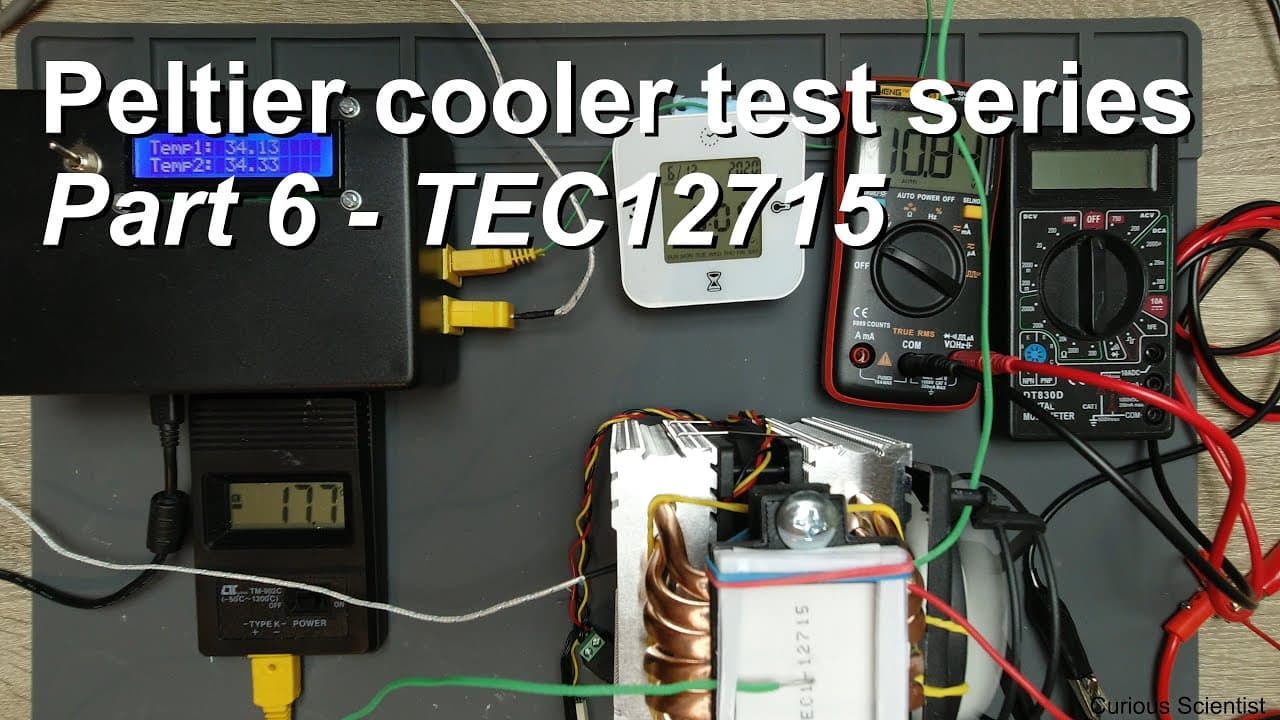
The video tests the cooling performance of a Tec 12 715 model thermoelectric cooler under various current loads.
Transcript
Nakamura this is the sixth video in this series right test different particulars and I assess and compare their performance and properties so in this part of the series I will test the tec 12 715 model which is the 15 amperes model so you can run quite a high current to it so it has a very high relatively high cooling performance I don't have the n... Read More
Key Insights
- 🥶 The Tec 12 715 model can deliver impressive cooling performance, achieving cold side temperatures below -17 degrees Celsius at optimal currents.
- 😅 The relationship between the hot and cold sides is critical; if the hot side overheats, the unit's overall cooling effectiveness is compromised.
- 🙂 Accurate temperature measurement is essential; slight variations in thermocouple placement can lead to significant differences in observed temperatures.
- ❓ Thermoelectric coolers are sensitive to environmental conditions, highlighting the importance of managing ambient temperature and airflow to enhance performance.
- 😘 Stacking thermoelectric coolers may offer a viable solution for achieving significantly lower temperatures, particularly in experimental or industrial applications.
- ⚡ The experiments underscore the need to monitor voltage and current carefully, as fluctuations can adversely impact performance and potentially damage the equipment.
- 😎 Data collected contributes to a comprehensive understanding of thermoelectric cooling systems, aiding in the design and implementation of more efficient cooling solutions.
Install to Summarize YouTube Videos and Get Transcripts
Explore YouTube Video Summarizer or Get YouTube Transcript Extractor
Questions & Answers
Q: What is the significance of using different current settings in the experiments?
Varying the current settings is essential to evaluate the performance range of the Tec 12 715 thermoelectric cooler. By adjusting the current, the experiment can determine the lowest achievable cold side temperature under different loads, helping identify the optimal operating conditions for maximum efficiency.
Q: How does the cooling efficiency change as current increases?
As the current increases, the cold side temperature drops significantly at lower currents but eventually plateaus or increases slightly due to overheating on the hot side. This indicates that while the cooler can handle a surge in current effectively, there’s a threshold beyond which the cooling efficiency declines owing to thermal limitations.
Q: What role do the thermometers play in the experimental setup?
The thermometers are critical for monitoring temperatures on both the cold and hot sides of the thermoelectric cooler. They provide real-time data on thermal performance, allowing for accurate assessments of how well the system is functioning during the experiments and informing adjustments to current levels.
Q: What were the observed minimum temperatures achieved during the tests?
The experiments indicated that the minimum temperature on the cold side could reach approximately -17.6 degrees Celsius at optimal conditions without thermal loads. However, performance varied with increased thermal loading, reflecting the unit's limitations in maintaining low temperatures under sustained operation.
Q: How does airflow contribute to the cooling performance of the system?
Airflow plays a crucial role in dissipating heat from the hot side of the thermoelectric cooler. In this setup, fans increase air circulation around the heatsink, helping to manage temperatures effectively and prevent overheating, which is essential to maintaining overall cooling efficiency of the system.
Q: What future experiments are suggested based on the current findings?
Future experiments may explore stacking multiple thermoelectric coolers to enhance cooling power while examining their performance under varying conditions. Tests could focus on identifying how low temperatures can be achieved with stacked units while managing effective heat dissipation using efficient heatsinks.
Summary & Key Takeaways
-
The video demonstrates a series of experiments using a Tec 12 715 thermoelectric cooler to assess its cooling efficiency at different current settings, revealing significant variations in cold-side temperatures.
-
The experimental setup includes various measuring tools, multimeters, and thermometers to effectively track voltage, current, and thermal performance during operation, ensuring accurate data collection.
-
The results indicate that as the current increases, the cold side temperature initially drops, but the effectiveness declines when the hot side overheats, demonstrating the limitations of the cooling system under sustained loads.
Read in Other Languages (beta)
Share This Summary 📚
Summarize YouTube Videos and Get Video Transcripts with 1-Click
Try YouTube Summary with ChatGPT & Claude or YouTube Transcript Generator
Explore More Summaries from Curious Scientist 📚

![Building a coil winder [Part 6] - A few improvements thumbnail](/_next/image?url=https%3A%2F%2Fi.ytimg.com%2Fvi%2F3eyxG_g2iUA%2Fhqdefault.jpg&w=750&q=75)


Summarize YouTube Videos and Get Video Transcripts with 1-Click
Try YouTube Summary with ChatGPT & Claude or YouTube Transcript Generator