What If China Invades Taiwan?
TL;DR
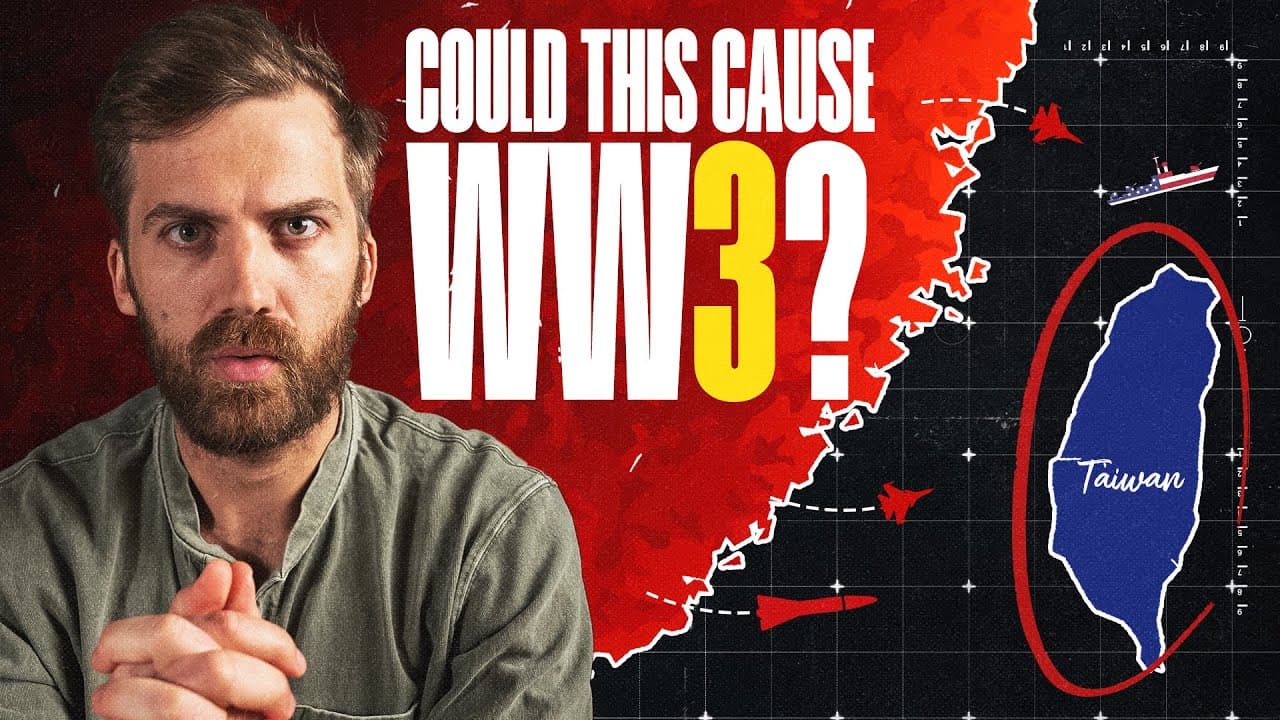
A Chinese invasion of Taiwan could lead to a massive military conflict involving the U.S. and its allies. China's military has grown significantly, making a potential invasion more feasible. The U.S. would likely intervene, leading to a dangerous escalation. The scenario highlights the risks of miscalculation and the potential for a broader conflict.
Transcript
(dramatic music) - [Johnny] In the summer of 1995, China sent a bunch of its troops to the province of Fujian. They then started testing missiles and putting it on TV. They then started running highly publicized combat exercises, very similar to what it would look like to cross this 130 kilometer wide straight to invade the island of Taiwan. A plac... Read More
Key Insights
- China views Taiwan as a rebellious province and has a legal imperative to reunify it with the mainland.
- In the 1990s, U.S. military intervention successfully deterred Chinese aggression towards Taiwan.
- China's military capabilities have significantly increased over the past two decades.
- China frequently conducts military flyovers in Taiwan's air defense zone as a show of force.
- A Chinese invasion would likely begin with a surprise attack on Taiwan's military infrastructure.
- The U.S. and its allies would face a difficult decision on how to respond to a Chinese invasion.
- A conflict over Taiwan could potentially escalate into a broader regional or global war.
- China may attempt less violent means, like blockades, to bring Taiwan to the negotiating table.
Install to Summarize YouTube Videos and Get Transcripts
Explore YouTube Video Summarizer or Get YouTube Transcript Extractor
Questions & Answers
Q: How would China begin an invasion of Taiwan?
China would likely start with a surprise attack targeting Taiwan's military infrastructure. This would involve guided missile strikes and fighter jets aimed at disabling Taiwan's ability to defend itself. The goal would be to quickly neutralize Taiwan's defenses, paving the way for a large-scale amphibious assault across the Taiwan Strait.
Q: Why is Taiwan important to China?
Taiwan is seen by China as a breakaway province, part of its territory since the Chinese Civil War. Reunification with Taiwan is a central goal of China's national policy, rooted in historical claims and nationalistic sentiment. Control over Taiwan is also strategically important for China's military and economic influence in the Asia-Pacific region.
Q: What role would the U.S. play in a Taiwan conflict?
Historically, the U.S. has been a key ally to Taiwan, providing military support and acting as a deterrent against Chinese aggression. In a conflict scenario, the U.S. would likely deploy military assets to the region, including aircraft carriers and submarines, to protect Taiwan and counter Chinese forces, though this risks escalating the conflict.
Q: How has China's military changed since the 1990s?
Since the 1990s, China's military has undergone significant modernization and expansion. It now boasts a larger navy than the U.S. in terms of ship numbers, advanced missile systems, and improved air capabilities. This growth enhances China's ability to project power and challenge U.S. military dominance in the region.
Q: What are the risks of a Taiwan-China conflict escalating?
A conflict over Taiwan could quickly escalate as the U.S. and its allies intervene to support Taiwan. This could lead to direct military confrontations between nuclear-armed powers, increasing the risk of a broader war. Additionally, regional tensions could flare, involving other countries and destabilizing the Asia-Pacific region.
Q: Why might China prefer non-violent methods over invasion?
China may prefer non-violent methods, such as economic blockades or diplomatic pressure, to force Taiwan to negotiate reunification. These methods carry fewer risks of international backlash and military escalation. However, if peaceful means are exhausted, China's legal framework mandates the use of force to achieve its objectives.
Q: What historical events influence China's approach to Taiwan?
The Chinese Civil War and the subsequent separation of Taiwan from mainland China heavily influence China's approach. The 1995-96 Taiwan Strait Crisis, where U.S. military intervention deterred China, also impacts current strategies. These events shape China's determination to reunify Taiwan and its military readiness to achieve this goal.
Q: How does Taiwan prepare for a potential Chinese invasion?
Taiwan prepares by maintaining a robust defense strategy, including advanced missile systems and fortified military installations. It conducts regular military exercises to simulate responses to Chinese aggression. Taiwan also relies on international support, primarily from the U.S., to bolster its defense capabilities and deter potential invasions.
Summary & Key Takeaways
-
China's legal stance requires it to use force if Taiwan declares independence or peaceful reunification seems impossible. With military capabilities vastly improved, China conducts frequent flyovers into Taiwan's air defense zone, signaling its intent to assert dominance.
-
A potential invasion would begin with a surprise attack on Taiwan's military assets, followed by an amphibious assault. The U.S. and allies would face a strategic dilemma, risking escalation into a broader conflict.
-
Historical context shows U.S. military presence once deterred China. However, the balance of power has shifted, making a peaceful resolution more complex. The scenario underscores the fragility of peace and the risks of military escalation.
Read in Other Languages (beta)
Share This Summary 📚
Summarize YouTube Videos and Get Video Transcripts with 1-Click
Try YouTube Summary with ChatGPT & Claude or YouTube Transcript Generator
Explore More Summaries from Johnny Harris 📚





Summarize YouTube Videos and Get Video Transcripts with 1-Click
Try YouTube Summary with ChatGPT & Claude or YouTube Transcript Generator