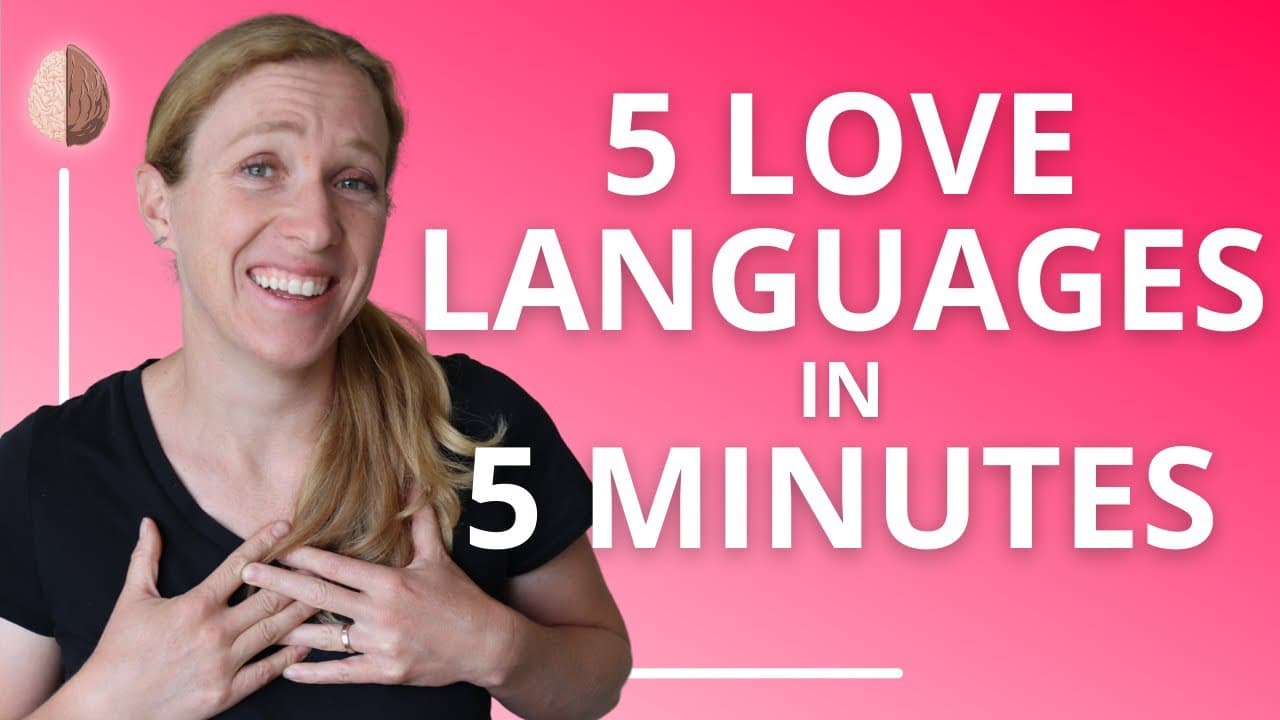
How to Use Five Love Languages in Relationships
TL;DR
Improve relationships by identifying how each person most naturally receives love, then expressing care in that preferred way instead of relying only on what feels easiest to give. The five categories are words of affirmation, physical touch, gifts, acts of service, and quality time, and people may value several while still having a primary preference.
Transcript
Gary Chapman wrote a book with a simple premise that has really resonated with a lot of people, it’s called the 5 Love languages, and I like it because it’s a very simple way to improve your relationships. It’s not about psychoanaliyzing or complicated techniques-it’s just learning to love your spouse in the way they like to be loved. Now this book... Read More
Key Insights
- A primary love language is a person's natural preference for expressing, understanding, or receiving love, according to Gary Chapman's framework. People may appreciate several forms of affection, but the framework proposes that one category often carries particular importance for each individual.
- Words of affirmation are verbal expressions of affection and care, including praise, compliments, and saying "I love you." For people who favor this language, spoken or written acknowledgment may communicate appreciation more effectively than actions, gifts, touch, or shared time alone.
- Physical touch is affectionate contact that can include sex but is not limited to it. Appropriate examples vary by relationship and can include roughhousing with a toddler, a side squeeze for a teenager, a hug between friends, or a high-five or pat on the back.
- Gifts are concrete reminders of another person's love and are often valued for their sentiment rather than their material worth. A person who favors this language may appreciate the thought, effort, or personal meaning represented by an item more than its monetary value.
- Acts of service are helpful actions performed for another person, such as cleaning a car, packing a lunch, or assisting with a difficult project. These actions communicate care by reducing a burden or meeting a practical need that matters to the recipient.
- Quality time is time intentionally spent together, and it may communicate love more strongly than a physical object for someone who prioritizes shared experiences. Planning a special date and arranging childcare is one example of adapting an occasion to a partner's preference.
- Different primary love languages are not inherently a relationship problem because people can learn to express love in ways that do not come naturally to them. The framework compares this adaptation to learning or translating between spoken languages so that care is understood by its recipient.
- The practical method is to identify your own preference and the other person's preference, then show care in the form they most value. A love languages survey can support this process for couples, children, families, employees, and other relationships.
Install to Summarize YouTube Videos and Get Transcripts
Explore YouTube Video Summarizer or Get YouTube Transcript Extractor
Questions & Answers
Q: What are the five love languages?
The five love languages are words of affirmation, physical touch, gifts, acts of service, and quality time. Words of affirmation use praise, compliments, and verbal care. Physical touch includes appropriate affectionate contact. Gifts provide concrete, sentimental reminders of love. Acts of service offer practical help, while quality time centers on intentionally spending time together.
Q: How do you identify your primary love language?
You can identify your primary love language by considering which forms of care you most naturally give, understand, and value receiving. The framework also provides a survey through its website to help clarify that preference. Because people often appreciate multiple forms of affection, the goal is not to exclude categories but to recognize which one has the strongest impact.
Q: Why should partners learn each other's love languages?
Partners should learn each other's love languages because the form of love one person prefers to give may not be the form the other person most values receiving. Knowing both preferences helps each partner translate good intentions into meaningful actions. This can strengthen communication and connection without requiring psychoanalysis or complicated relationship techniques.
Q: What should you do if your partner has a different love language?
If your partner has a different primary love language, learn to express care in that preferred form rather than relying only on what feels easiest for you. Different preferences do not need to be a problem. Like spoken languages, unfamiliar love languages can be learned, practiced, and translated so that affection reaches the other person more clearly.
Q: How can quality time replace a gift for a special occasion?
Quality time can replace a physical gift when the recipient values shared experiences more than objects. For example, instead of buying a birthday present for a spouse whose primary language is quality time, a partner could arrange babysitters, plan a special date, and create time alone away from the children. The experience is matched to the recipient's preference.
Q: Are gifts as a love language mainly about materialism?
Gifts as a love language are not usually presented as materialism. Their importance often comes from sentimentality and from serving as a concrete reminder of another person's affection. A thoughtful card or personally created item may represent time, care, and attention. Its emotional meaning can matter more to the recipient than the object's material qualities.
Q: Can the five love languages apply outside romantic relationships?
The five love languages can apply to many relationships, including those involving children, teenagers, family members, friends, coworkers, and employees. Appropriate expressions differ by context. A friend may appreciate a hug, a coworker a high-five, a child shared time, or an employee recognition delivered in a form that matches their preferred way of receiving appreciation.
Q: How do acts of service communicate love?
Acts of service communicate love by doing something helpful for another person. Examples include cleaning the person's car, packing their lunch, or helping them complete a difficult project. For someone who favors this language, practical assistance can demonstrate attention and care because it addresses a real need, reduces a burden, or makes daily life easier.
Summary & Key Takeaways
-
Gary Chapman's framework proposes that people naturally prefer particular ways of giving and receiving love. These preferences fall into five categories: words of affirmation, physical touch, gifts, acts of service, and quality time. Although people can appreciate several categories, the framework suggests that each person may have one primary love language.
-
Relationship difficulties can arise when one person expresses care in a form that does not strongly resonate with the recipient. A carefully made gift, for example, may have less impact on someone who primarily values quality time. Different preferences are manageable because people can learn to communicate love in unfamiliar ways.
-
The recommended process is to identify your own primary love language, discover the preferences of people around you, and intentionally adapt your behavior. A survey can help identify these preferences. The framework can be applied with spouses, children, teenagers, friends, coworkers, employees, and other people who receive love or appreciation differently.
Read in Other Languages (beta)
Share This Summary 📚
Summarize YouTube Videos and Get Video Transcripts with 1-Click
Try YouTube Summary with ChatGPT & Claude or YouTube Transcript Generator
Explore More Summaries from Therapy in a Nutshell 📚





Summarize YouTube Videos and Get Video Transcripts with 1-Click
Try YouTube Summary with ChatGPT & Claude or YouTube Transcript Generator