How Do You Use Explicit Type Conversion with int() in Python? (Part 1)
TL;DR
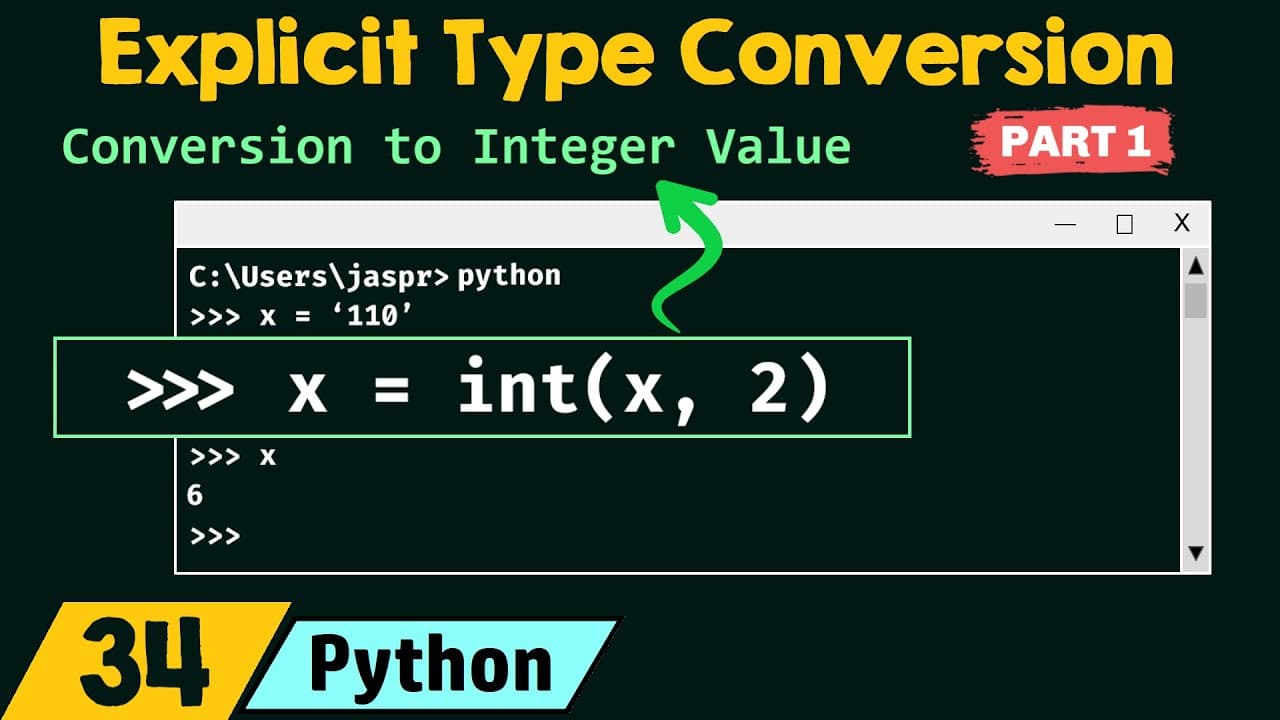
Explicit type conversion in Python means manually converting an object from one type to another, such as passing a string to int() to produce an integer. The lesson explains why concatenating a string with an integer causes a TypeError, how int() accepts a value and an optional base, and why the conversion result must be stored if you want a variable to reference it. Read on for direct answers about the syntax, error, and conversion process.
Transcript
foreign we have understood the concept of implicit type conversion there we have understood that implicit type conversion is all about the ability of python to convert the type of one object to another without any programmers intervention now in this presentation we will understand the concept of explicit type conversion in details so without any f... Read More
Key Insights
- Explicit type conversion requires programmer intervention to change data types.
- The int() function is used to convert objects to integer type explicitly.
- Implicit type conversion is automatic but can lead to errors if not handled.
- Python does not implicitly convert integers to strings to avoid crashes.
- Using int(), you can specify a base for conversion, such as binary to decimal.
- The programmer must store the conversion result to update the variable's type.
- Explicit conversion is necessary when automatic conversion is not performed.
- The type() function helps verify the data type after conversion.
Install to Summarize YouTube Videos and Get Transcripts
Explore YouTube Video Summarizer or Get YouTube Transcript Extractor
Questions & Answers
Q: How do you perform explicit type conversion with int() in Python?
Pass the value you want to convert to the int() function. This explicitly converts an object of another type to an integer through programmer intervention.
Q: What is explicit type conversion in Python?
Explicit type conversion is the conversion of an object from one type to another through programmer intervention. Unlike implicit conversion, it requires the programmer to call a conversion function such as int().
Q: What is the difference between implicit and explicit type conversion?
Implicit type conversion happens when Python converts an object from one type to another without programmer intervention. Explicit type conversion happens when the programmer deliberately requests the conversion, such as by calling int().
Q: Why does concatenating a string and an integer raise a TypeError?
The plus operator acts as a concatenation operator when its first operand is a string. If the other operand is an integer, Python reports that it can concatenate only a string, not an integer, to a string.
Q: Why does Python not implicitly convert an integer to a string in this example?
The lesson states that Python will not implicitly convert an integer to a string because the program may crash. The programmer must therefore handle the required conversion explicitly.
Q: What arguments can the int() function accept?
The syntax shown allows int() to receive a value and a base. The value is the object to convert, while the base tells Python how to interpret a string written in a particular numeral system.
Q: How can you check an object's type before or after conversion?
Use the type() function to inspect the type of an object. In the example, applying type() to a variable holding a quoted value shows that the object belongs to the str class.
Q: Does calling int() automatically change the original variable's type?
Calling int() returns the converted integer value, but the result must be stored for a variable to reference that converted object. Simply calling the function does not by itself update what the original variable points to.
Summary & Key Takeaways
-
Explicit type conversion is a manual process where programmers convert data types using functions like int(). This is necessary when automatic conversion isn't performed, such as converting strings to integers to avoid type errors.
-
The int() function can convert a string to an integer, and specifying a base allows conversion from binary to decimal. Programmers must store conversion results to update the variable's type.
-
Implicit conversion in Python is automatic but limited, especially when converting integers to strings. Explicit conversion prevents errors and potential program crashes by ensuring correct data type handling.
Read in Other Languages (beta)
Share This Summary 📚
Summarize YouTube Videos and Get Video Transcripts with 1-Click
Try YouTube Summary with ChatGPT & Claude or YouTube Transcript Generator
Explore More Summaries from Neso Academy 📚
Summarize YouTube Videos and Get Video Transcripts with 1-Click
Try YouTube Summary with ChatGPT & Claude or YouTube Transcript Generator