Link Layer Services
TL;DR
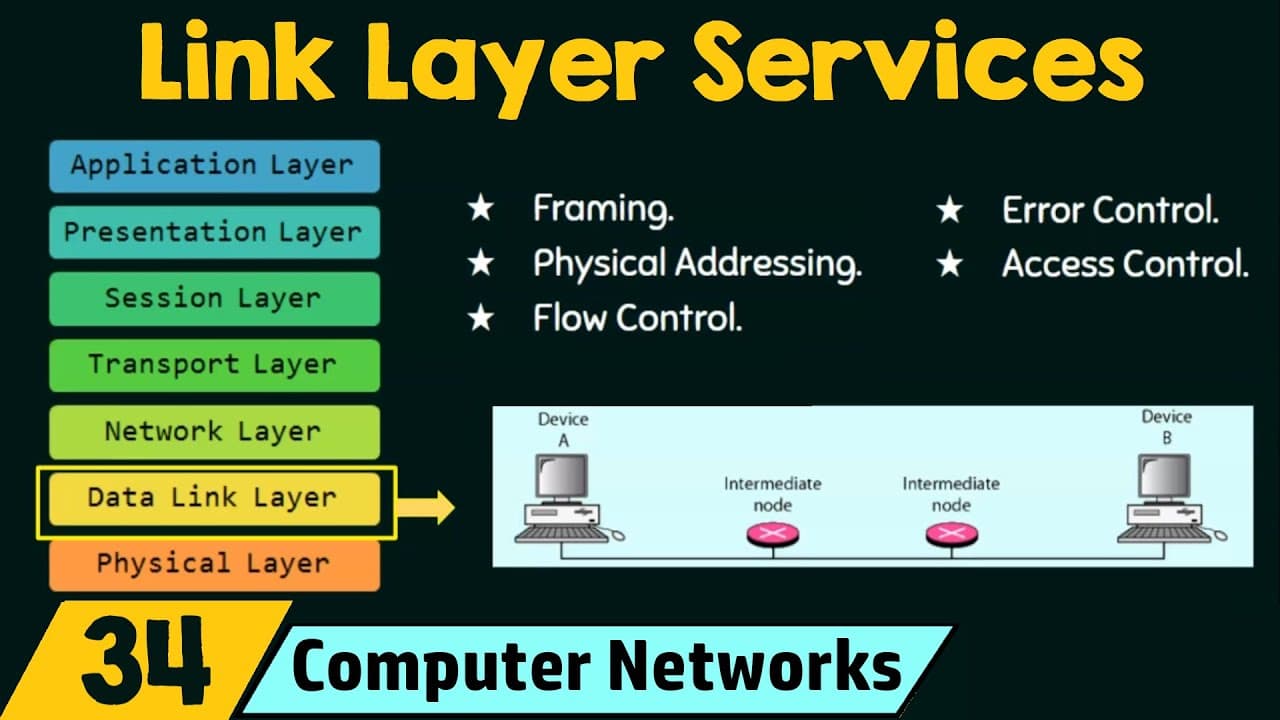
This lecture provides an overview of the services offered by the data link layer: framing, physical addressing, flow control, error control, and access control.
Transcript
hello everyone welcome back to the next lecture in today's lecture we are going to see about the link layer services as usual we will start the session with the outcomes in today's session we have two outcomes upon the completion of this session the learner will be able to number one know the various services offered by datalink layer after knowing... Read More
Key Insights
- 🍻 The data link layer is the second layer in the OSI reference model and is responsible for encapsulating network layer packets into frames.
- 🎮 Framing, physical addressing, flow control, error control, and access control are the five services offered by the data link layer.
- 💌 Framing involves grouping bits into distinguishable frames, similar to pauses in communication or envelopes in postal systems.
- 🖼️ Physical addressing adds source and destination MAC addresses to the header of the frame.
- 🌸 Flow control coordinates the amount of data that can be sent before receiving acknowledgment, preventing overload and packet loss.
- 😒 Access control manages the use of a common media by multiple devices.
- 🕵️ Error control involves detecting and potentially correcting transmission errors in frames.
Install to Summarize YouTube Videos and Get Transcripts
Explore YouTube Video Summarizer or Get YouTube Transcript Extractor
Questions & Answers
Q: What is the role of the data link layer in the OSI reference model?
The data link layer is responsible for adding headers and trailers to network layer packets, creating frames for node-to-node communication.
Q: What are the five services offered by the data link layer?
The five services offered are framing, physical addressing, flow control, error control, and access control.
Q: How does framing work in the data link layer?
Framing involves grouping bits into frames, allowing the receiver to distinguish one frame from another. This can be done using pauses or delimiters.
Q: How does flow control prevent packet loss?
Flow control establishes a speed matching mechanism between sender and receiver, ensuring that the sender does not overwhelm the receiver with data. The sender waits for acknowledgment before sending the next set of packets.
Key Insights:
- The data link layer is the second layer in the OSI reference model and is responsible for encapsulating network layer packets into frames.
- Framing, physical addressing, flow control, error control, and access control are the five services offered by the data link layer.
- Framing involves grouping bits into distinguishable frames, similar to pauses in communication or envelopes in postal systems.
- Physical addressing adds source and destination MAC addresses to the header of the frame.
- Flow control coordinates the amount of data that can be sent before receiving acknowledgment, preventing overload and packet loss.
- Access control manages the use of a common media by multiple devices.
- Error control involves detecting and potentially correcting transmission errors in frames.
- Each service offered by the data link layer is important for ensuring reliable and efficient communication between nodes.
Summary & Key Takeaways
-
The data link layer is the second layer in the OSI reference model, responsible for adding a header and trailer to network layer packets to create frames for node-to-node communication.
-
The five services offered by the data link layer are framing, physical addressing, flow control, error control, and access control.
-
Framing involves grouping bits into distinguishable frames, similar to using pauses or envelopes in communication.
-
Physical addressing adds source and destination MAC addresses to the frame header.
-
Flow control ensures matching speeds between sender and receiver to prevent overload and packet loss.
-
Access control manages the use of a common media by multiple devices.
-
Error control involves detecting and potentially correcting transmission errors in frames.
Read in Other Languages (beta)
Share This Summary 📚
Summarize YouTube Videos and Get Video Transcripts with 1-Click
Try YouTube Summary with ChatGPT & Claude or YouTube Transcript Generator
Explore More Summaries from Neso Academy 📚
Summarize YouTube Videos and Get Video Transcripts with 1-Click
Try YouTube Summary with ChatGPT & Claude or YouTube Transcript Generator