How Does DSpark Make AI Inference Faster?
TL;DR
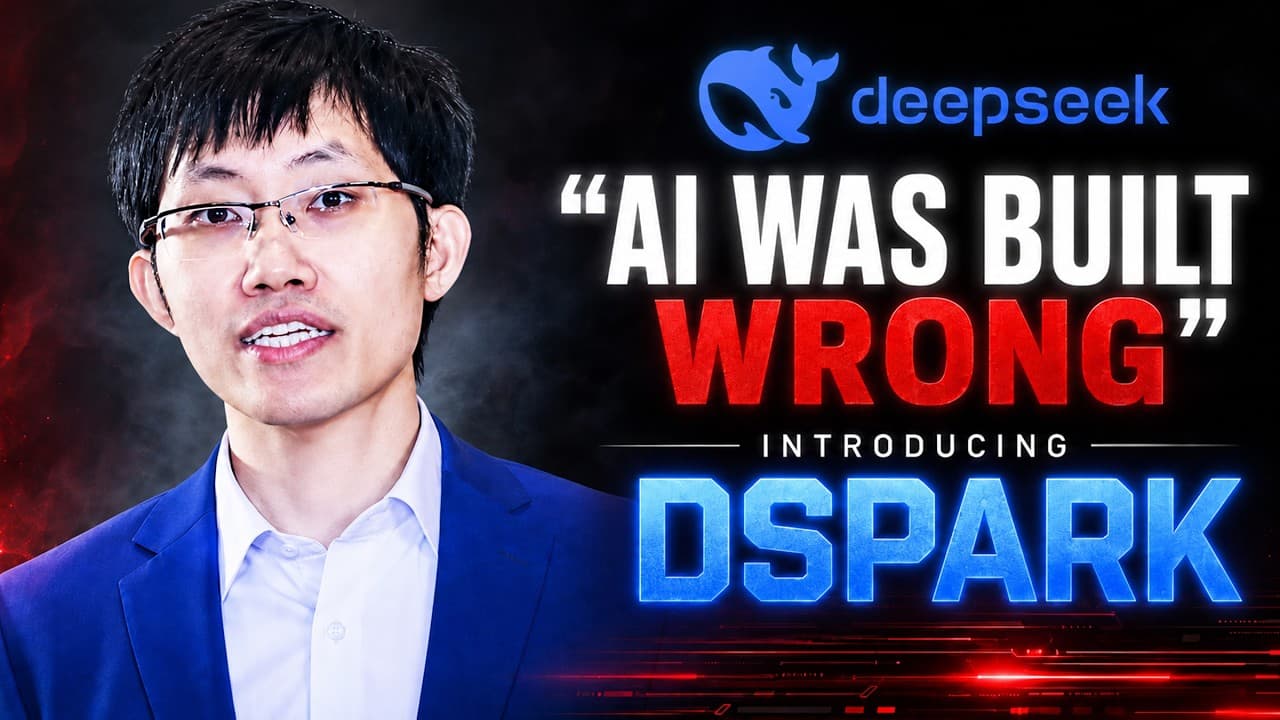
DSpark accelerates AI responses by letting a helper model draft several tokens, correcting dependencies among those tokens, and verifying only the guesses worth checking under current traffic conditions. DeepSeek reports live per-user speed gains of 60–85% for V4 Flash and 57–78% for V4 Pro, while keeping the main model responsible for the final output.
Transcript
[music] >> Deepseek just upgraded V4, and this is the kind of AI breakthrough most people will underestimate at first because it doesn't make the model more intelligent. It makes the whole system faster, cheaper, and much harder to overload. And that's huge because a smarter model is useless if it's too slow, too expensive, or too hard to serve. DS... Read More
Key Insights
- DSpark is an inference optimization system that targets response speed, serving cost, GPU utilization, and capacity rather than increasing the underlying intelligence of DeepSeek V4. Its purpose is to make the same hardware serve more users with less perceived waiting.
- Speculative decoding works by having a smaller helper model draft several likely tokens before the main model verifies them. Accepted tokens let generation advance faster, while rejected portions are discarded and corrected without transferring final control away from the main model.
- Suffix decay is the deterioration of later tokens in a parallel draft because they are predicted without fully knowing the earlier draft choices. This can cause the helper to combine incompatible continuations, even though the main model would reject those combinations during verification.
- Semi-autoregressive generation is DSpark's method for combining fast parallel drafting with enough sequence awareness to keep later guesses connected. A lightweight correction layer aligns later tokens with earlier ones, reducing the usual tradeoff between drafting speed and coherence.
- The Markov head is DSpark's default correction mechanism because it cheaply predicts what should follow from the previous token. An RNN head can retain more draft history, but the reported improvement was small and its production deployment would be more complicated.
- Confidence-scheduled verification is the mechanism that decides which drafted tokens deserve main-model checking. DSpark assigns confidence scores, permits longer verification when capacity is available, and removes low-confidence trailing tokens when traffic is heavy so weak guesses do not consume scarce capacity.
- Accepted draft length is a central performance metric because it measures how many proposed tokens survive main-model verification. Across Qwen 3 models with 4 billion, 8 billion, and 14 billion parameters, DSpark improved this metric over Eagle 3 by 30.9%, 26.7%, and 30%.
- DSpark's selective verification substantially increased reported acceptance rates by filtering weak guesses before verification. Chat rose from 45.7% to 95.7%, math from 76.9% to 92.5%, and code from 67.6% to 92%, while calibrated confidence error reached around 1%.
- More videos from this channel:
- More from this channel: AI Revolution
Install to Summarize YouTube Videos and Get Transcripts
Explore YouTube Video Summarizer or Get YouTube Transcript Extractor
Questions & Answers
Q: How does DSpark make DeepSeek V4 respond faster?
DSpark uses speculative decoding, where a smaller helper model rapidly proposes several upcoming tokens and the main model verifies them together. It then adds a lightweight correction step so later proposed tokens remain connected to earlier ones. By accepting good drafts and avoiding unnecessary token-by-token generation, the system can reduce waiting time without changing which model controls the final response.
Q: What is speculative decoding in AI inference?
Speculative decoding is a serving technique in which a smaller, faster helper model drafts multiple likely tokens for a larger target model. The target model checks those proposals, accepts the valid portion, and resumes generation where a proposal fails. The helper does not replace the target model or determine the final answer. It reduces the number of slow generation steps when its predictions are accepted.
Q: What problem does suffix decay cause in parallel drafting?
Suffix decay occurs when later tokens in a parallel draft become less reliable because they were guessed before the system knew which earlier guesses would be selected. A helper might begin with a strong prediction but combine pieces from incompatible continuations near the end. This weakens longer drafts and causes more proposed tokens to be rejected by the main model, reducing the potential acceleration.
Q: How does DSpark reduce suffix decay?
DSpark reduces suffix decay through semi-autoregressive generation. It first preserves the speed advantage of drafting tokens in parallel, then applies a small correction layer that gives later tokens information about earlier draft choices. This added sequence awareness helps the proposal remain coherent deeper into the block, allowing more tokens to pass main-model verification without requiring fully step-by-step drafting.
Q: Why does DSpark use a Markov head by default?
DSpark uses a Markov head by default because it offers a simple, inexpensive way to improve continuity between drafted tokens. The head primarily considers the previous token when predicting what should follow. DeepSeek also evaluated an RNN head that could remember more of the sequence, but the reported improvement was small and the RNN approach was more complicated to operate in production.
Q: What is confidence-scheduled verification in DSpark?
Confidence-scheduled verification gives every drafted token a score estimating whether the main model will accept it. DSpark uses those scores and the system's current load to choose how much of the draft to verify. It can inspect more tokens when the GPU has spare capacity and cut off weaker trailing guesses during heavy traffic, preventing low-value verification work from reducing overall serving capacity.
Q: How did DSpark perform against Eagle 3 and Dflash?
Across Qwen 3 models with 4 billion, 8 billion, and 14 billion parameters, DSpark increased average accepted draft length over Eagle 3 by 30.9%, 26.7%, and 30%, respectively. Against Dflash, the stated gains include 16.3% and 18.4%. At proposal length 15, improvements over Dflash reached 30% on math, 26% on code, and 22% on chat.
Q: What live speed improvements did DeepSeek report for DSpark?
DeepSeek reports that DSpark can improve per-user response speed by up to 85% and says the system has already been deployed under live user traffic. The stated gain for V4 Flash is 60–85%, while V4 Pro improves by 57–78%. These results matter because they concern production serving conditions, not only offline benchmarks, and target faster responses with better hardware utilization.
Summary & Key Takeaways
-
DSpark improves speculative decoding, a method in which a smaller helper model proposes several upcoming tokens and the main model verifies them. Its semi-autoregressive design adds sequence awareness after fast parallel drafting, helping later predictions remain consistent with earlier ones without changing which model ultimately determines the answer.
-
A confidence-scheduled verification system scores drafted tokens by their likelihood of acceptance. It checks more tokens when hardware capacity is available and removes weaker trailing guesses during heavy traffic. Throughput profiles guide these choices, allowing DSpark to balance response speed, batch size, and available GPU capacity under changing production loads.
-
Benchmarks across Qwen 3 models and Gemma showed that DSpark produced longer accepted drafts than Eagle 3 and Dflash. Selective verification raised reported acceptance rates to 95.7% for chat, 92.5% for math, and 92% for code. DeepSeek also reports substantial speed improvements under live V4 traffic.
Read in Other Languages (beta)
Share This Summary 📚
Summarize YouTube Videos and Get Video Transcripts with 1-Click
Try YouTube Summary with ChatGPT & Claude or YouTube Transcript Generator
Explore More Summaries from AI Revolution 📚



Summarize YouTube Videos and Get Video Transcripts with 1-Click
Try YouTube Summary with ChatGPT & Claude or YouTube Transcript Generator