What Are Benzene Side Chain Reactions?
TL;DR
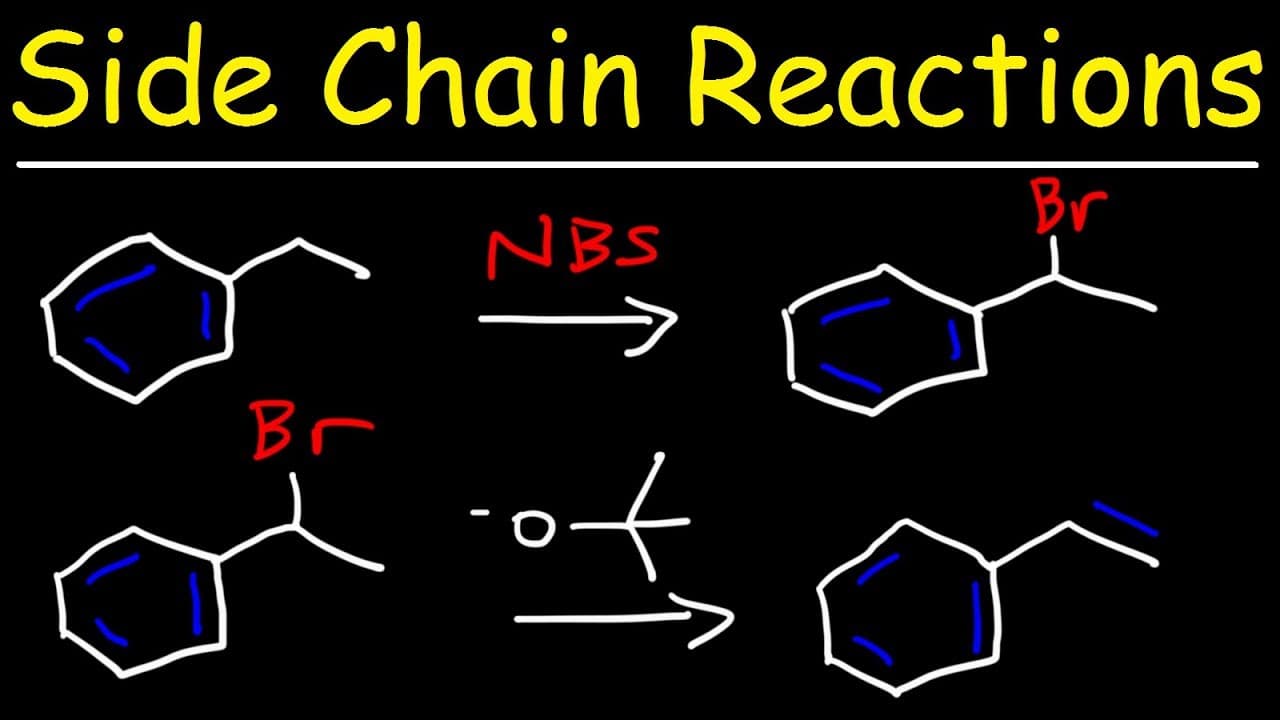
Benzene side chain reactions involve substituting hydrogen atoms with other groups through methods like bromination, Friedel-Crafts alkylation, and nucleophilic substitution. Key reactions include transforming bromobenzene into toluene, creating benzyl alcohol from benzyl bromide, and generating benzaldehyde via oxidation. The nature of alkyl groups can influence oxidation outcomes, affecting their transformation into carboxylic acids.
Transcript
in this video we're gonna focus on a few side chain reactions of benzene that you might need to know so let's start with benzene and let's react it with BR 2 and iron 3 bromide febr3 is the catalyst in this reaction and so this is the bromination of benzene we're gonna replace a hydrogen atom with a bromine atom so right now what we have is bromo b... Read More
Key Insights
- 🫀 The bromination of benzene is facilitated by an iron (III) bromide catalyst, resulting in the substitution of a hydrogen atom with a bromine atom.
- 🥺 Dimethyl copper lithium can be used to displace a bromine atom in bromobenzene, leading to the formation of toluene.
- 💁 Benzyl bromide can undergo SN2 reactions with nucleophiles like hydroxide ion or cyanide for the formation of benzyl alcohol or a nitro group, respectively.
- 💁 Oxidation of benzyl bromide using PCC converts it into benzaldehyde, while reduction of nitrobenzene forms aniline.
- ❓ Benzene can be transformed into benzylamine through SN2 reactions with ammonia, followed by deprotonation.
- 👥 The presence of certain alkyl groups on a benzene ring affects their oxidizability, with tertiary alkyl groups remaining unaffected during oxidation reactions.
- 😋 Friedel-Crafts alkylation reactions allow for the introduction of alkyl groups onto the benzene ring.
Install to Summarize YouTube Videos and Get Transcripts
Explore YouTube Video Summarizer or Get YouTube Transcript Extractor
Questions & Answers
Q: What is the purpose of using iron (III) bromide as a catalyst in the bromination reaction of benzene?
Iron (III) bromide acts as a Lewis acid catalyst, facilitating the formation of a brominium ion intermediate. This allows for the substitution of a hydrogen atom with a bromine atom on the benzene ring.
Q: How can benzyl bromide be further transformed into benzaldehyde?
Benzyl bromide can be oxidized using PCC (pyridinium chlorochromate), leading to the formation of benzaldehyde. PCC selectively converts primary alcohols to aldehydes without further oxidation to carboxylic acids.
Q: What is the mechanism behind the formation of benzylamine from benzyl bromide and ammonia?
The reaction proceeds through an SN2 reaction, where the nucleophilic ammonia attacks the carbon carrying the bromine atom. The resulting intermediate undergoes deprotonation using hydroxide ion or excess ammonia to generate benzylamine.
Q: How can nitrobenzene be synthesized from benzene?
Nitrobenzene can be obtained by treating benzene with a mixture of nitric acid and sulfuric acid under suitable conditions. The nitration reaction introduces a nitro group (-NO2) onto the benzene ring.
Summary & Key Takeaways
-
Bromination of benzene using BR2 and FeBr3 catalyst produces bromobenzene.
-
Reacting bromobenzene with dimethyl copper lithium replaces the bromine atom, resulting in toluene.
-
Benzyl bromide, derived from bromobenzene, can be reacted with hydroxide ion to form benzyl alcohol or oxidized to benzaldehyde using PCC.
-
Benzene can be converted to benzylamine through SN2 reactions with ammonia and subsequent deprotonation.
-
Benzyl bromide can undergo SN2 reaction with cyanide to yield a nitro group, which can be reduced to a primary amine or further converted to a carbonyl group.
Read in Other Languages (beta)
Share This Summary 📚
Summarize YouTube Videos and Get Video Transcripts with 1-Click
Try YouTube Summary with ChatGPT & Claude or YouTube Transcript Generator
Explore More Summaries from The Organic Chemistry Tutor 📚


Summarize YouTube Videos and Get Video Transcripts with 1-Click
Try YouTube Summary with ChatGPT & Claude or YouTube Transcript Generator