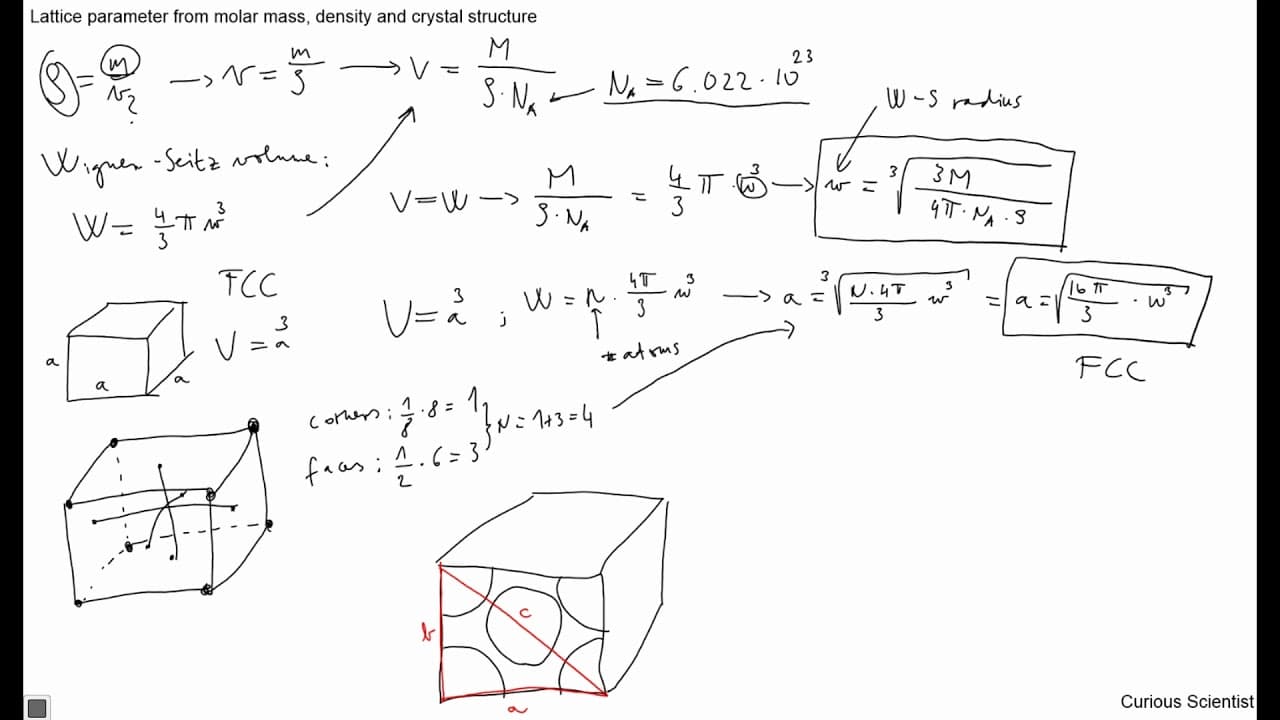
Lattice parameter from molar mass and density - FCC structure and basics
TL;DR
Learn to derive lattice parameters and covalent radii using density and molar mass.
Transcript
welcome again in this video I'm going to show you some very cool stuff basically by using your periodic table you can calculate the lattice parameter or the covalent radius of the material all you need is basically the molar mass the density and crystal structure of the material and everything else is just basic geometry so it's very simple but it'... Read More
Key Insights
- 👻 The relationship between density, mass, volume, and molecular structures allows for systematic calculations of crucial material properties.
- 🫀 The Wigner-Seitz radius serves as an average distance between atoms, providing insight into atomic spacing within solids.
- 😀 Face-centered cubic (FCC) structure calculations showcase how geometry can yield the number of atoms per unit cell, influencing lattice parameters.
- 👻 The presented formulas allow for quick derivations of properties like the covalent radius and lattice parameter when molar mass and density are known.
- 🧑🎓 Simple geometric principles can significantly impact the understanding of complex crystalline structures for students and researchers.
- 🧑🎓 The calculations demonstrated in the video can also be useful exercises for students interested in solid state physics and materials science.
- 🫀 Engaging in these calculations deepens understanding of how atomic arrangements impact the physical properties of materials.
Install to Summarize YouTube Videos and Get Transcripts
Explore YouTube Video Summarizer or Get YouTube Transcript Extractor
Questions & Answers
Q: What is the significance of the periodic table in the calculations mentioned?
The periodic table provides essential information such as molar mass and density, which are crucial for deriving the lattice parameter and covalent radius of materials. These properties allow scientists to understand the arrangement of atoms in a solid structure and facilitate further calculations related to material properties.
Q: How does one derive the Wigner-Seitz radius from density and molar mass?
To derive the Wigner-Seitz radius, the formula V = molar mass/density gives the volume per atom. This volume corresponds to the Wigner-Seitz volume, from which the Wigner-Seitz radius can be calculated. The formula involves rearranging the volume formula into a spherical volume expression and solving for the radius.
Q: Can the method discussed be applied to all material structures?
Yes, the method can be applied to various material structures such as body-centered cubic (BCC) and hexagonal close-packed (HCP). Each structure has its own unique geometric relationships, but the core principle of using density and molar mass remains the same, adapted to the geometry of the specific crystal structure.
Q: What role does the Avogadro constant play in these calculations?
The Avogadro constant is critical for converting macroscopic properties like molar mass and density into molar quantities that correspond to individual atoms. It connects the mass/volume ratios with atomic scale parameters, thereby facilitating accurate calculations of properties like the Wigner-Seitz radius and lattice parameters.
Summary & Key Takeaways
-
This content explains how to calculate the lattice parameter and covalent radius of a material using the periodic table, focusing on density, molar mass, and basic geometry.
-
It introduces essential formulas, including the concept of Wigner-Seitz volume and its relationship to material structure, particularly for simple cubic, face-centered cubic (FCC), body-centered cubic (BCC), and hexagonal close-packed (HCP).
-
A practical example using nickel illustrates the process, demonstrating calculations of Wigner-Seitz radius, lattice parameters, and covalent radii, serving as an educational resource for students in material science.
Read in Other Languages (beta)
Share This Summary 📚
Summarize YouTube Videos and Get Video Transcripts with 1-Click
Try YouTube Summary with ChatGPT & Claude or YouTube Transcript Generator
Explore More Summaries from Curious Scientist 📚
![Building a coil winder [Part 6] - A few improvements thumbnail](/_next/image?url=https%3A%2F%2Fi.ytimg.com%2Fvi%2F3eyxG_g2iUA%2Fhqdefault.jpg&w=750&q=75)
![Building a Peltier cooler-based cooling box - First iteration, improvements [Part 2/6] thumbnail](/_next/image?url=https%3A%2F%2Fi.ytimg.com%2Fvi%2F0YlNw0EGnzI%2Fhqdefault.jpg&w=750&q=75)




Summarize YouTube Videos and Get Video Transcripts with 1-Click
Try YouTube Summary with ChatGPT & Claude or YouTube Transcript Generator