Prompting Playbook 2025: What Are the 4 Beginner Moves and 12 Pro Patterns?
TL;DR
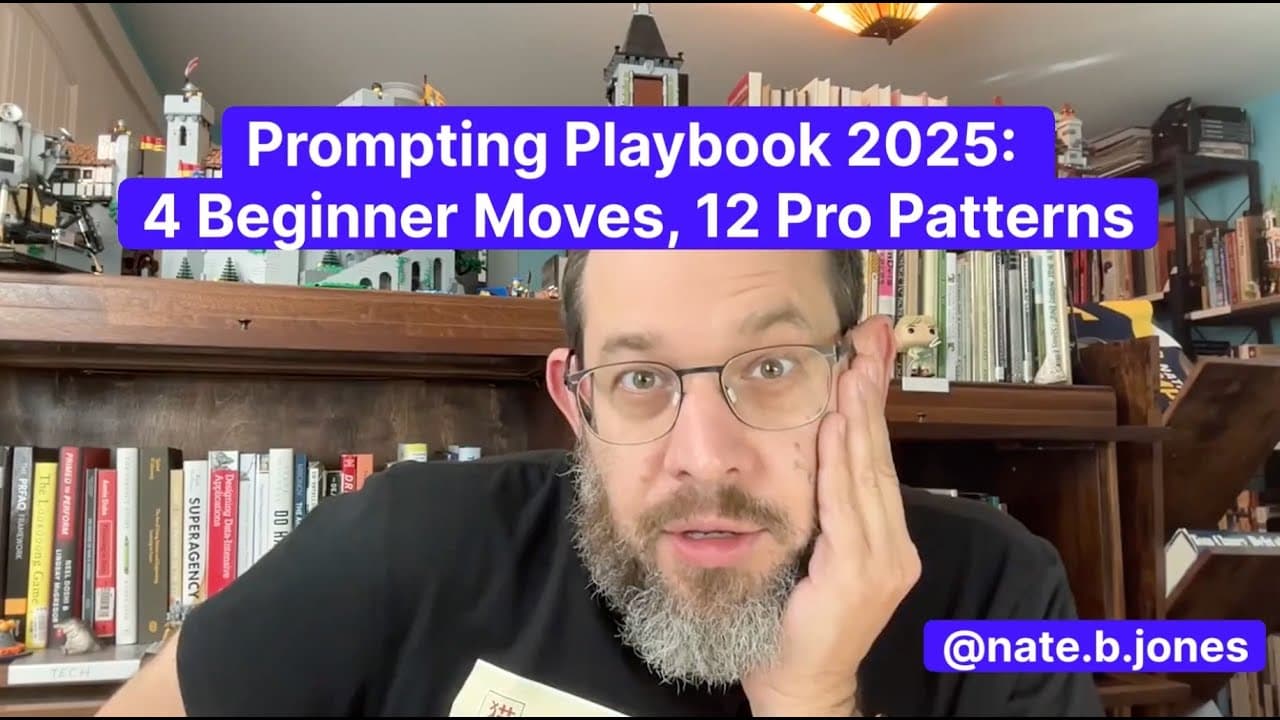
Reliable AI prompts use four moves: define the output shape, provide only the necessary context, give the model a silent working plan, and require a final quality check. Concrete constraints, such as exactly five one-sentence bullets, and an explicit “unknown” option can improve consistency and reduce unsupported additions. Read on for practical ways to turn these moves into clearer, more dependable prompts.
Transcript
So, I have never done this. I went back through all of the prompt guides I've written over the last year plus and I went through them. I collated them. I pulled them together and I'm putting it into a comprehensive prompting course. But that's not all. I'm also separating it out so that it's got a really easy beginners pathway into prompting. I'm g... Read More
Key Insights
- Output shape is the first major prompting control because it defines the expected deliverable before generation begins. A prompt can require one paragraph of 110–130 words, exactly five one-sentence bullets, a five-row comparison table, or a checklist containing only six items.
- Minimal but sufficient context is more useful than an unfiltered collection of information. Supplying only the needed facts gives the model a clearer evidence boundary, while numbered labels make it easier to trace claims back to the information provided in the prompt.
- An explicit unknown option reduces pressure to invent missing information. Simply saying not to guess may conflict with the model's tendency to produce a complete, helpful response, so directing it to write unknown or request clarification provides a useful alternative behavior.
- A silent plan guides the model's process without requiring a narration of its internal thinking. Instructions can ask it to list options, compare them, prioritize by importance, assign owners, estimate time, and then present only the final comparison, agenda, or recommendation.
- A best-recommendation instruction resolves ambiguity when analysis does not produce a clear conclusion. Asking the model to select one option and explain why gives it a defined response path instead of allowing the output to end with an inconclusive list of competing choices.
- A quick quality check encourages a second pass before the answer is shown. The model can verify bullet counts, headings, word limits, evidence labels, missing elements, complexity, and alignment with the original goal, then correct detected problems before returning the result.
- Prompts are contracts within broader pipelines that can include retrieval, memory, and evaluation. Clear specifications and scaffolding can improve efficiency and quality, while the prompt must still fit the surrounding architecture instead of being treated as an isolated unit.
- Governance is necessary because distribution shifts can break effective prompts. Sustainable prompting systems rely on versioning, monitoring, automated enforcement, token budgets, latency limits, and fallback logic, with simplicity and efficiency treated as architectural constraints alongside model capability.
Install to Summarize YouTube Videos and Get Transcripts
Explore YouTube Video Summarizer or Get YouTube Transcript Extractor
Questions & Answers
Q: How do you write a reliable AI prompt?
Define four things: the exact output shape, the minimum context needed, a simple process the model should follow silently, and a quality check before responding. This contractor-brief approach gives the AI clear requirements for both the deliverable and the process.
Q: What are the four beginner moves in Prompting Playbook 2025?
The four moves are to specify the deliverable’s shape, supply minimal but sufficient context, guide the AI with a behind-the-scenes plan, and request a final quality check. Together, they provide more control over structure, evidence, process, and reliability.
Q: How should an AI prompt specify the output format?
Describe the format with concrete, measurable constraints. Examples include one paragraph between 110 and 130 words with no headings, exactly five one-sentence bullets, a five-row comparison table, or a checklist containing only six items.
Q: How much context should you include in an AI prompt?
Include all the information needed to complete the task, but avoid unrelated material. You can label inputs as Fact 1, Fact 2, and Fact 3, then instruct the AI to use only those facts so its claims are easier to trace.
Q: How can prompts reduce unsupported AI guesses?
Give the AI an acceptable action when information is missing, such as writing “unknown,” labeling an inference, or asking a clarifying question. Merely saying “do not guess” may be less helpful because the model still tries to produce a complete response.
Q: What is a silent plan in AI prompting?
A silent plan is a sequence of steps the AI follows behind the scenes while presenting only the final result. For example, it can list options, compare them, prioritize them, recommend one, and then show the final comparison without narrating every step.
Q: How do you add a quality check to an AI prompt?
Tell the AI exactly what to verify before returning its response and instruct it to correct any failures. Checks can cover bullet counts, required headings, word limits, missing elements, and whether every claim is supported by a supplied fact or labeled unknown.
Q: Why should prompts be treated as parts of broader pipelines?
Prompts can operate within systems that include retrieval, memory, and evaluation, so their wording and output structure must fit the surrounding architecture. Reliable pipelines also require versioning, monitoring, automated enforcement, token budgets, latency planning, and fallback logic.
Summary & Key Takeaways
-
Effective beginner prompting consists of four moves: specify the deliverable, supply minimal but sufficient context, guide the model with a silent process, and request a final quality check. This contractor-brief approach replaces casual instructions with clear requirements, giving the user more control over structure, content, reasoning direction, and reliability.
-
Output specifications can define paragraph length, bullet count, table dimensions, headings, or checklist size. Context can be labeled as numbered facts, with instructions to use only those facts and mark uncovered information as unknown. These constraints help limit unwanted response habits, unsupported additions, missing elements, and excessive detail.
-
Advanced prompting focuses beyond isolated prompts toward pipelines involving retrieval, memory, and evaluation. Prompts function as contracts inside those systems, while constraints, examples, schemas, and temperature shape output probabilities. Sustainable systems also require versioning, monitoring, automated enforcement, token budgets, latency planning, fallback logic, and efficient architectural choices.
Read in Other Languages (beta)
Share This Summary 📚
Summarize YouTube Videos and Get Video Transcripts with 1-Click
Try YouTube Summary with ChatGPT & Claude or YouTube Transcript Generator
Explore More Summaries from AI News & Strategy Daily | Nate B Jones 📚






Summarize YouTube Videos and Get Video Transcripts with 1-Click
Try YouTube Summary with ChatGPT & Claude or YouTube Transcript Generator