What Does AI Mean for Education? Anthropic's View
TL;DR
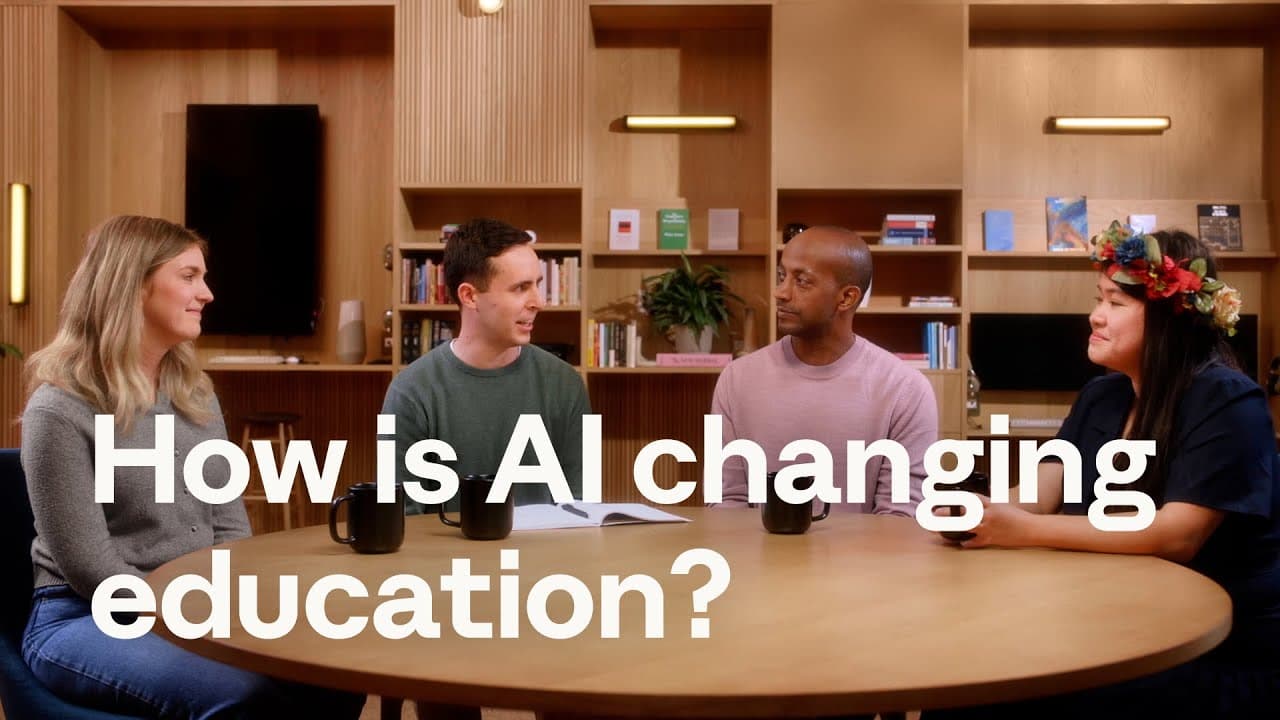
AI can scale personalized tutoring, assessment, and interactive learning that once required scarce one-on-one time, but it also drives cheating and raises questions about what students should still learn. Anthropic's research found 47% of student interactions with Claude were transactional, prompting a push toward AI fluency and critical thinking over answer-seeking.
Transcript
- I would hate to see a future where teachers outsource to AI the parts that I think which is the connection pieces, when you really understand your students and can spend time with them, and AI can be used in so to have more time to do that kind of work. And I'm excited for us that knowledge they already have. - Hi everyone. We're here to which is... Read More
Key Insights
- Anthropic frames its education work around "holding light and shade," taking both the benefits and the risks of AI seriously, since education embodies massive upside for access alongside real concerns about cheating and how students learn.
- Anthropic's Societal Impacts research found that 47% of student interactions with Claude were transactional, answer-seeking exchanges rather than the higher-order learning tasks educators actually want students to practice.
- Bloom's taxonomy shows learning progresses from remembering facts and understanding knowledge up to higher-order tasks, but the study found Claude was often performing the very tasks teachers want students to do themselves.
- AI enables interactive learning at scale, letting any subject become a simulation or role-play, such as a classroom game where students became a virus, driving engagement across any topic without heavy teacher programming.
- AI can democratize one-on-one support like career counseling and role-play with historical figures, giving students in low-resource regions access to personalized guidance that scarce human resourcing cannot always provide.
- Critical thinking and information literacy become central skills, teaching students to question and corroborate what an AI presents, moving from trusting sources to evaluating why a claim is true and how to verify it.
- Teachers modeling uncertainty is powerful, showing kids that adults do not always know the answers and demonstrating a real process for learning and verifying rather than pretending to have every answer.
- Anthropic built an AI fluency framework defining effective, ethical, and safe AI use, partnering with two organizations and creating a core course plus training for educators who want to teach it.
Install to Summarize YouTube Videos and Get Transcripts
Explore YouTube Video Summarizer or Get YouTube Transcript Extractor
Questions & Answers
Q: What does "holding light and shade" mean for AI in education?
It is Anthropic's approach of taking seriously both the benefits and the risks of the AI systems it builds. In education this trade-off is especially acute: AI offers the potential to scale personalized learning, tutoring, and assessment, but it also invites more fundamental questions about how, and even what, students should learn, and it can lead to more cheating even as it democratizes access.
Q: What did Anthropic's research find about how students use Claude?
Anthropic's Societal Impacts team studied how users interact with Claude and found that 47% of student interactions were transactional, answer-seeking types of exchanges. This was described as a wake-up call, because the tool was often performing the tasks educators actually want students to do themselves, rather than supporting the deeper learning process teachers hope to see.
Q: How does Bloom's taxonomy relate to AI in learning?
Bloom's taxonomy describes how learning builds from remembering facts and understanding knowledge up to higher-order thinking tasks. The concern raised is that when students use AI transactionally, Claude ends up performing the higher tasks that you want your students to do. Educators want AI to support the climb up that ladder rather than replace the effortful thinking that produces real learning.
Q: How can AI make learning more interactive?
AI lets teachers create interactive learning experiences and simulations at scale for any subject. One speaker recalled a classroom simulator game where students became a virus, generating high engagement. With AI, similar immersive, engaging role-play and simulation experiences can be built across any topic without teachers needing to fully program them, letting students learn by doing rather than passively reading.
Q: How can AI help students in low-resource regions?
AI can democratize personalized support that is otherwise hard to resource, such as career counseling or one-on-one guidance many students lack access to. Students can ask Claude to role-play scenarios, including conversations with historical figures, providing engaging, tailored help. This is especially valuable in regions with low resourcing where a human is not always available to sit down individually with each learner.
Q: Why is critical thinking still important in the age of AI?
The panel stresses teaching students to critically evaluate the facts and information they are presented with, especially from AI. Learners should move from simply trusting sources to asking why something is true, how to trust it, and how to corroborate it. If an AI gives an answer, students should know what else to check, making information literacy one of the most important skills to develop.
Q: How should teachers and parents model learning with AI?
Speakers argue adults should model uncertainty rather than pretend to have every answer. A parent or teacher can ask a question, get an AI response, then ask whether that is enough and what else can be checked, going through the verification process together. Modeling that adults do not always know, and showing a real process for learning, gives kids a healthier, more honest relationship with knowledge.
Q: What is Anthropic doing to support education?
Anthropic partnered with two organizations to build an AI fluency framework, defined as using AI in ways that are effective, ethical, and safe. It created a core course plus training for educators interested in teaching AI fluency, helping people assess their own AI interactions. The goal is to give teachers and students autonomy and durable skills rather than quickly outdated tool-specific instructions.
Summary & Key Takeaways
-
Four Anthropic staff with personal ties to education, including former math teacher Drew Bent and physics-trained Ephraim, discuss navigating AI in education at work and as parents, framing it as "holding light and shade": weighing scaled personalized learning against cheating and deeper questions about how and what students should learn.
-
Societal Impacts research found 47% of student Claude interactions were transactional and answer-seeking, often performing the higher-order Bloom's taxonomy tasks teachers want students to do. Educators are experimenting by flipping the script, using AI for interactive simulations, role-play, and continuous assessment that scale personalized support once limited by human resourcing.
-
The panel emphasizes teaching critical thinking, information literacy, and modeling uncertainty so students learn to verify AI outputs rather than trust them blindly. Anthropic's response includes an AI fluency framework defining effective, ethical, and safe use, a core course, and educator training built with two partner organizations.
Read in Other Languages (beta)
Share This Summary 📚
Summarize YouTube Videos and Get Video Transcripts with 1-Click
Try YouTube Summary with ChatGPT & Claude or YouTube Transcript Generator
Explore More Summaries from Anthropic 📚


Summarize YouTube Videos and Get Video Transcripts with 1-Click
Try YouTube Summary with ChatGPT & Claude or YouTube Transcript Generator