Do We Really Have Free Will or Is It an Illusion?
TL;DR
The debate on free will centers around whether our choices are genuinely independent or predetermined by physical laws. While determinism suggests our actions are controlled by prior events, some argue that emergent properties of complex systems, like consciousness, may allow for free decision-making. Ultimately, the subjective experience of feeling free plays a crucial role in how we perceive our choices.
Transcript
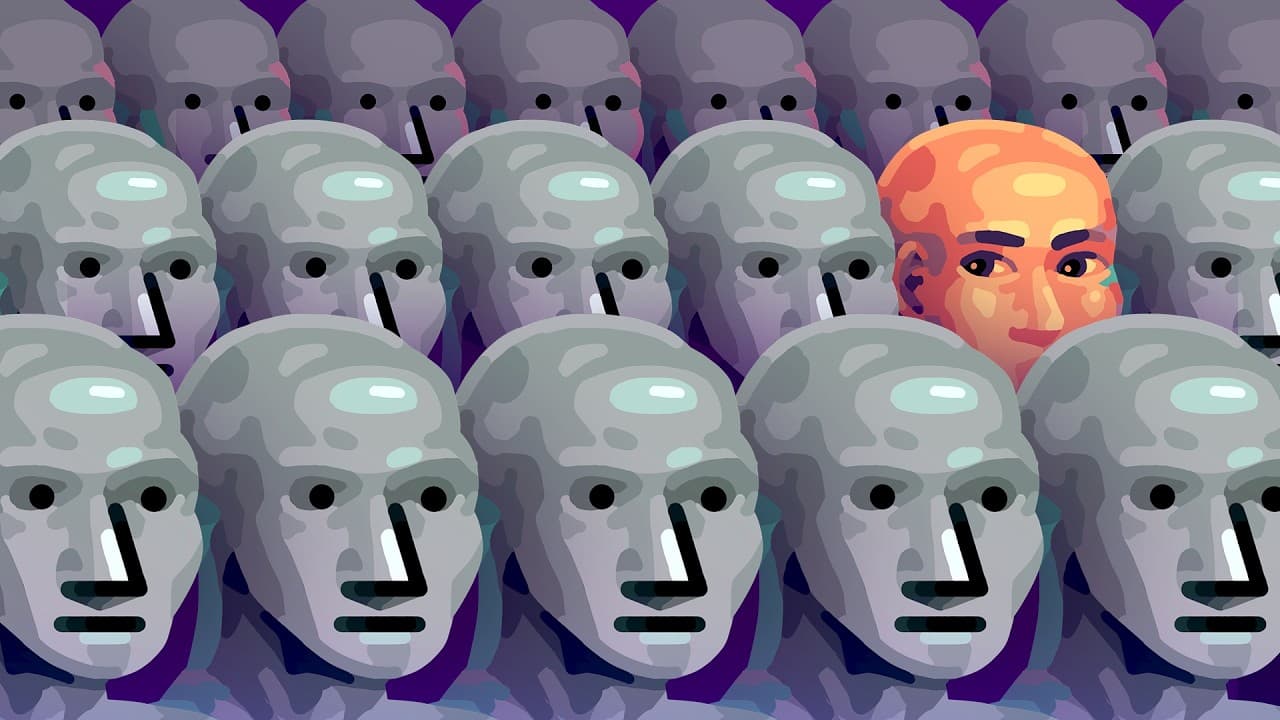
Are you free? Free to choose what you do and make decisions? Or are you an NPC, unable to decide anything for yourself? You feel that you have control over your life, or at least what you’ll have for breakfast. But this may be an illusion. Physics actually may force you to go through life as if on rails, with no free will at all. You expe... Read More
Key Insights
- 🥶 The concept of free will is central to human relationships, responsibility, and morality.
- 🥺 Determinism posits that all events are causally determined by preceding factors, leading to a potentially predestined life experience.
- 👻 Quantum mechanics introduces randomness, prompting a debate about whether that randomness allows for actual decision-making.
- 🥶 Emergence theory illustrates how higher-order phenomena arise from complex systems, suggesting a layer of reality where free will may exist.
- 🥶 The subjective feeling of making choices and exercising free will remains significant, regardless of the philosophical conclusions drawn.
- 🥶 Complex systems can influence one another without being reducible to their individual components, indicating that free will may be a feature of higher cognitive functions.
- 🛟 Life experiences and decision-making processes operate within complexes of both determinism and emergent properties, reflecting human consciousness's nuanced nature.
Install to Summarize YouTube Videos and Get Transcripts
Explore YouTube Video Summarizer or Get YouTube Transcript Extractor
Questions & Answers
Q: What are the two main philosophical positions regarding free will discussed in the content?
The two main philosophical positions are determinism, which asserts that every action is predetermined by prior events and physical laws, and the belief in free will, which argues that individuals can make independent choices that shape their futures. This contention examines the implications of both viewpoints on moral responsibility and personal agency.
Q: How do proponents of the no-free-will camp justify their stance?
Proponents of the no-free-will camp argue that all events, including human decisions, are governed by deterministic physical laws. They posit that since particles behave according to these laws without any will or motivation, individuals are merely experiencing predetermined outcomes. This view suggests that even randomness in quantum physics does not grant true agency, as randomness can lead to events that still do not equate to individual decision-making.
Q: What is the emergence argument presented in favor of free will?
The emergence argument proposes that higher levels of complexity, like consciousness, arise from interactions between simpler components, such as neurons in the brain. This perspective suggests that while individual particles lack agency, the complex interactions among them create new properties that empower individuals to make decisions within their conscious experience. It asserts that free will emerges from this higher-level complexity, diverging from a purely reductionist view.
Q: Why do some believe the debate on free will matters for everyday life?
The debate on free will impacts how individuals perceive responsibility and agency in their lives. If free will exists, people can be held accountable for their actions, reinforcing moral and legal systems. Conversely, if determinism is true, it raises questions about guilt and accountability. This philosophical inquiry underscores the importance of understanding human experience and interaction in society.
Summary & Key Takeaways
-
The video discusses the philosophical debate surrounding free will, questioning whether people truly have the ability to make independent choices.
-
It presents arguments from both sides of the debate, highlighting the deterministic view that our actions are governed by physical laws and quantum randomness.
-
The conclusion suggests that despite the complexities of the argument, the subjective experience of feeling free in decision-making remains significant.
Read in Other Languages (beta)
Share This Summary 📚
Summarize YouTube Videos and Get Video Transcripts with 1-Click
Try YouTube Summary with ChatGPT & Claude or YouTube Transcript Generator
Explore More Summaries from Kurzgesagt – In a Nutshell 📚
Summarize YouTube Videos and Get Video Transcripts with 1-Click
Try YouTube Summary with ChatGPT & Claude or YouTube Transcript Generator