KPM12-J High-Resolution Resistance-Based Displacement Sensor
TL;DR
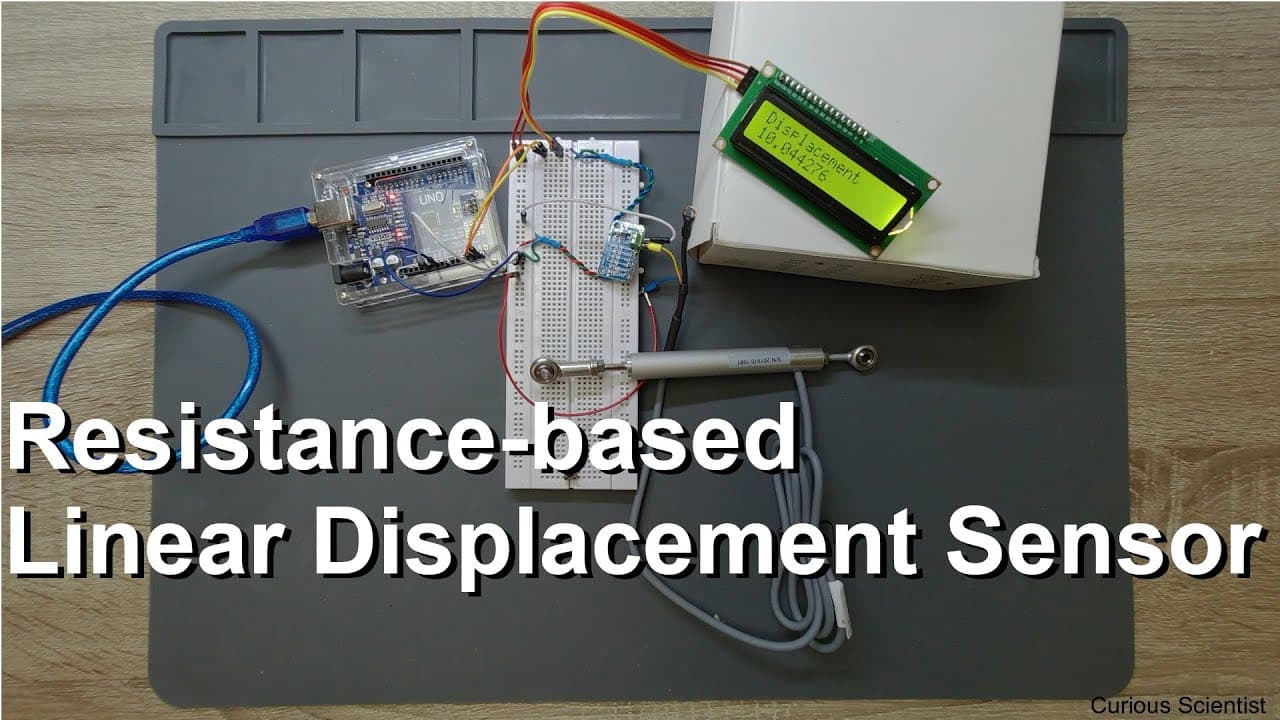
The video discusses a precise displacement sensor's workings and calibration process.
Transcript
back America in this video I'm going to show you a displacement sensor again this is another version of displacement sensor so already I have shown you some very simple which is based on a caliper for example digital caliper or a digital readout and I used something which is based on a linear potentiometer a slight potentiometer and in this case I'... Read More
Key Insights
- 😫 The displacement sensor's fundamental mechanism involves a moving piston and a set of wedge-shaped plates that interact to measure deflection.
- 🥳 Elastic deformation of the metal parts leads to a linear change in resistance, which the strain gauge can detect reliably.
- 🧡 The precision of the sensor is highlighted by its capability to measure within a range of ten micrometers, suitable for high-accuracy needs.
- 🍓 Calibration is vital for transforming raw data from the sensor into meaningful displacement measurements, establishing a reliable relationship between the two.
- 🗺️ The sensor operates on a resistance-based circuit, where changes in voltage reflect the distance traveled by the piston.
- ❓ Practical implementation of the sensor involves programming with an Arduino and configuring settings like sampling frequency for optimal data collection.
- 👤 Users can adjust settings for better resolution based on application requirements, such as modifying gain settings for voltage.
Install to Summarize YouTube Videos and Get Transcripts
Explore YouTube Video Summarizer or Get YouTube Transcript Extractor
Questions & Answers
Q: How does the displacement sensor measure movement?
The displacement sensor employs a piston that moves within a cylinder, affecting the distance between two wedge-shaped plates. As these plates bend due to the movement, a strain gauge measures the resulting deflection, which correlates to the displacement of the piston. This deflection causes a change in resistance, which translates into measurable voltage output, indicating the piston’s position.
Q: What role does the strain gauge play in this sensor?
The strain gauge is crucial for measuring the deflection of the metal plates that bend as the piston moves. When the piston extends or retracts, it creates stress on the wedges, leading to elastic deformation. The strain gauge detects this change in resistance stemming from the deformation, allowing for precise measurements of the displacement.
Q: What is the significance of the calibration process mentioned?
Calibration ensures that the readings from the displacement sensor are accurate. By measuring known displacements and correlating them with the sensor's output, one can derive a linear function that corrects any discrepancies. This process is pivotal for achieving the stated precision of 10 micrometers and ensuring reliable performance in practical applications.
Q: How does the video illustrate the precision of the displacement sensor?
The presenter demonstrates the sensor's precision by showing real-time measurements on an LCD screen. By gradually altering the position of the piston, he explains how the displayed values change, highlighting the sensor’s ability to capture minute variations in position. This is exemplified through consistent readings at nominal and precise levels, underscoring its functionality.
Q: What are the practical applications of this displacement sensor?
The displacement sensor can be used in various fields like robotics, automation, and other projects requiring precise motion measurements. Its ability to provide fine readings makes it suitable for applications where accurate positioning and movement detection are critical, such as robotic arms or CNC machines.
Q: What are the components involved in the sensor's circuitry?
The circuitry includes four cables, with one for shielding, two for output, and one for power supply. The output voltage from the sensor is read by a 16-bit analog-to-digital converter, which then sends the values to an Arduino for processing and display on an LCD, thus integrating hardware with software for effective measurement.
Summary & Key Takeaways
-
The video introduces a displacement sensor that employs a moving piston and a strain gauge to measure deflection and displacement accurately.
-
It details the electrical circuit's functionality, including how the output voltage reflects the position of the piston and the calibration process involved.
-
The presenter emphasizes the sensor's high precision, suitable for applications requiring fine measurements, such as robotics and automation.
Read in Other Languages (beta)
Share This Summary 📚
Summarize YouTube Videos and Get Video Transcripts with 1-Click
Try YouTube Summary with ChatGPT & Claude or YouTube Transcript Generator
Explore More Summaries from Curious Scientist 📚


Summarize YouTube Videos and Get Video Transcripts with 1-Click
Try YouTube Summary with ChatGPT & Claude or YouTube Transcript Generator