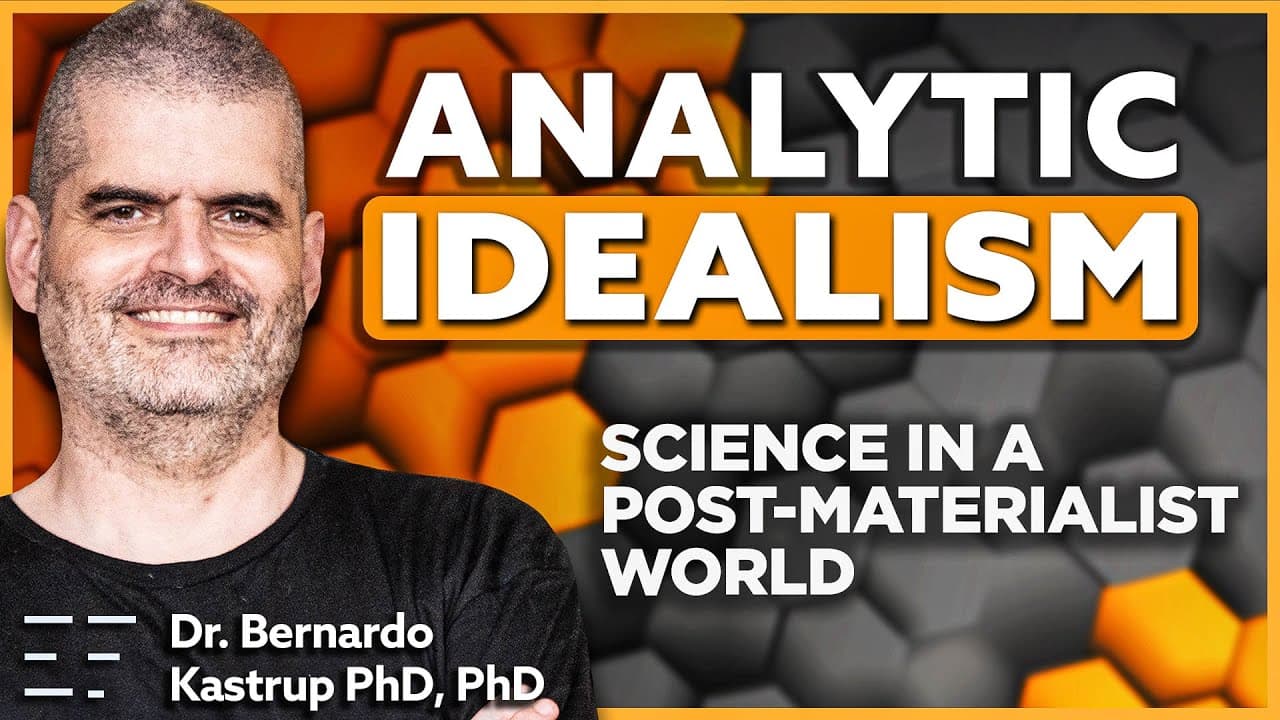
Analytic Idealism: A superior hypothesis (Part 4) | Analytic Idealism with Bernardo Kastrup
TL;DR
Analytic Idealism proposes that consciousness is the fundamental aspect of reality, and the physical world is the extrinsic appearance of mental states.
Transcript
welcome back to essentia foundation's analytic idealism course last time in part three we covered a constitutive pensionism with discussed the fact that pansysm seems to be motivated on a fallacious logical bridge on the notion that the structure of the world perceived should also be the structure of the perceiver of the subject of perception now t... Read More
Key Insights
- 🌍 Analytic Idealism suggests that consciousness is the fundamental aspect of reality, and the physical world is its extrinsic appearance.
- 🖐️ Dissociation plays a crucial role in understanding the relationship between mental states and their appearance.
- 〽️ The universe can be seen as a vast network of conscious mental states, with individual alters perceiving the appearance of other alters through impingement.
- 🤬 The extrinsic appearance of the physical world is a representation or symbol of the underlying mental states.
Install to Summarize YouTube Videos and Get Transcripts
Explore YouTube Video Summarizer or Get YouTube Transcript Extractor
Questions & Answers
Q: What is the relationship between consciousness and the physical world?
According to Analytic Idealism, the physical world is the extrinsic appearance of conscious experience, which is the result of the impingement of mental states on dissociative boundaries.
Q: How does Analytic Idealism address the problem of interaction between the mind and the body?
Analytic Idealism suggests that the body is the extrinsic appearance of dissociated mental states, and the interaction between the mind and body occurs through impingement of these mental states on the dissociative boundaries.
Q: What evidence supports the idea of dissociative processes and their appearance from the outside?
Research conducted by Yolanda Shalom in 2014 showed that patterns of brain activity in patients with dissociative identity disorder and actors pretending to be dissociated were distinct, providing evidence for the appearance of dissociative processes.
Q: How does Analytic Idealism explain the relationship between the individual mind and the universal mind?
Analytic Idealism proposes that individuals are alters within the universal mind, and the appearance of the physical world is the result of the impingement of mental states from other alters on dissociative boundaries.
Summary & Key Takeaways
-
The content discusses the limitations and incoherence of various philosophical perspectives, including physicalism and panpsychism.
-
It suggests that the nature of reality is best understood through the concept of consciousness and the relationship between experience and the experiencer.
-
The idea of dissociation is introduced, where the mind undergoes a split, resulting in the formation of separate alters and the extrinsic appearance of mental states.
Read in Other Languages (beta)
Share This Summary 📚
Summarize YouTube Videos and Get Video Transcripts with 1-Click
Try YouTube Summary with ChatGPT & Claude or YouTube Transcript Generator
Explore More Summaries from Essentia Foundation 📚



Summarize YouTube Videos and Get Video Transcripts with 1-Click
Try YouTube Summary with ChatGPT & Claude or YouTube Transcript Generator