How to Architect Secure Enterprise AI Agents
TL;DR
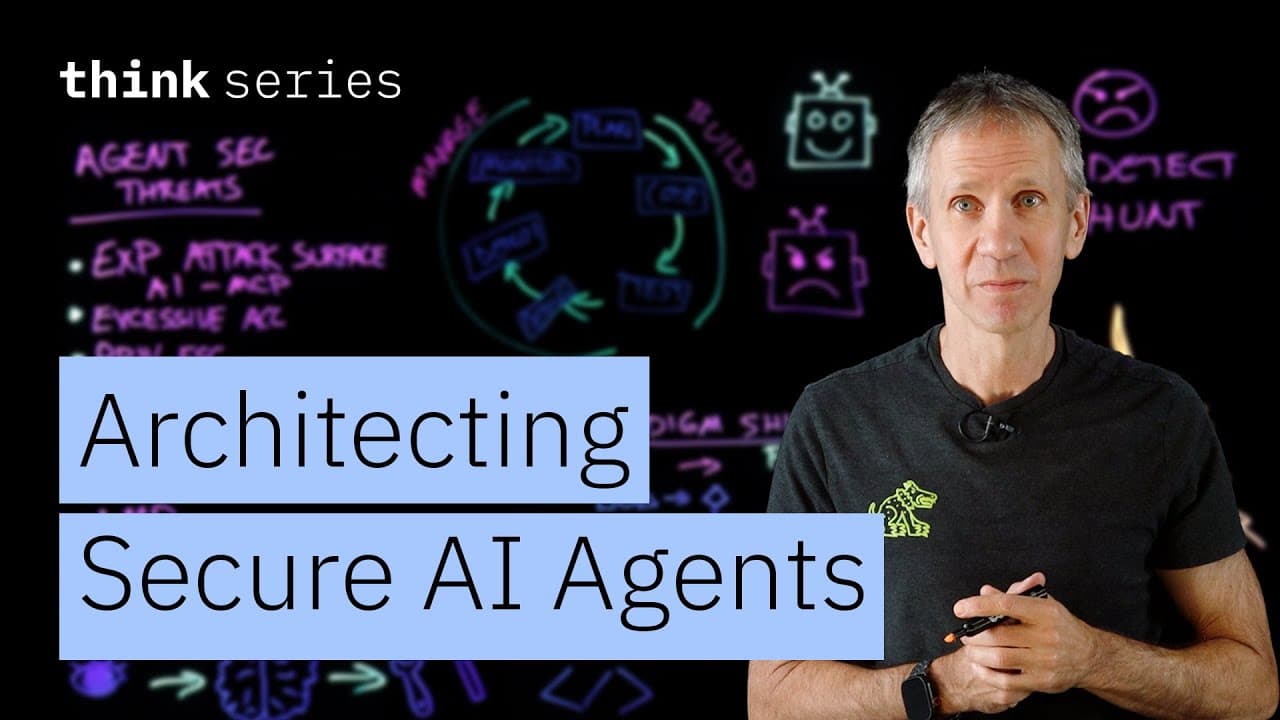
Secure AI agents by defining acceptable agency, enforcing least privilege, assigning unique identities, sandboxing execution, and routing model and MCP traffic through policy controls. Apply security throughout an evaluation-first DevSecOps lifecycle, continuously observe reasoning and actions, audit access, detect threats in real time, and retain human oversight for autonomous decisions.
Transcript
AI agents are all the rage. These systems are able to perceive context, reason over goals and constraints, and take actions through tools and services. Some have called them models, using tools in a loop. Making agents even more powerful is their ability to do all of this autonomously, without human intervention. Just tell the agent what you want d... Read More
Key Insights
- AI agents are probabilistic systems that may produce different decisions from identical inputs. Their dynamic and adaptive behavior makes outcome evaluation, continuous observation, and explicit operational boundaries more important than relying only on deterministic implementation logic.
- An agent development lifecycle is a continuous sequence of planning, coding, testing, debugging, deployment, monitoring, and renewed planning. This structure connects building the system with managing its behavior after deployment and provides recurring opportunities to evaluate security and reliability.
- DevSecOps is an approach that integrates development, operations, and security throughout the agent lifecycle. Security begins during planning, continues through implementation and testing, and remains active during deployment and monitoring rather than being added after the architecture is complete.
- AI agents expand the attack surface through the AI component, MCP connections, tools, and external services. Important threats include excessive agency, privilege escalation, data leakage, prompt injection, compromised automation acting as an attack amplifier, and behavior that drifts outside compliance requirements.
- Acceptable agency is the explicitly defined set of actions an agent may perform. Architects must identify permitted tools, understand downstream risks, constrain unwanted behavior, sandbox execution, and align every allowed capability with business goals and risk-mitigation requirements.
- The principle of least privilege limits an agent to the access required for its current task and removes access when it is no longer needed. Role-based and risk-based controls, combined with just-in-time or time-limited permissions, reduce unnecessary exposure.
- Nonhuman identities are unique identities assigned to individual agents. Each agent needs separate credentials instead of shared access so actions can be traced to the responsible agent, permissions can be managed independently, and misbehavior can be investigated through audits.
- AI gateways are policy enforcement points placed between users, agents, models, MCP connections, tools, or services. They can inspect traffic for prompt injection attempts, apply organizational policies, and identify possible data loss as information moves through agent workflows.
Install to Summarize YouTube Videos and Get Transcripts
Explore YouTube Video Summarizer or Get YouTube Transcript Extractor
Questions & Answers
Q: How do you architect a secure enterprise AI agent?
Architect a secure enterprise AI agent by first defining acceptable agency and explicit boundaries. Give each agent a unique identity, apply role-based access control and least privilege, grant access only when needed, and sandbox execution. Route model and MCP interactions through policy controls, continuously observe reasoning and actions, audit activity, detect threats, and preserve human oversight.
Q: Why do AI agents require a different security approach?
AI agents require a different approach because they move systems from deterministic logic toward probabilistic and dynamic decisions. They can adapt through interaction and human feedback, use tools and services, and operate without continuous human intervention. These properties make behavior less predictable and require evaluation-first development, explicit constraints, continuous monitoring, governance, auditing, and checks on autonomous actions.
Q: What security threats can AI agents introduce?
AI agents can expand the attack surface through the AI system itself, MCP connections, integrated tools, and external services. Threats described include excessive access, excessive agency, unauthorized privilege escalation, data leakage, prompt injection, and compliance drift. A compromised autonomous agent can also amplify an attack by using its capabilities rapidly without immediate human control.
Q: How does DevSecOps improve AI agent security?
DevSecOps places security throughout planning, coding, testing, debugging, deployment, monitoring, and subsequent planning. It integrates development with operations while treating security as a continuing responsibility at the beginning, middle, and end of the lifecycle. This approach supports ongoing evaluation of whether an agent remains safe, reliable, secure, compliant, and aligned with organizational goals.
Q: How should access control work for AI agents?
Access control should treat agents as nonhuman identities with unique credentials and assigned roles. Each agent should receive only the permissions required for its task, based on role and risk. Just-in-time or time-limited access can provide a capability briefly and remove it afterward. All identity assignments, permissions, and access activity should be auditable.
Q: What is acceptable agency in secure AI architecture?
Acceptable agency defines what an agent is permitted to do and what it must not do. Establishing it requires mapping allowed actions and tools to business objectives, examining the downstream risks created by integrations, constraining unnecessary capabilities, and creating enforceable boundaries. Sandboxing and least privilege then help keep actual behavior within those defined limits.
Q: How can an AI firewall protect models and MCP traffic?
An AI firewall, proxy, or gateway can sit between a user and an AI system, or between an agent and MCP-connected tools or services. It examines traffic against policy before allowing interactions to continue. The control can look for prompt injection attempts and inspect outgoing or returning data for possible data loss during MCP calls.
Q: Why do secure AI agents need monitoring and human oversight?
Secure AI agents need monitoring because they act autonomously and can make probabilistic decisions that require checks and balances. Continuous observation provides visibility into reasoning, decisions, tool use, and compliance-related actions. Auditable traces help identify which agent acted and whether controls worked correctly, while human involvement supplies oversight when autonomous behavior requires review or intervention.
Summary & Key Takeaways
-
AI agents create a security paradigm shift because they make probabilistic, dynamic decisions, adapt through interactions and feedback, and act autonomously through tools and services. Development therefore moves toward evaluation-first practices that measure outcomes against stated goals, organizational expectations, safety requirements, reliability targets, and acceptable operational boundaries.
-
A structured agent lifecycle includes planning, coding, testing, debugging, deploying, monitoring, and returning to planning. DevSecOps places security throughout this cycle instead of treating it as a final addition. Continuous monitoring and evaluation help teams determine whether agent behavior remains secure, reliable, compliant, and aligned with business objectives.
-
Secure architecture combines constrained agency, role-based access control, sandboxing, unique agent identities, just-in-time permissions, traffic inspection, auditing, and human oversight. AI firewalls, proxies, or gateways can examine model and MCP interactions for policy violations, prompt injection attempts, and possible data loss before requests or responses continue through the system.
Read in Other Languages (beta)
Share This Summary 📚
Summarize YouTube Videos and Get Video Transcripts with 1-Click
Try YouTube Summary with ChatGPT & Claude or YouTube Transcript Generator
Explore More Summaries from IBM Technology 📚
Summarize YouTube Videos and Get Video Transcripts with 1-Click
Try YouTube Summary with ChatGPT & Claude or YouTube Transcript Generator