How to Manage Multiple Businesses Without Burnout
TL;DR
Run multiple businesses sustainably by giving them one unifying theme, capable leaders, repeatable structures, and a clearly defined founder role. Use the five A's, alignment, awareness, accountability, activity, and assets, to coordinate teams, surface risks early, measure responsibilities, maintain weekly execution, and build resources that keep producing value without constant effort.
Transcript
I run multiple businesses in multiple time zones with hundreds of people on the team and thousands of clients all around the world. Now, if that sounds like hell to you, maybe you're not running your business as effectively as you could, cuz I absolutely love it. And I want to share with you exactly how I've structured things so it's not that diffi... Read More
Key Insights
- A unifying theme gives multiple businesses a shared strategic direction. The stated theme is developing entrepreneurs who stand out, scale up, and make a positive impact through business, allowing distinct companies to operate under one coherent purpose.
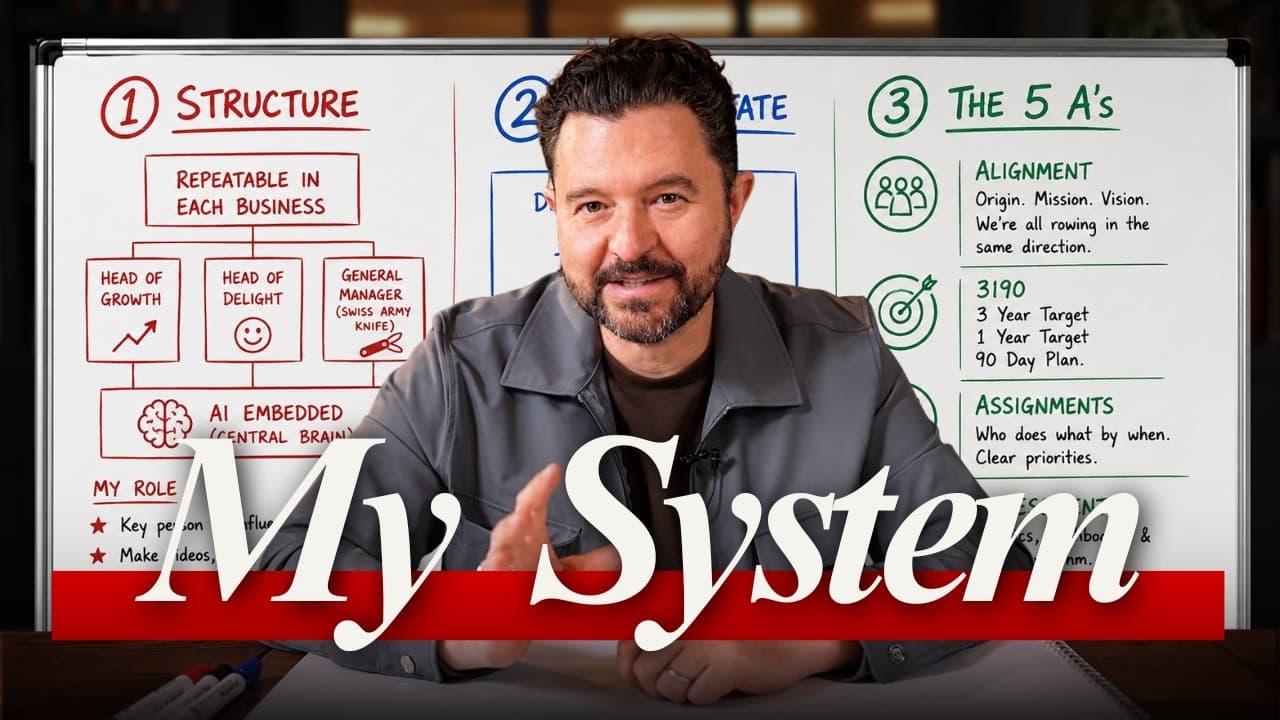
- Dedicated leaders make a portfolio of businesses manageable. Each business includes people responsible for its growth and operation, with recurring roles such as head of growth, head of delight, and a general manager who serves as a versatile problem solver.
- The founder's role is to provide influence rather than manage every daily task. Core contributions include making videos, writing books, speaking on stages, creating introductions, clarifying direction, and occasionally supporting coaching or alignment around products and services.
- A future-state organization chart defines the desired company before hiring or restructuring begins. The team pictures the organization it wants to become and reverse engineers the necessary roles, responsibilities, and capabilities instead of simply extending its current structure.
- Alignment connects the team's origin, mission, and vision with practical time horizons. Three-year, one-year, and 90-day targets clarify where the company is going and what each person must do now to advance toward that future state.
- Awareness prevents emerging concerns from becoming larger problems. Team members are encouraged to record and discuss capability gaps, likely obstacles, and possible failures as soon as they notice them, rather than allowing unresolved concerns to fester.
- Accountability works through visible responsibilities and measurable outcomes. Every team member knows their own numbers and can see everyone else's responsibilities on the organization chart, making ownership transparent across functions such as marketing, growth, and client acquisition.
- Assets create lasting value beyond the work required to produce them. Videos, books, brand guidelines, clean databases, culture documents, and awards can continue performing useful work, helping the business build momentum and become less dependent on continuous team activity.
Install to Summarize YouTube Videos and Get Transcripts
Explore YouTube Video Summarizer or Get YouTube Transcript Extractor
Questions & Answers
Q: How can a founder run multiple businesses without burning out?
A founder can reduce overload by organizing the businesses around one unifying theme, assigning capable leaders within every company, and repeating the same core operating structure. The founder should focus on high-leverage contributions such as content, books, speaking, introductions, vision, coaching, and alignment instead of becoming responsible for every operational detail across every business.
Q: What leadership roles should each business have?
Each business should have leaders who are directly responsible for growing and operating it. The repeated structure described includes a head of growth, a head of delight, and a general manager who acts as a versatile problem solver. The businesses also embed AI into their operations, while the founder serves as the key person of influence across the overall group.
Q: What is a future-state organization chart?
A future-state organization chart is a model of what the organization should look like at a desired point in the future. Instead of asking how the current company can grow forward, the leadership team defines the ideal structure first and works backward. This reverse-engineering process reveals the roles, responsibilities, and capabilities needed to create that future organization.
Q: What are the five A's for running a company?
The five A's are alignment, awareness, accountability, activity, and assets. Alignment creates shared direction, awareness surfaces risks and capability gaps, accountability assigns measurable responsibilities, activity establishes consistent weekly execution, and assets produce value with some permanence. Together, they form a repeatable framework that can be applied across multiple businesses and teams.
Q: How does the 3190 planning framework work?
The 3190 framework connects three planning horizons: the target for three years, the desired position one year from now, and the actions required during the next 90 days. When everyone understands these horizons, immediate work supports longer-term objectives. The framework is revisited during quarterly off-site meetings alongside the company's origin, mission, vision, issues, and new awarenesses.
Q: Why should teams raise awarenesses before problems occur?
Raising awarenesses helps a team address concerns while they are still emerging. Once goals are clear, people begin noticing possible failures, necessary fixes, and gaps in capability. Recording and discussing those observations prevents them from festering into larger issues. The approach encourages the company to respond proactively instead of waiting for something to break before taking action.
Q: How should a team manage and review weekly activity?
The team should identify three to six important activities for each person at a Monday meeting or through a shared Slack channel. Those commitments are documented and reviewed on Friday to determine how many were completed. Team members can also creatively disagree, described as locking antlers, to test whether the proposed activities are the most effective choices.
Q: Why are business assets more valuable than activity alone?
Business assets have permanence and can continue doing useful work regardless of the team's current activity. Examples include videos, books, brand guidelines, clean databases, culture and onboarding documents, and awards. Creating new assets every quarter makes the company more stable, supports a flywheel of momentum, and helps the business develop a life of its own.
Summary & Key Takeaways
-
Multiple businesses can operate effectively under one overarching structure when they share a unifying theme and have dedicated leaders. Each business repeats core roles, including a head of growth, a head of delight, and a general manager, while the founder concentrates on influence, vision, introductions, content, coaching, and strategic alignment.
-
Planning begins with a future-state organization chart rather than the present structure. Leaders define the organization they want to create, then work backward to determine the required roles and capabilities. The origin, mission, and vision establish direction, while three-year, one-year, and 90-day targets translate that direction into coordinated action.
-
The five A's provide a repeatable operating model: alignment establishes shared direction, awareness surfaces potential obstacles, accountability assigns transparent measures, activity organizes weekly priorities, and assets create lasting value. Quarterly off-sites, Monday commitments, Friday reviews, constructive disagreement, and ongoing asset creation help businesses become increasingly stable and less dependent on constant activity.
Read in Other Languages (beta)
Share This Summary 📚
Summarize YouTube Videos and Get Video Transcripts with 1-Click
Try YouTube Summary with ChatGPT & Claude or YouTube Transcript Generator
Explore More Summaries from Daniel Priestley || Key Person Of Influence 📚





Summarize YouTube Videos and Get Video Transcripts with 1-Click
Try YouTube Summary with ChatGPT & Claude or YouTube Transcript Generator