How to Build and Sell a Business in 1,000 Days
TL;DR
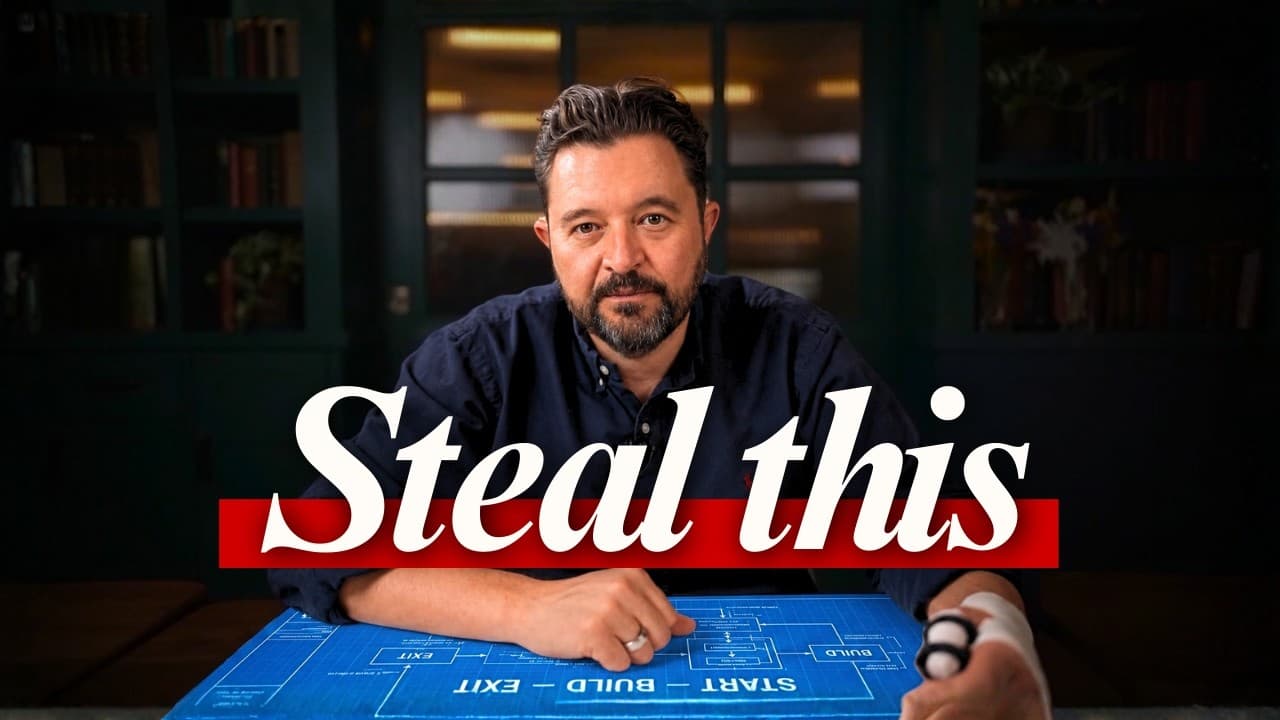
Build toward an exit by moving through six stages: founder opportunity fit, fast cheap experiments, product-market fit, go-to-market execution, scaling, and exit preparation. AI can accelerate research, prototyping, pricing, messaging, analysis, forecasting, expansion planning, acquirer discovery, and data-room preparation, making a 1,000-day journey more achievable than traditional business-building timelines.
Transcript
Today, I want to share with you how to start build and exit a business in under 1,000 days. This never used to be possible. It used to take decades, and now it takes 1 to 3 years. Let's go and have a look. Building and selling a company used to take decades, and now it's faster than ever. People are building and selling a company in a matter of yea... Read More
Key Insights
- Founder opportunity fit is the first stage because the chosen business should align with the founder’s background, interests, and experience. With many businesses open to AI-driven improvement, focus matters more than discovering an opportunity that nobody else has previously identified.
- Fast cheap experiments are practical tests of customer interest before significant investment. A waiting list, prototype, slide deck, brochure, assessment, or preregistration form can reveal whether prospective customers value the idea and whether the founder should continue developing it.
- Innovation is often created by studying something that already works and adding a distinct improvement or perspective. The recommended approach is to identify proven products or services, understand why customers value them, and test a version that is better, faster, cheaper, or more emotionally appealing.
- AI is useful during early validation because it can research existing products, surface relevant examples, and demonstrate how a founder’s variation might look. Tools such as ScoreApp can also produce landing pages, waiting lists, and assessments in minutes instead of the weeks previously required.
- Product-market fit is the alignment of a product or service with the ideal customer, pricing, and messaging. AI can research comparable purchases, generate pricing variations, calculate customer return on investment, and create brochure, website, and video content for testing that alignment.
- Go-to-market execution is a repeatable operating rhythm built around activities that already work. The business continually runs advertising and sales meetings, measures results, uses AI to analyze performance and recommend improvements, then acts on the strongest recommendations to generate more consistent revenue.
- Scaling is expansion across products, customer groups, and territories. A company might add an offer for existing customers, transfer a successful approach from France to Germany, or apply a solution used by dentists to chiropractors, while using AI to reduce research and forecasting costs.
- Exit preparation is the deliberate search for a financial or strategic buyer, supported by a small group within the leadership team. AI can identify previously unknown strategic acquirers and help prepare the documents required for the company’s data room.
Install to Summarize YouTube Videos and Get Transcripts
Explore YouTube Video Summarizer or Get YouTube Transcript Extractor
Questions & Answers
Q: How can you build and sell a business in 1,000 days?
Follow six connected stages: establish founder opportunity fit, run fast cheap experiments, achieve product-market fit, execute a repeatable go-to-market strategy, scale into additional products or markets, and prepare for an exit. AI can shorten work across every stage by supporting research, prototypes, pricing, content, forecasting, performance analysis, expansion planning, buyer discovery, and data-room preparation.
Q: What is founder opportunity fit in entrepreneurship?
Founder opportunity fit means selecting a business opportunity that matches the founder’s background, interests, and capabilities. The goal is not to uncover an idea that nobody has seen before. It is to identify an opportunity that is particularly suitable for that founder. AI can support this process by interviewing the founder and helping reveal patterns in their experience and backstory.
Q: How do fast cheap experiments validate a business idea?
Fast cheap experiments test customer interest before the founder commits substantial resources. Examples include launching a waiting list, showing customers a prototype, presenting a slide deck or brochure, creating an online assessment, and asking people to preregister. These actions put an early version of the idea in front of customers and reveal whether there is enough interest to continue developing it.
Q: How can AI help a startup find product-market fit?
AI can help align the offer with the ideal customer, price, and message. It can research what prospective customers pay for comparable products, generate multiple pricing structures, calculate how a buyer might justify the purchase through return on investment, and produce brochure, website, and video content. These outputs give the company more options to test while refining its market position.
Q: What does a repeatable go-to-market strategy involve?
A repeatable go-to-market strategy involves consistently performing the activities that generate sales, such as running advertisements and conducting sales meetings. The company creates a dependable weekly rhythm, measures the results, and improves the process through repeated testing. AI can define and forecast the strategy, analyze performance data, identify useful customer segments, and recommend pricing or execution changes.
Q: How can customer assessment data improve a go-to-market plan?
Customer assessment data can reveal which segments deserve attention and which should be ignored. In the example provided, 150 assessment responses were analyzed with Claude, which recommended three target segments, a pricing adjustment, and a go-to-market strategy for those customers. The analysis became a monthly process of testing, reviewing suggestions, implementing the strongest ideas, and increasing market activity.
Q: How does a company scale after finding product-market fit?
A company scales by extending its products, entering new territories, or serving additional ideal customer profiles. It might sell a related product to existing customers, bring an approach that works in France into Germany, or adapt a solution from dentists to chiropractors. AI can support the required research, prototyping, innovation, and financial forecasting while reducing the number of employees needed for expansion.
Q: How should a company prepare for a strategic exit?
A company should assign a small number of leadership-team members to focus specifically on the exit. They can evaluate a financial sale based on business performance or seek a strategic buyer that sees a strong fit with its own operations. AI can research potential acquirers the team has not considered and assist with producing the documents required for the sale’s data room.
Summary & Key Takeaways
-
The process begins with founder opportunity fit, choosing a business aligned with the founder’s background and interests. The founder then runs fast cheap experiments, such as prototypes, waiting lists, brochures, slide decks, and preregistration forms, to test customer demand before investing heavily in a complete product or service.
-
After testing demand, the business must establish product-market fit by aligning its offer, ideal customer, messaging, and price. It then executes a repeatable go-to-market strategy through advertising, sales meetings, measurement, and iteration. AI can support research, content production, pricing analysis, forecasting, segmentation, and recommendations for improvement.
-
Scaling involves extending products, entering new territories, and serving additional customer groups while operating with a smaller, flatter team. Exit preparation then focuses on identifying either financial or strategic acquirers and assembling the required data room. AI can accelerate market research, financial work, document preparation, and potential-acquirer discovery.
Read in Other Languages (beta)
Share This Summary 📚
Summarize YouTube Videos and Get Video Transcripts with 1-Click
Try YouTube Summary with ChatGPT & Claude or YouTube Transcript Generator
Explore More Summaries from Daniel Priestley || Key Person Of Influence 📚



Summarize YouTube Videos and Get Video Transcripts with 1-Click
Try YouTube Summary with ChatGPT & Claude or YouTube Transcript Generator