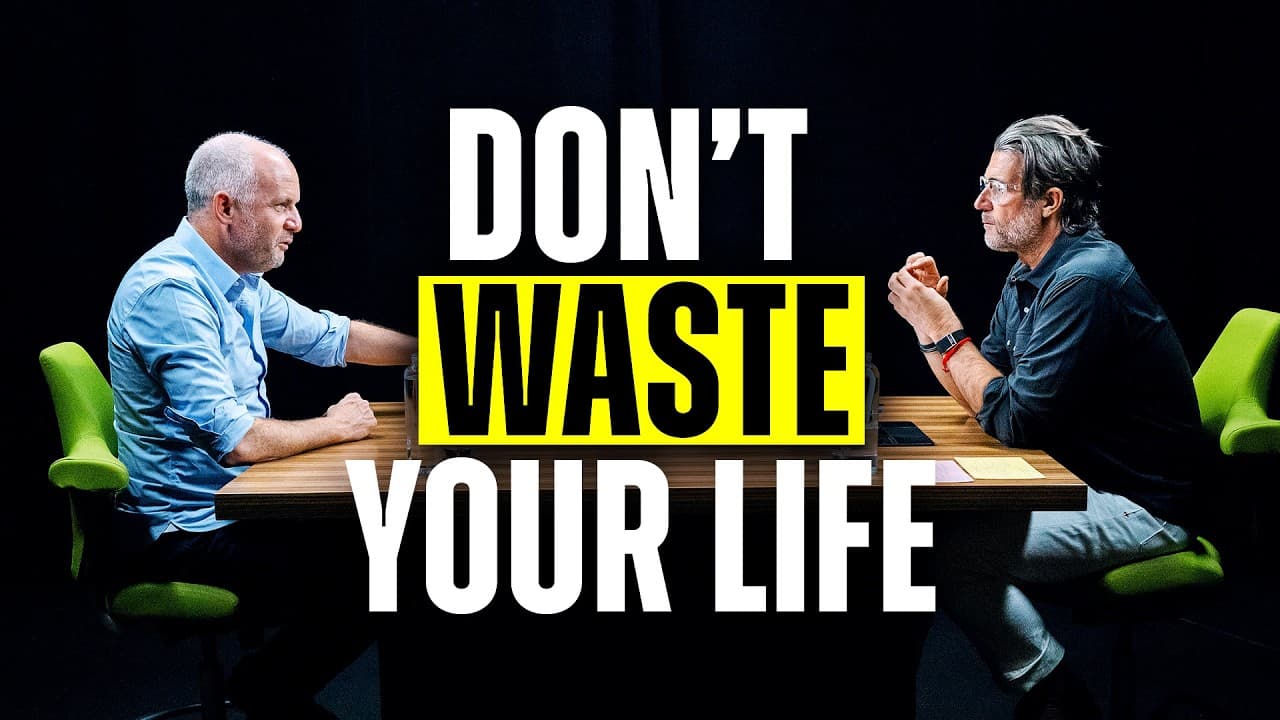
Why Is Being Productive Making You Miserable? #1 Time Expert Oliver Burkeman Explains
TL;DR
Productivity makes you anxious and unhappy when you treat doing more as inherently good and expect efficiency to give you control over time. Oliver Burkeman explains that possible tasks are effectively infinite, personal control is partial, and searching for yet another silver bullet sustains chronic stress. Read on to learn why accepting limits can support a more meaningful life.
Transcript
We are deeply conditioned by this ethos that doing lots of things is kind of an inherent good. Business without satisfaction is a malady of epidemic proportions. We do a lot of things often masquerading as productivity techniques mainly to make ourselves feel like little gods over our time. Time is going to win the battle in the end. So there is a ... Read More
Key Insights
- Time is not a resource that can be fully possessed, stored, or controlled. People experience only the present moment, exercise partial influence over what happens, and eventually confront limits that no planning system or personal discipline can remove.
- Overwhelm is created by a mismatch between effectively infinite possible demands and limited human output. Trying to complete everything cannot produce lasting relief because new tasks continue arriving faster than any person can permanently clear them.
- Productivity systems can increase busyness by helping people process an endless stream of inputs more efficiently. Faster completion encourages faster responses from others, creates expectations of continued availability, and expands the volume of work directed toward the efficient person.
- Inbox zero can generate shame and guilt when an impossible standard is mistaken for evidence of competence. Answering messages more quickly may produce additional replies and strengthen a reputation for responsiveness, leaving the person with more email rather than greater control.
- Productivity is not an inherent moral good because the value of activity depends on what someone is doing. Completing more tasks does not automatically improve the world, establish personal worth, or demonstrate that a life is meaningful.
- Self-worth becomes unstable when approval depends on accomplishing enough. Since incoming demands have no clear limit while individual capacity remains constrained, the person continually experiences a deficit and rarely feels permitted to rest or regard themselves as adequate.
- The search for complete control encourages chronic stress because each failed system suggests that another technique, habit, or period of discipline will finally make life manageable. This keeps satisfaction located in an imagined future while present life continues passing.
- A meaningful life is defined more by choosing worthwhile actions and showing up with presence than by maximizing the number of completed tasks. Accepting human limitation does not oppose accomplishment, but changes accomplishment from a debt owed into a deliberate commitment.
- "We are deeply conditioned by this ethos that doing lots of things is kind of an inherent good." (0:00)
- "Business without satisfaction is a malady of epidemic proportions." (0:06)
- "Maybe the problem here is not going to be solved by the 101st." (0:31)
- "Maybe the problem is looking for a silver bullet." (0:31)
- "A lot of it can be understood as ways of trying to feel less limited." (4:42)
Install to Summarize YouTube Videos and Get Transcripts
Explore YouTube Video Summarizer or Get YouTube Transcript Extractor
Questions & Answers
Q: Why does productivity make you anxious and unhappy?
Productivity becomes harmful when doing many things is treated as inherently good and as a route to controlling time. Because possible demands are effectively infinite and personal control is limited, the pursuit creates anxiety, exhaustion, irritability, impatience, and discontentment.
Q: Why can working faster make overwhelm worse?
Working faster cannot eliminate overwhelm because the space of things that seem to need doing is effectively infinite. Greater efficiency may process more tasks, but it does not create the lasting state of completion people are chasing.
Q: What is broken about our relationship with time?
The problem begins with viewing time as a resource that people possess and must use as efficiently as possible. Burkeman says people only ever have the present moment, cannot put time aside for later, and have only partial control over how it unfolds.
Q: How does the desire for control create chronic stress?
People often believe they can exert more control over their lives, external events, and emotions than they actually can. Repeated failures to gain that control cause disappointment and can intensify the urge to control rather than encourage acceptance of uncertainty.
Q: Why do productivity systems fail to provide lasting satisfaction?
Productivity systems promise that doing more will finally make life manageable, but they cannot remove uncertainty or human limits. After trying a hundred supposed silver bullets, the transcript suggests that looking for the 101st may itself be the problem.
Q: How are procrastination and distraction connected to time anxiety?
Burkeman describes procrastination and distraction as action problems that can arise from attempts to feel less limited. They reflect the wish to feel like a little god over time despite having only partial control.
Q: Why is doing many things not inherently good?
The transcript challenges the conditioning that treats doing lots of things as an inherent good. Busyness without satisfaction can leave someone accomplishing a great deal while still struggling to enjoy life.
Q: What alternative does Oliver Burkeman offer to chasing productivity?
He points toward honestly accepting limited control and the natural uncertainty of the world. Rather than seeking another silver bullet, the approach is to inhabit the present moment and live into the problem's irresolvability.
Summary & Key Takeaways
-
Modern anxiety about time begins with the belief that time is a resource people possess and should control. In reality, only the present moment is directly available, future events remain uncertain, and personal influence is partial. Attempts to deny these limits often appear as procrastination, distraction, overwork, or obsessive time management.
-
Overwhelm cannot be solved simply by completing tasks faster because the supply of possible work continually expands. Technologies and productivity systems promise greater control, but efficiency can generate additional demands. Rapid email responses, for example, invite quicker replies, establish expectations of responsiveness, and attract even more messages from other people.
-
Productivity becomes harmful when it is treated as a moral imperative or a condition of self-worth. The number of completed tasks cannot define a meaningful life because the value of an action depends on what was done and how it was approached. Presence, discernment, and acceptance of limitation offer a healthier standard.
Read in Other Languages (beta)
Share This Summary 📚
Summarize YouTube Videos and Get Video Transcripts with 1-Click
Try YouTube Summary with ChatGPT & Claude or YouTube Transcript Generator
Explore More Summaries from Rich Roll 📚





Summarize YouTube Videos and Get Video Transcripts with 1-Click
Try YouTube Summary with ChatGPT & Claude or YouTube Transcript Generator