What Are the Health Benefits of Different Light Wavelengths?
TL;DR
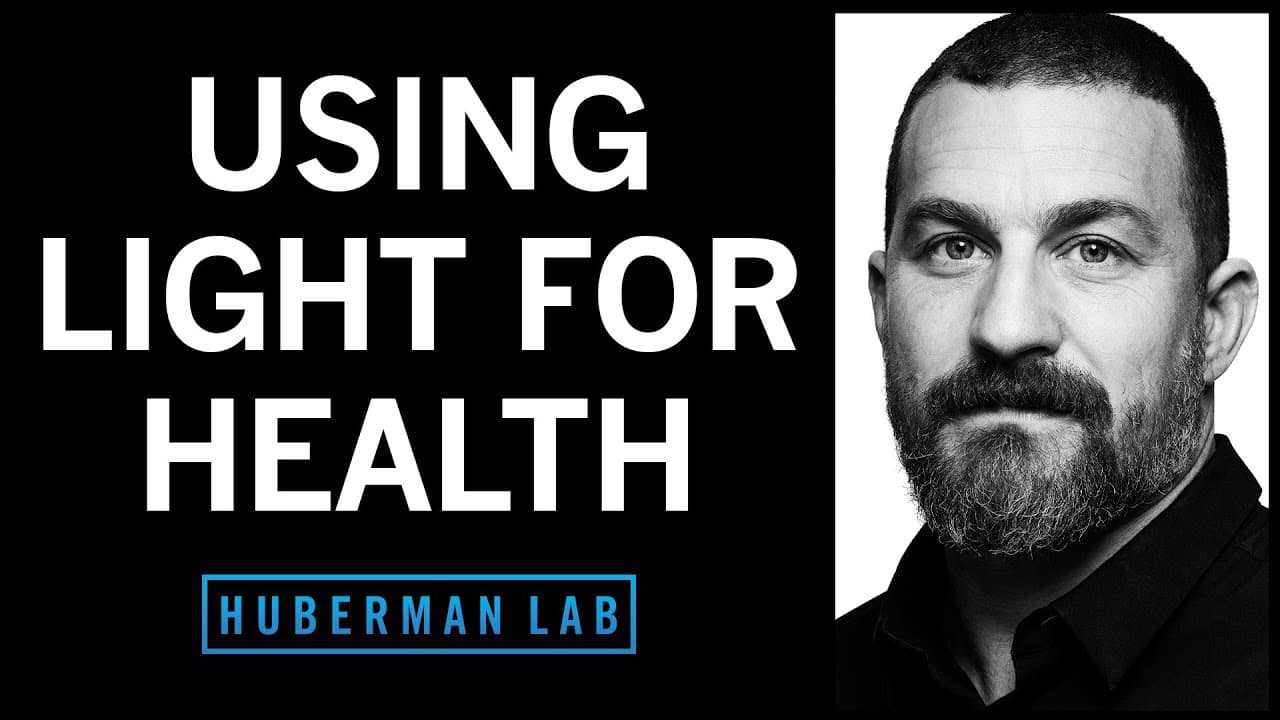
Light exposure can enhance health by influencing hormone signals, gene expression, and biological pathways. Specific wavelengths, like red and near-infrared light, penetrate deeper into tissues and support functions such as skin health, sleep regulation, and mood improvement. Using red light therapy for just one to three minutes a few times a week can significantly aid vision and overall well-being.
Transcript
- Welcome to the Huberman Lab Podcast, where we discuss science and science-based tools for everyday life. [upbeat music] I'm Andrew Huberman, and I'm a professor of neurobiology and ophthalmology at Stanford School of Medicine. Today, we are going to discuss light and the many powerful uses of light to optimize our health. We're going to discuss t... Read More
Key Insights
- 🙂 Light can be translated into electrical and hormone signals in our brain and body, influencing various biological functions.
- 🙂 Different wavelengths of light penetrate tissues to different depths, with longer wavelengths (e.g., red and near-infrared) having deeper penetration.
- 🙂 Light exposure can have both rapid and slow effects on our biology, including changes in hormone levels, sleep-wake cycles, and even mating behavior.
- 🙂 Melatonin, regulated by light exposure, plays a significant role in regulating sleep, mood, bone mass, and gonadal function.
Install to Summarize YouTube Videos and Get Transcripts
Explore YouTube Video Summarizer or Get YouTube Transcript Extractor
Questions & Answers
Q: How does light affect the brain and body?
Light can be translated into electrical signals, hormone signals, and cascades of biological pathways in the brain and body. It can also change which genes the body’s cells express throughout the lifespan.
Q: What health applications of light are covered in Huberman Lab Podcast #68?
Andrew Huberman discusses light for skin health, appearance, longevity, wound healing, and hormone balance. He also covers its use in regulating sleep, alertness, and mood, as well as offsetting dementia and age-related vision loss.
Q: Can red light help offset age-related vision loss?
Research from Dr. Glen Jeffery’s lab found that brief red-light exposure early in the day can offset much of the vision loss occurring in people age 40 or older. The therapy described lasts one to three minutes and is performed a few times per week.
Q: Why must the red-light vision protocol be used early in the day?
The transcript states that red-light exposure has to occur early in the day for this application. It helps cells at the back of the eye replenish the mechanisms they use to produce ATP, the energy those highly active cells require.
Q: How does red light support cells in the eye?
Cells at the back of the eye convert light information into electrical signals that the brain uses to create visual images. As these cells become less efficient at producing ATP with age, early-day red-light exposure helps replenish their energy-producing mechanisms.
Q: Is phototherapy supported by scientific research?
The episode traces scientific phototherapy back to 1903, when Niels Finsen received the Nobel Prize for using it to treat lupus. It also distinguishes therapies grounded in rigorous research from commercial light products whose promised outcomes may lack a scientific basis.
Q: Who conducted the red-light research highlighted in the episode?
The highlighted work comes from Dr. Glen Jeffery and the Jeffery Lab at University College London. The lab is described as conducting pioneering, rigorous research in visual neuroscience and studying red light for age-related vision loss.
Q: How should people evaluate light-based health protocols?
The episode emphasizes linking a specific protocol to the biological mechanism explaining how it works. Huberman says this combination allows phototherapies to be applied in a rational, safe, and powerful way, while avoiding unsupported claims about flashing or colored-light products.
Summary & Key Takeaways
-
Light can be translated into electrical signals and hormone signals in our brain and body, affecting various aspects of our biology.
-
Different wavelengths of light can penetrate tissues to different depths, with longer wavelengths (such as red and near-infrared) being able to penetrate deeper.
-
Light can impact our biology in both rapid and slow ways, with rapid effects including increased alertness and slow effects including changes in hormone levels and circadian rhythms.
Read in Other Languages (beta)
Share This Summary 📚
Summarize YouTube Videos and Get Video Transcripts with 1-Click
Try YouTube Summary with ChatGPT & Claude or YouTube Transcript Generator
Explore More Summaries from Andrew Huberman 📚

Summarize YouTube Videos and Get Video Transcripts with 1-Click
Try YouTube Summary with ChatGPT & Claude or YouTube Transcript Generator