How Can Dialysis Machine Readings Indicate Access Stenosis?
TL;DR
Dialysis machine readings provide crucial insights into access stenosis. A negative arterial pressure may indicate arterial inflow stenosis, while increased venous pressure can suggest issues like clotted dialyzers or venous outflow stenosis. Monitoring recirculation and dialysis adequacy drop can further help identify access problems.
Transcript
so let's move on to part two of access to gnosis we learned how to evaluate stenosis on physical examination in the last video so besides a good physical exam are there any other clinical clues that might indicate access to gnosis the dialysis machine can provide some of these clues to understand this more let's briefly remind ourselves of the dial... Read More
Key Insights
- 💁 The dialysis machine screen provides valuable information about arterial and venous pressure readings, which can indicate access issues like arterial inflow stenosis or venous outflow stenosis.
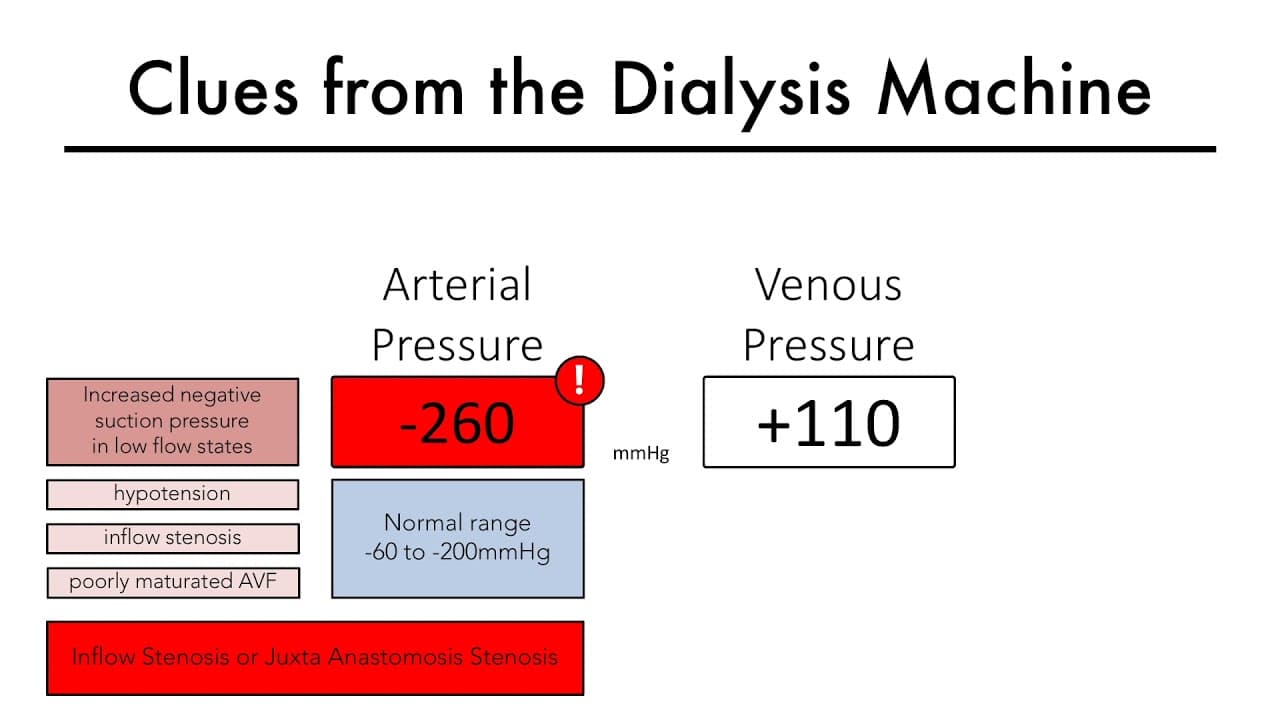
- 💦 A negative arterial pressure may suggest access problems requiring the pump to work harder, triggering an alarm.
- 😮 A rise in venous pressure can indicate issues such as a clotted dialyzer, vein spasm, or venous outflow stenosis.
Install to Summarize YouTube Videos and Get Transcripts
Explore YouTube Video Summarizer or Get YouTube Transcript Extractor
Questions & Answers
Q: How can the dialysis machine screen provide clinical clues for evaluating access to gnosis?
The arterial and venous pressure readings on the dialysis machine screen can indicate issues such as arterial inflow stenosis or venous outflow stenosis. Abnormal pressure readings can suggest access problems.
Q: What does a negative arterial pressure reading indicate?
A negative arterial pressure reading may suggest arterial inflow stenosis. In low flow states or poorly matured AV fistulas, the pump needs to work harder, creating higher negative pressure. This can trigger the arterial pressure alarm.
Q: How does a rise in venous pressure suggest access to gnosis?
A rise in venous pressure can indicate issues like a clotted dialyzer, vein spasm, or venous outflow stenosis. Any resistance to blood flow in the post pump circuit can cause the venous pressures to become more positive.
Q: Besides pressure readings, what other clinical clues can be observed on the dialysis machine screen?
Presence of recirculation and a drop in dialysis adequacy, as measured by monthly KT or V, can also be clinical clues of access to gnosis. These issues may not occur until advanced stenosis.
Summary & Key Takeaways
-
The dialysis machine screen displays important information about the arterial and venous pressure readings, which can indicate access issues such as arterial inflow stenosis or venous outflow stenosis.
-
A negative arterial pressure may suggest arterial inflow stenosis, while a rise in venous pressure may indicate a clotted dialyzer, vein spasm, or venous outflow stenosis.
-
Recirculation and a drop in dialysis adequacy can also be clinical clues of access to gnosis.
Read in Other Languages (beta)
Share This Summary 📚
Summarize YouTube Videos and Get Video Transcripts with 1-Click
Try YouTube Summary with ChatGPT & Claude or YouTube Transcript Generator
Explore More Summaries from YaleCourses 📚






Summarize YouTube Videos and Get Video Transcripts with 1-Click
Try YouTube Summary with ChatGPT & Claude or YouTube Transcript Generator