GPT-5 Full Review: What Are the 10 Mind-Blowing Use Cases?
TL;DR
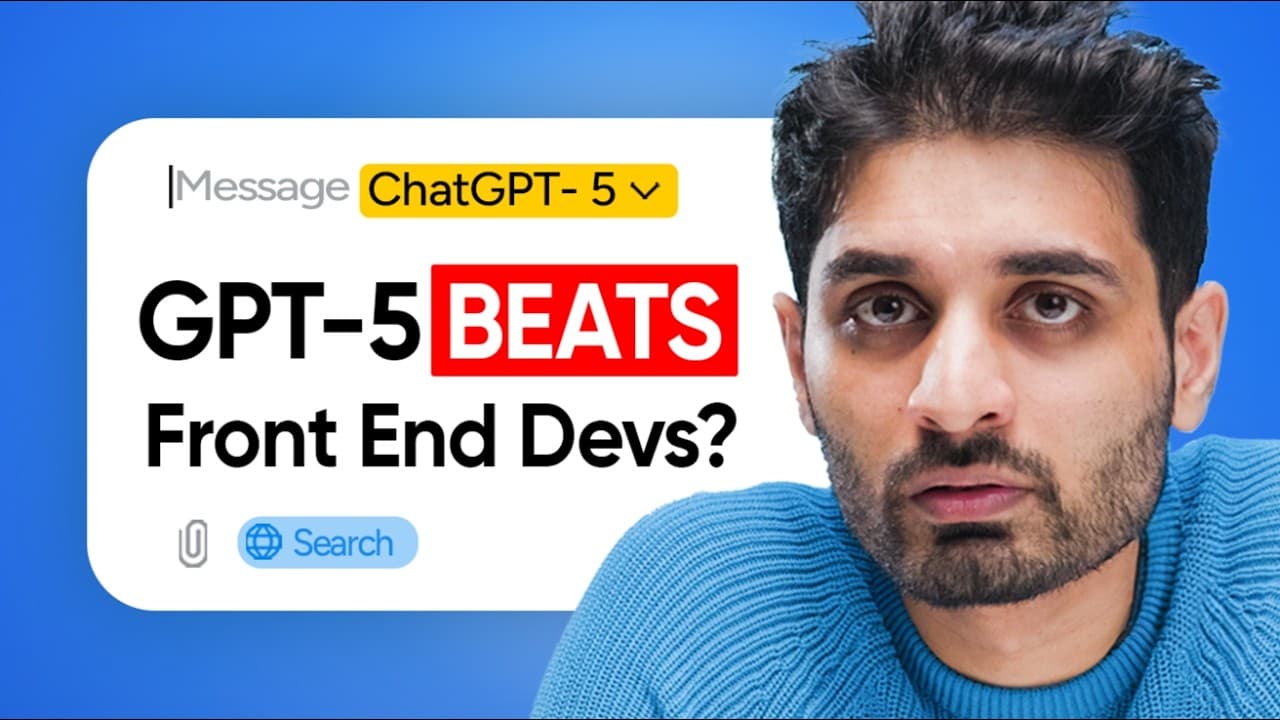
GPT-5 can one-shot functional front ends, app backends and simple browser-based 2D games from short prompts. The demonstrations include a Twitter clone with close to 900 lines of code, a Node and Express backend, and a drag-and-drop CRM with confetti and shake effects. Read on for specific answers about GPT-5 thinking, deployment, physics, sprites and automatic bug fixes.
Transcript
Ladies and gentlemen, OpenAI has launched GPD5. Now, we've had early access to GPD5 for a while now, and we've tried a lot of different prompts, and let me tell you something about the model before I show you what it can do. I think it's definitely one of the smartest models out there, and it can oneshot a lot of things. It's able to oneshot entire... Read More
Key Insights
- GPT-5 ships in two versions: standard GPT-5 and 'GPT-5 thinking', which reasons more before outputting tokens. The reviewer used the thinking variant for these coding demos because it deliberates longer prior to generating code.
- GPT-5 one-shot a functional Twitter clone with a modern black-and-white UI, working front-end buttons, and icon-based default profile pictures, producing close to 900 lines of code with tabs for explore, notifications, messages, DMs, bookmarks, and profile.
- The model can generate a separate backend on request, building it in Node and Express with full run instructions, local commands, and a complete endpoint list, though backend projects must be downloaded and run on your own server rather than previewed in canvas.
- GPT-5 built a drag-and-drop Kanban-style CRM for won and lost deals from a two-to-three line prompt, including CSS card effects, confetti when a deal is won, and a shake animation when a deal is lost.
- The model reasons about physics: it one-shot a Spider-Man web-swinging 2D side-scroller where you attach webs to buildings, build momentum, and swing over them, and it correctly modeled a Sudarshan chakra's frisbee-like motion along its own axis.
- GPT-5 self-heals bugs by identifying the error, explaining it, and fixing it on the fly, walking through the entire codebase. The reviewer compared this to the old Wolverine AI-coding repository that did automatic healing.
- The model handled image tasks inside the game workflow, letting the user upload a custom PNG sprite, then automatically removing its background and feathering the edges when asked.
- The reviewer argues developers spend as little as 9% of their time actually writing code, with much of the rest on meetings, code reviews, and bug fixing, suggesting future coding will happen inside GitHub and IDEs powered by these new models.
- "It's able to oneshot entire front ends." (0:12)
- "It can make games, like simple 2D games on the browser." (0:18)
- "It is now really, it's already close to about 900 lines of code and still going." (2:03)
- "So, it's actually now creating the back end for you in Node and Express and it'll also come with full instructions on how to deploy it." (3:27)
Install to Summarize YouTube Videos and Get Transcripts
Explore YouTube Video Summarizer or Get YouTube Transcript Extractor
Questions & Answers
Q: What can GPT-5 build from a single prompt?
GPT-5 can one-shot entire front ends, build apps and create simple 2D browser games. In the review, it generated a functional Twitter clone from one prompt and produced close to 900 lines of code.
Q: What is the difference between GPT-5 and GPT-5 thinking?
The review describes two versions, GPT-5 and GPT-5 thinking. GPT-5 thinking spends more time thinking before it outputs tokens, and it was used for the coding demonstrations.
Q: Can GPT-5 build a functional Twitter clone?
Yes. The generated black-and-white Twitter clone included functional front-end controls and sections for Explore, notifications, messages, DMs, bookmarks and profiles. The reviewer could post, reply and use follow controls from the browser preview.
Q: Can GPT-5 create a backend for an app?
Yes. After being prompted, GPT-5 created a backend in Node and Express, supplied local run commands and listed its endpoints. The project had to be downloaded with the Node packages and run on the user's own server because it could not be previewed in canvas.
Q: How quickly did GPT-5 build the Twitter app?
The reviewer estimated that the full Twitter app took about 2 or 3 minutes. That result included the front end and a separately requested backend, though the front end still needed to be wired to the backend.
Q: Can GPT-5 build a drag-and-drop CRM?
Yes. From a prompt of two or three lines, GPT-5 created a Kanban-style CRM for won and lost deals. Users could add a deal, assign an amount and drag it between stages.
Q: What visual effects did GPT-5 add to the CRM?
The CRM displayed confetti when a deal was moved to won. Moving a deal to lost produced a small sad shake animation, alongside other CSS and card effects requested in the prompt.
Q: Can GPT-5 reason about physics in 2D games?
The reviewer says GPT-5 can think about physics in 2D games. The demonstrated examples included a Spider-Man web-swinging game with momentum and a returning Sudarshan chakra modeled with frisbee-like motion.
Summary & Key Takeaways
-
OpenAI launched GPT-5, which the reviewer calls one of the smartest and fastest models available. After early access and extensive testing, they demonstrate it live building full front ends, apps, and simple 2D browser games from short prompts, letting viewers judge its capabilities for themselves.
-
Using GPT-5 thinking, the model one-shot a Twitter clone (~900 lines) with functional UI, then a separate Node and Express backend, and a drag-and-drop CRM with confetti and shake animations. It also built a physics-aware Spider-Man swinging game supporting custom sprite uploads with automatic background removal.
-
GPT-5 fixes its own bugs on the fly, explaining and healing errors like the old Wolverine tool. The reviewer notes devs spend as little as 9% of time writing code, arguing future work shifts to GitHub and IDEs, with tools like Superbase-connected apps becoming superpowered for end-to-end deployment.
Read in Other Languages (beta)
Share This Summary 📚
Summarize YouTube Videos and Get Video Transcripts with 1-Click
Try YouTube Summary with ChatGPT & Claude or YouTube Transcript Generator
Explore More Summaries from Varun Mayya 📚




Summarize YouTube Videos and Get Video Transcripts with 1-Click
Try YouTube Summary with ChatGPT & Claude or YouTube Transcript Generator