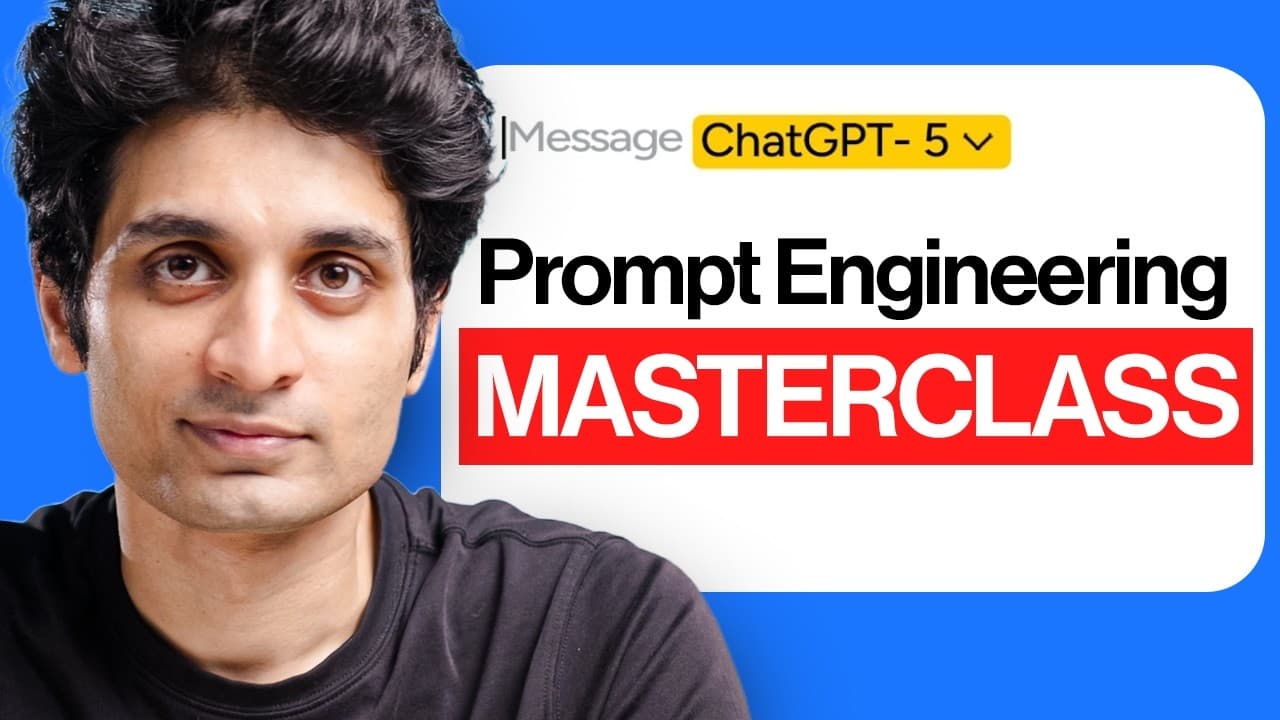
How to Master AI Prompting Techniques
TL;DR
Mastering AI prompting involves understanding how to provide detailed context and examples, akin to world-building, to achieve creative outputs. Effective prompt engineering can significantly enhance AI's utility, helping users identify knowledge gaps and optimize learning. Using AI PCs with Intel Core Ultra Processors allows running open-source models locally, bypassing subscription costs.
Transcript
So if you remember my conversation with Sam Alman from earlier this year, we were talking about what new jobs has AI created. Sam responded, well, the first example we saw of that was prompt engineer. When he said that, I think some of the responses were, hey, maybe this is actually a new job. And some of the other responses are like no way this is... Read More
Key Insights
- Prompt engineering is similar to world-building; the more context and examples you provide, the more creative and accurate the AI's output.
- The effectiveness of AI prompts is enhanced by understanding the differences between AI models and tailoring prompts accordingly.
- Deep research involves using AI to summarize and extract unique insights from extensive texts, focusing on what others might overlook.
- Meta-prompting involves using one AI model to generate prompts for another, optimizing the output by leveraging different model strengths.
- Understanding and addressing knowledge gaps can be achieved by regularly querying AI about areas where one's knowledge might be lacking.
- Preventing AI hallucinations involves instructing AI to provide confidence scores and answer only when certain, reducing misinformation.
- Using voice notes for prompting can enhance the richness of input, allowing for more detailed and nuanced AI responses.
- Emotional and personalized prompting can improve AI's output by simulating human-like interactions and responses.
Install to Summarize YouTube Videos and Get Transcripts
Explore YouTube Video Summarizer or Get YouTube Transcript Extractor
Questions & Answers
Q: How can effective AI prompting improve creativity?
Effective AI prompting improves creativity by providing detailed context and examples, similar to world-building. This approach forces the AI to creatively fill in the gaps, leading to more unique and tailored outputs. By understanding how different AI models respond to various prompt patterns, users can optimize their interactions and achieve more innovative results.
Q: What is meta-prompting in AI?
Meta-prompting involves using one AI model to generate prompts for another model. This technique leverages the strengths of different AI models, optimizing the final output. By understanding the capabilities of each model, users can create richer and more effective prompts, resulting in more accurate and creative responses from the AI.
Q: How can AI help identify knowledge gaps?
AI can help identify knowledge gaps by regularly querying it about areas where one's understanding might be lacking. This process involves asking the AI to point out weaknesses or missing information in one's knowledge base. By addressing these gaps, users can improve their learning and make more informed decisions, enhancing personal and professional growth.
Q: What are some ways to prevent AI hallucinations?
Preventing AI hallucinations involves instructing the AI to provide confidence scores for its responses and to answer only when it is confident. This approach reduces the risk of misinformation and ensures more accurate outputs. By setting these parameters, users can trust the AI's responses more and avoid relying on incorrect or misleading information.
Q: How can voice notes enhance AI prompting?
Voice notes can enhance AI prompting by allowing users to provide more detailed and nuanced input. This method captures the richness of spoken language, offering context and subtleties that might be lost in typed prompts. By using voice notes, users can convey complex ideas more effectively, leading to richer and more accurate AI responses.
Q: What is emotional prompting in AI?
Emotional prompting involves using emotional words or phrases in AI instructions, which can improve the AI's output by simulating human-like interactions. This technique leverages the human brain's connection between emotion and memory, leading to more memorable and impactful responses. By incorporating emotional elements, users can enhance the AI's engagement and effectiveness.
Q: How can AI PCs benefit students?
AI PCs, powered by Intel Core Ultra Processors, allow students to run open-source AI models locally, bypassing subscription costs. This setup provides unlimited access to AI tools for learning and experimentation, enabling students to explore AI capabilities without worrying about monthly fees. By investing in a good laptop, students can enhance their educational experience and creativity.
Q: What is the importance of personalization in AI use?
Personalization in AI use is crucial as it allows the AI to learn about the user's preferences, needs, and knowledge gaps over time. This tailored interaction leads to more accurate and relevant responses, enhancing the user's experience. By continuously engaging with AI, users can receive personalized recommendations and insights that align with their goals and interests.
Summary & Key Takeaways
-
Prompt engineering is akin to world-building, where providing detailed context and examples can lead to more creative and accurate AI outputs. Understanding AI models' differences and tailoring prompts accordingly enhances effectiveness.
-
Deep research with AI allows for summarizing and extracting unique insights from large texts. Meta-prompting uses one AI model to generate prompts for another, optimizing outputs by leveraging different model strengths.
-
Regularly querying AI about knowledge gaps can help address them, while preventing hallucinations involves instructing AI to provide confidence scores. Voice notes and emotional prompting enhance richness and human-like responses.
Read in Other Languages (beta)
Share This Summary 📚
Summarize YouTube Videos and Get Video Transcripts with 1-Click
Try YouTube Summary with ChatGPT & Claude or YouTube Transcript Generator
Explore More Summaries from Varun Mayya 📚





Summarize YouTube Videos and Get Video Transcripts with 1-Click
Try YouTube Summary with ChatGPT & Claude or YouTube Transcript Generator