Why Did Netanyahu Visit Trump in Washington?
TL;DR
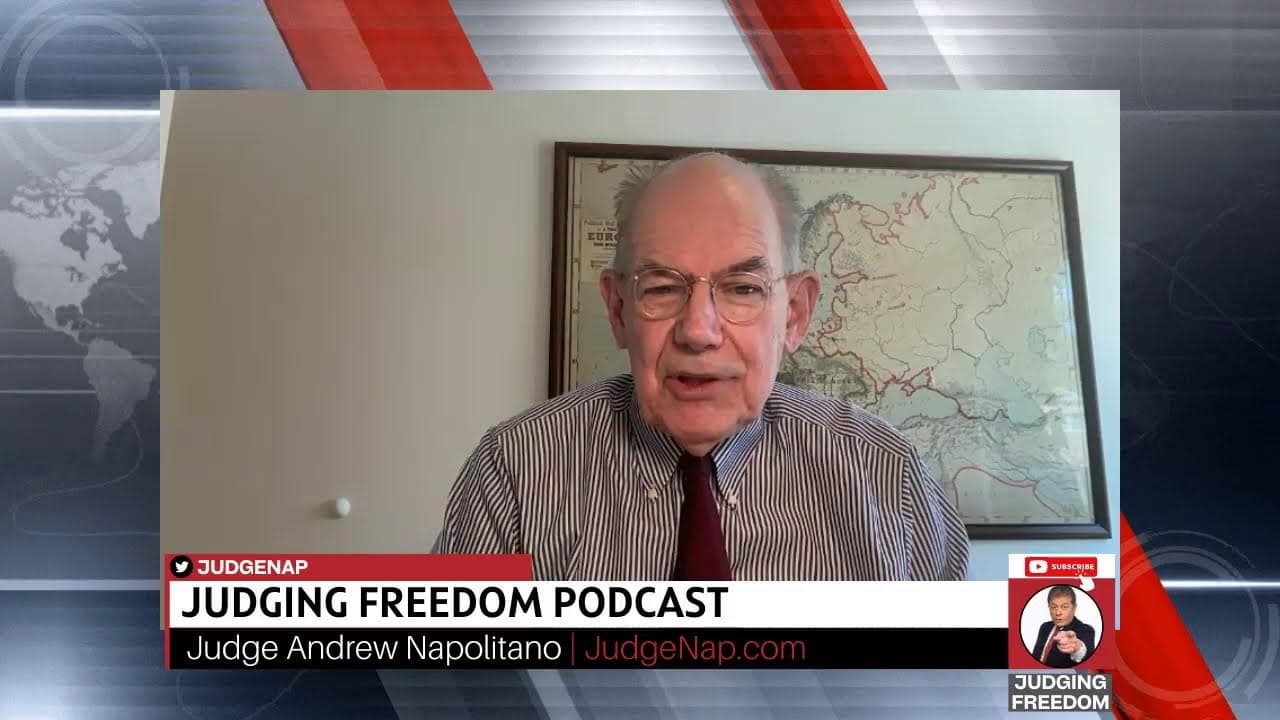
Mearsheimer argues that the United States paused some weapons for Ukraine primarily because supplying both Ukraine and Israel has reduced American stockpiles to dangerous levels. He also disputes claims that Iran was days from possessing a nuclear weapon, contending that the recent strikes did not eliminate Iran’s enrichment capability and that Washington remains unwilling to make the concessions needed to end the Ukraine war.
Transcript
Hi everyone, Judge Andrew Npalitano here for Judging Freedom. Today is Thursday, January 3rd, excuse me, July 3rd. Thursday, July 3rd, 2025. Professor John Mirshimer joins us now. Professor Mirshimer, as always, welcome here. Thank you for accommodating my schedule and thank you for interrupting your time off to uh join us uh before we get to Israe... Read More
Key Insights
- • The weapons pause is substantive, according to Mearsheimer, because simultaneous support for Ukraine and Israel has reduced American inventories to levels the Pentagon considers dangerous. He views stockpile pressure, rather than a moral or ideological change toward Ukraine, as the principal explanation.
- • The decisive Ukraine funding choice is still ahead because material authorized through the Biden pipeline will eventually run out. Mearsheimer says Trump must then decide whether to seek congressional approval for continued weapons support or end American supplies to Ukraine entirely.
- • Europe cannot replace American support for long, according to Mearsheimer, because European governments have experienced even greater difficulty expanding weapons production. He also argues that weak British, French, and German economies constrain their ability to finance Ukraine indefinitely.
- • Putin’s strategy is to appear reasonable and willing to negotiate while continuing Russia’s military campaign against Ukraine as vigorously as possible. Mearsheimer contrasts that approach with Trump’s efforts to obtain a settlement without offering the concessions that Mearsheimer considers necessary.
- • Trump has not resolved the foreign policy conflicts discussed in the interview, according to Mearsheimer. He points to continuing hostilities involving Ukraine, Gaza, Iran, and the Houthis as evidence that Trump’s promises and negotiations have not produced durable settlements.
- • Iran’s nuclear capability was not completely eliminated, according to the interview’s assessment of statements from the IAEA and Pentagon. The discussion says Iran could resume uranium enrichment within months, or possibly as soon as a year, leaving the underlying dispute unresolved.
- • The claim that Iran was days from possessing a nuclear weapon is ludicrous, according to Mearsheimer. He says building a bomb would take at least a year and highlights Senator John Kennedy’s inability to identify whether the briefing’s assessment originated with American or Israeli intelligence.
- • American and Israeli intelligence positions are closely aligned at senior levels, according to Mearsheimer. He argues that this alignment makes the nominal source of the Iran assessment less meaningful, while also alleging that senior American officials routinely advance Israel’s preferred interpretation of events.
Install to Summarize YouTube Videos and Get Transcripts
Explore YouTube Video Summarizer or Get YouTube Transcript Extractor
Questions & Answers
Q: Why did the United States pause weapons for Ukraine?
Mearsheimer argues that the pause in artillery shells and missiles was driven primarily by pressure on American weapons inventories. The United States was supplying large quantities of equipment to both Ukraine and Israel while maintaining a military system that privileges quality over quantity. He says the Pentagon consequently believed American stocks were falling to a dangerous level, including for potential requirements in East Asia.
Q: Can Europe replace American military support for Ukraine?
Europe may temporarily substitute for some American support, but it cannot do so for long, according to Mearsheimer. European countries have struggled even more than the United States to expand their defense industrial capacity and therefore lack sufficient weapons to transfer. He also points to troubled British, French, and German economies and doubts that permanently financing the war is politically feasible.
Q: What decision will Trump face when existing Ukraine aid runs out?
Mearsheimer says the major test will arrive after all material remaining in the Biden pipeline has been delivered. Trump will then have to choose whether to approach Congress for permission and funding to continue supplying Ukraine with weapons or to terminate that support. The current pause may matter, but Mearsheimer considers that later choice the genuinely decisive one.
Q: How does Mearsheimer describe Putin’s Ukraine strategy?
Mearsheimer describes Putin as pursuing a calculated two-track strategy. Putin presents himself as reasonable, communicates with Trump and Macron, and signals an interest in peace. At the same time, Russia continues prosecuting the war against Ukraine as vigorously as possible. This allows Putin to preserve a diplomatic posture without reducing military pressure while negotiations remain inconclusive.
Q: Why has Trump failed to end the Ukraine war, according to Mearsheimer?
Mearsheimer argues that Trump is seeking an agreement but remains unwilling to make the concessions required to produce one. He characterizes Trump as flailing rather than following an effective settlement strategy. In his assessment, conversations with Putin cannot end the conflict unless Washington changes its position on the terms that Russia regards as necessary for an agreement.
Q: Did the strikes completely destroy Iran’s nuclear capability?
The interview’s answer is no. Napolitano cites the IAEA’s Rafael Grossi as saying Iran could return to uranium enrichment within months, while also referring to a Pentagon estimate that enrichment could resume as soon as a year later. Mearsheimer therefore rejects the idea that the capability was totally obliterated or that the underlying nuclear dispute has been permanently resolved.
Q: Was Iran days away from producing a nuclear weapon?
Mearsheimer strongly rejects that assertion. He says it would take Iran at least a year to build a bomb and calls the claim that it was only days away ludicrous. His criticism centers on a Senate briefing described by Senator John Kennedy, who could not say whether the assessment presented to senators came from American intelligence or Israeli intelligence.
Q: Why was Tulsi Gabbard’s absence from the Iran briefing significant?
Napolitano notes that the legally designated director of national intelligence was absent from a briefing involving Rubio, Hegseth, Ratcliffe, and General Caine. Mearsheimer alleges that officials did not trust Gabbard and did not want her present because she would have contradicted the claim that Iran was days from a bomb. The interview presents her absence as evidence of disagreement over the assessment.
Summary & Key Takeaways
-
Mearsheimer interprets the pause in artillery shells and missiles for Ukraine as a substantive response to depleted American weapons stocks. He argues that supplying Ukraine and Israel simultaneously has strained inventories, while the United States and Europe have struggled to increase industrial production enough to meet Ukraine’s continuing military requirements.
-
European governments cannot replace American military support for Ukraine for long, according to Mearsheimer. He cites Europe’s limited weapons production, difficulties expanding its industrial base, troubled British, French, and German economies, and the political challenge of financing what he describes as an open-ended war with no clear conclusion.
-
Mearsheimer rejects claims that Iran was within days of producing a nuclear weapon and questions a Senate briefing that excluded Director of National Intelligence Tulsi Gabbard. He argues that the strikes failed to eliminate Iran’s enrichment capability and criticizes the close alignment between senior American officials and Israeli intelligence assessments.
Read in Other Languages (beta)
Share This Summary 📚
Summarize YouTube Videos and Get Video Transcripts with 1-Click
Try YouTube Summary with ChatGPT & Claude or YouTube Transcript Generator
Explore More Summaries from Judge Napolitano - Judging Freedom 📚



![[SPECIAL] Ryan Dawson : The Epstein Client List! thumbnail](/_next/image?url=https%3A%2F%2Fi.ytimg.com%2Fvi%2FGdcxDmhskAI%2Fhqdefault.jpg&w=750&q=75)
Summarize YouTube Videos and Get Video Transcripts with 1-Click
Try YouTube Summary with ChatGPT & Claude or YouTube Transcript Generator