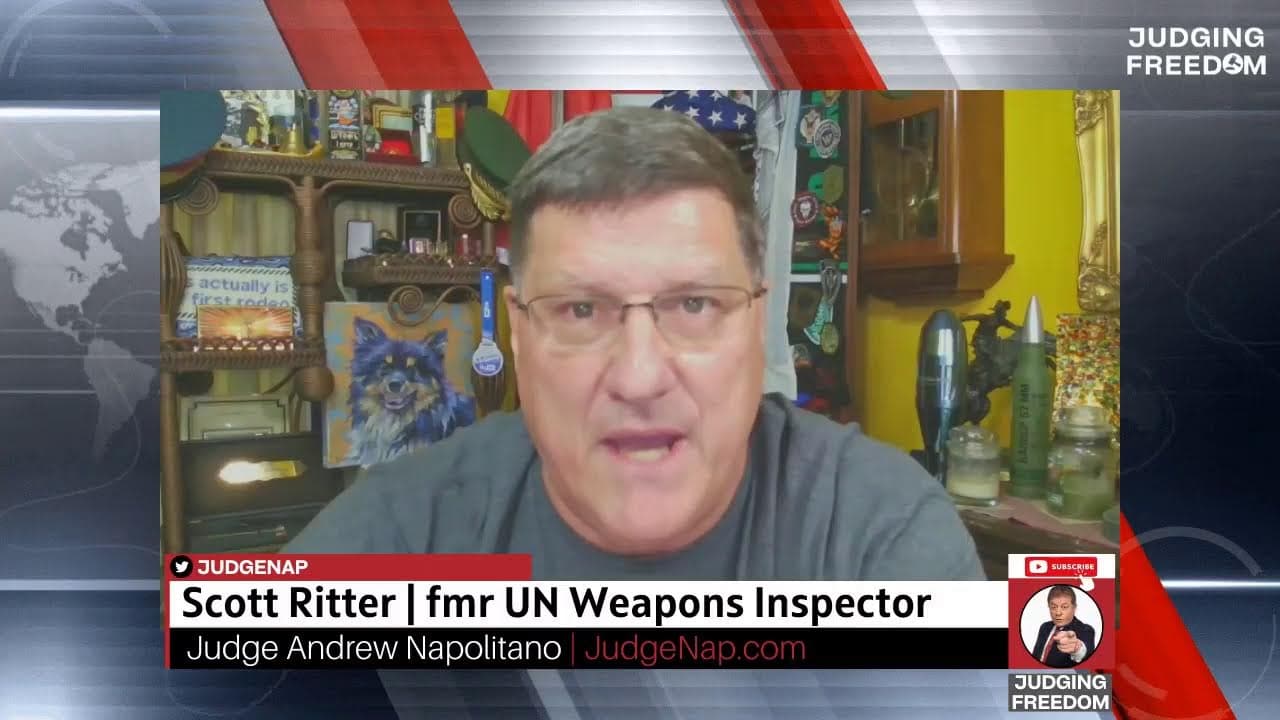
Why Does Scott Ritter Reject U.S. Israel Policy?
TL;DR
Scott Ritter argues that U.S. officials should place their constitutional duties and the interests of Americans above support for Israel. He portrays proposed diplomatic arrangements for Gaza and the wider Middle East as detached from continued conflict, while alleging that American funding, contractors, and political commitments make the United States complicit in Palestinian suffering.
Transcript
Hi everyone, Judge Andrew Npalitano here for Judging Freedom. Today is Monday, July 7th, 2025. Scott Ritter will be with us in just a moment on is the Ukraine lie finally collapsing. But first, this we all know how devastating war is? Lives lost, communities destroyed. But war can also threaten your financial freedom. That's where America's heading... Read More
Key Insights
- Ritter’s central argument is that American public officials have a constitutional duty to prioritize the United States. He says religious convictions or commitments to Israel should not supersede an official’s oath, responsibilities, or obligation to protect the interests of the American people.
- Trump’s proposed approach is described by Ritter as seeking both a permanent cessation of hostilities in Gaza and a broader regional agreement. Ritter says the envisioned arrangement would make Israel an economic and energy hub, placing Israeli leadership at the center of regional peace and prosperity.
- Netanyahu’s position is characterized by Ritter as favoring continued violence until Israel’s enemies are destroyed. Ritter argues that this outlook lacks a credible explanation for defeating Hamas and conflicts with Trump’s search for an off-ramp from prolonged warfare.
- Conditions in Gaza are presented by Ritter as evidence that the conflict remains unresolved. He cites continued Hamas attacks, Israeli military activity, attacks on civilian locations, and Palestinians’ urgent need for humanitarian assistance as reasons to reject optimistic political narratives.
- American involvement in Gaza is described as both financial and operational. Ritter alleges that U.S. support facilitates Israeli conduct and that American security contractors have fired on Palestinians seeking aid, making Washington responsible for more than simply providing money.
- Humanitarian aid distribution is portrayed as dangerous for Palestinian families. Ritter asks listeners to consider how starving parents would respond when food is available nearby, then alleges that people approaching distribution sites face gunfire from contractors and attacks by Israeli forces.
- Ted Cruz’s biblical defense of Israel is rejected by Ritter as an improper basis for official policy. Ritter distinguishes the people referenced in Genesis from the modern state governed by Benjamin Netanyahu and argues that Christianity cannot override the Constitution.
- Religious freedom is presented as compatible with public service only when constitutional duties remain primary. Ritter says the United States has no state-sponsored church and argues that an official who openly subordinates American interests to Israel should resign or be removed by voters.
Install to Summarize YouTube Videos and Get Transcripts
Explore YouTube Video Summarizer or Get YouTube Transcript Extractor
Questions & Answers
Q: What does Scott Ritter think Trump wants from Netanyahu?
Ritter says President Trump wants a broad compromise that ends the Gaza conflict and transitions toward a permanent cessation of hostilities. He also describes Trump as promoting a new version of the Abraham Accords, built around Israel serving as a regional economic and energy hub. Ritter nevertheless believes this vision improperly legitimizes Israeli supremacy and fails to resolve fundamental regional disputes.
Q: Why does Scott Ritter call the proposed Middle East plans unrealistic?
Ritter argues that both Trump and Netanyahu rely on political visions that do not match conditions on the ground. He says Trump has not explained how Iran will be persuaded to abandon its nuclear program completely, while Israel has not explained how it will defeat Hamas. Continued Hamas attacks and renewed Houthi operations are presented as evidence that armed resistance remains active.
Q: How does Scott Ritter describe U.S. responsibility for Gaza?
Ritter says American responsibility goes beyond financing Israel’s operations. He argues that U.S. policy condones and facilitates Israeli conduct, including attacks he says have struck schools, refugee camps, and humanitarian distribution centers. He also points to the presence of American security contractors, alleging that their actions connect the United States directly to violence against Palestinian civilians seeking essential food assistance.
Q: Why are American security contractors in Gaza, according to Ritter?
Ritter says the contractors are present because the Trump administration wanted to establish an American footprint in Gaza as part of its proposed solution. He characterizes them as mercenaries serving contractual security arrangements rather than the American public. Ritter alleges that footage shows contractors celebrating after shooting toward Palestinians, and he calls for eventual accountability for any crimes they committed.
Q: What humanitarian problem does Ritter identify in Gaza?
Ritter emphasizes that Palestinian families desperately need food and must approach humanitarian distribution locations to survive. He asks listeners to imagine seeking aid while their children are starving. According to his account, civilians attempting to obtain supplies risk being fired upon by American contractors or attacked by Israeli forces, turning access to essential assistance into a potentially lethal undertaking.
Q: Why does Scott Ritter reject Ted Cruz’s biblical argument for supporting Israel?
Ritter rejects Cruz’s claim that biblical commands require American officials to support the modern state of Israel. He notes that Israel in the cited religious context is not automatically identical to the country governed by Benjamin Netanyahu. More importantly, Ritter argues that a senator’s personal Christianity cannot supersede the Constitution, official duties, or responsibility to represent American citizens and interests.
Q: What standard does Ritter set for U.S. government officials?
Ritter says every American official must treat the Constitution and the security of the American people as the highest priorities. He criticizes officials who describe Israel’s security as their leading concern, arguing that such language conflicts with service to the United States. In his view, anyone who intentionally places another country first should leave American government rather than retain public authority.
Q: What does Ritter say voters should do about officials who prioritize Israel?
Ritter argues that voters should remove officials who openly subordinate American interests to Israel. Referring specifically to Senator Ted Cruz, he says the people of Texas should vote him out if they accept that his position places the United States in danger for Israel’s benefit. Ritter also says an official who genuinely holds such priorities should resign because they conflict with constitutional service.
Summary & Key Takeaways
-
The discussion opens with Ritter assessing a White House meeting between President Trump and Benjamin Netanyahu. Ritter says Trump seeks an end to hostilities and a broader regional arrangement centered on Israel, while Netanyahu favors continued military action until Israel’s enemies are destroyed. Ritter considers both positions disconnected from realities on the ground.
-
Ritter condemns Israel’s conduct in Gaza and argues that American responsibility extends beyond financial support. He alleges that U.S. complicity facilitates attacks on Palestinian civilians and criticizes American security contractors operating near humanitarian aid distribution. His comments portray Gaza as a place where violence, hunger, and inadequate accountability reinforce one another.
-
The interview then examines Senator Ted Cruz’s religious justification for supporting Israel. Ritter rejects the idea that biblical belief should determine American foreign policy or supersede constitutional obligations. He argues that senators and federal officials swear loyalty to the United States and therefore must prioritize Americans rather than another country’s security or political objectives.
Read in Other Languages (beta)
Share This Summary 📚
Summarize YouTube Videos and Get Video Transcripts with 1-Click
Try YouTube Summary with ChatGPT & Claude or YouTube Transcript Generator
Explore More Summaries from Judge Napolitano - Judging Freedom 📚
![[SPECIAL] Ryan Dawson : The Epstein Client List! thumbnail](/_next/image?url=https%3A%2F%2Fi.ytimg.com%2Fvi%2FGdcxDmhskAI%2Fhqdefault.jpg&w=750&q=75)

Summarize YouTube Videos and Get Video Transcripts with 1-Click
Try YouTube Summary with ChatGPT & Claude or YouTube Transcript Generator