What Is Microsoft Mu? The On-Device Windows AI Model
TL;DR
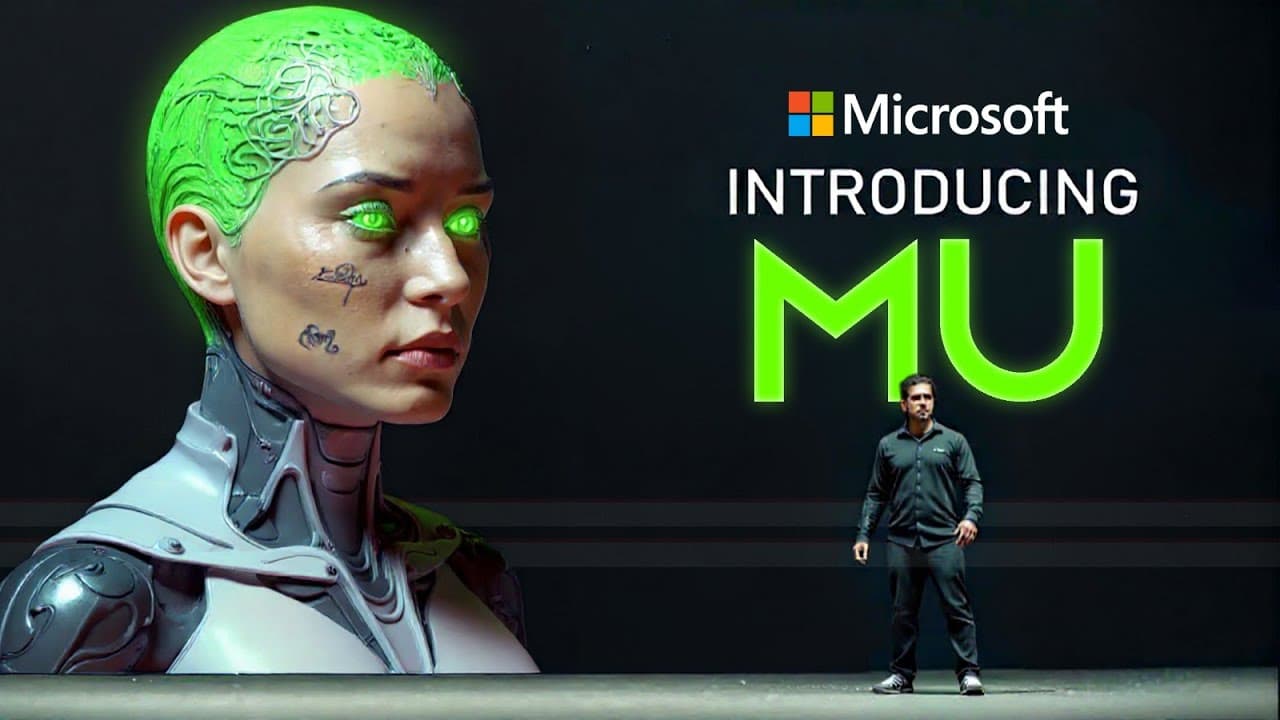
Microsoft embedded a 330-million-parameter language model called Mu into Copilot+ PCs that runs entirely on-device using the Neural Processing Unit. It responds in under half a second with no cloud connection, letting you change Windows settings by typing natural commands. It outputs over 200 words per second on hardware like the Surface Laptop 7.
Transcript
Windows just baked in a tiny language model that runs entirely on your device and responds in milliseconds. Meanwhile, Google dropped a new open-source music model that can jam live, switch instruments midbar, and follow prompts in real time right in your browser. Then there's Similar, a new AI agent that quietly handles your web chores while you s... Read More
Key Insights
- Microsoft's Mu is a micro language model with 330 million parameters embedded directly into new Copilot+ PCs, running entirely on-device with no cloud dependency and responding in milliseconds.
- Mu breaks a question down once, holds the meaning in memory, and builds a response from that instead of rereading the whole request, making it roughly twice as fast for the first word and nearly five times faster overall.
- Mu runs on a dedicated chip called the Neural Processing Unit (NPU), which lets it output more than 200 words per second on devices like the Surface Laptop 7 and reply to complex requests in under half a second.
- Mu was trained on over 3.5 million examples covering Windows settings from screen brightness to privacy options, with added typos and phrasings so it handles real-world messiness.
- Google's Magenta RT is an 800-million-parameter open-weight music model under Apache 2.0 that generates 2 seconds of 48kHz stereo audio in about 1.25 seconds, enabling live jamming and genre morphing mid-bar.
- Simular is an on-device Mac web agent that runs a sandboxed WebKit window locally, keeping cookies, login tokens, and autofill data on your SSD while letting you override the agent at any time.
- Simular scored 90.05% completion on the WebVoyager benchmark and edged out OpenAI and Anthropic on OSWorld and AndroidWorld, tasks involving pop-ups, infinite scroll, and badly labeled inputs.
- OpenAI's $6.5 billion acquisition of Jony Ive's hardware firm IO hit a trademark lawsuit from hearing-aid startup IYO, forcing OpenAI to scrub all branding and promo material until lawyers resolve it.
Install to Summarize YouTube Videos and Get Transcripts
Explore YouTube Video Summarizer or Get YouTube Transcript Extractor
Questions & Answers
Q: What is Microsoft Mu and how many parameters does it have?
Mu is a micro language model that Microsoft quietly embedded into its new Copilot+ PCs. It has 330 million parameters, making it lightweight yet capable. Instead of processing a request piece by piece, Mu breaks the question down once, holds the meaning in memory, and builds a response from that. It runs entirely on the device with no cloud connection, allowing it to reply in milliseconds when you type commands to change Windows settings.
Q: How does Mu run so fast without the cloud?
Mu runs directly on a special chip called the Neural Processing Unit (NPU), which handles AI workloads efficiently on-device. Because it breaks your question down once and holds the meaning in memory rather than rereading the whole thing, it replies almost twice as quick for the first word and nearly five times faster overall compared to similar models. It outputs more than 200 words per second on devices like the Surface Laptop 7 and answers complex requests in under half a second.
Q: How was Microsoft Mu trained?
Microsoft did not just feed Mu random internet data. They started with high-quality educational material, then distilled knowledge from larger, more powerful models so Mu could be smart without being huge. To make it understand Windows settings, they trained it with over 3.5 million examples covering everything from screen brightness to privacy options. They added variations, typos, and different phrasings to handle real-world messiness. After fine-tuning, it performed nearly as well as much larger models while staying lightweight and fast.
Q: What is Google Magenta RT and what can it do?
Magenta RT is a new open-weight music model from Google's Magenta team, released under Apache 2.0 and available on GitHub and HuggingFace. It has 800 million parameters and generates 2 seconds of 48kHz stereo audio in about 1.25 seconds on a free-tier Colab TPU. This low latency lets you jam live, feed style prompts mid-performance, and morph genres or instruments in the middle of a bar, for example going from synth wave to bossa nova piano without dropping tempo. It is self-hostable, avoiding API bills or rate limits.
Q: How does the Simular AI web agent keep your data private?
Simular spins up a fully sandboxed WebKit window directly on your Mac desktop instead of using cloud-hosted browsing. The whole process stays on device, so every cookie, login token, and autofill scrap lives on your SSD rather than being sent to a distant data center. It logs into paywalled sites using the same keychain credentials you would use in Safari, and nothing leaks outward or is stored off device. Even if you hit Wi-Fi turbulence, the workflow does not collapse because everything runs locally.
Q: How well does Simular perform on benchmarks?
Simular posted a 90.05% completion score on the messy real-world WebVoyager benchmark. It also edged out OpenAI and Anthropic on OSWorld and AndroidWorld, benchmarks where about half the tasks involve pop-ups, infinite scroll, and badly labeled inputs that would trip most bots. Its architecture uses a high-level planner to sketch the goal, a vision layer that reads live pixels to spot buttons, smaller sub-agents for scrolling and text entry, and a short-term memory thread that tracks recent clicks.
Q: Why did OpenAI wipe its Jony Ive hardware announcement?
OpenAI announced a $6.5 billion acquisition of Jony Ive's hardware shop called IO to build ultra-minimal AI devices. However, a hearing-aid startup called IYO sued over the almost identical name, and a court issued a takedown order on OpenAI's promo material. Overnight, the blog post and a slick 9-minute video of Ive chatting with Sam Altman disappeared from openai.com, though the clip still floats on YouTube. OpenAI says the deal itself is intact and they just have to scrub the branding until lawyers sort it out.
Q: Who is Jony Ive and what did he say about the OpenAI project?
Jony Ive is the ex-Apple design legend who left the company in 2019 after sketching icons like the iPhone, Apple Watch, and AirPods. In the announcement video he sounded giddy, telling Sam Altman that everything he has learned in 30 years led to this moment. Altman flashed a prototype and called it the coolest piece of technology the world will have ever seen. Insiders describe an unobtrusive desktop companion that stays aware of your environment and fits alongside a MacBook Pro and iPhone, with a release not expected until next year.
Summary & Key Takeaways
-
Microsoft quietly embedded a 330-million-parameter model called Mu into Copilot+ PCs. It runs on the Neural Processing Unit entirely offline, breaks a request down once and holds it in memory, and responds in under half a second, outputting over 200 words per second on the Surface Laptop 7.
-
Mu was trained starting with high-quality educational material, then distilled from larger models, plus 3.5 million examples of Windows settings tasks with typos and varied phrasings. It performs nearly as well as much larger models, uses regular search for one-word queries, and asks which monitor when adjusting brightness.
-
Google's Magenta RT enables real-time music generation, Simular runs a fully on-device Mac web-browsing agent that keeps data local while sharing control with the user, and OpenAI's Jony Ive hardware deal was forced to wipe its branding after a trademark lawsuit from startup IYO.
Read in Other Languages (beta)
Share This Summary 📚
Summarize YouTube Videos and Get Video Transcripts with 1-Click
Try YouTube Summary with ChatGPT & Claude or YouTube Transcript Generator
Explore More Summaries from AI Revolution 📚


Summarize YouTube Videos and Get Video Transcripts with 1-Click
Try YouTube Summary with ChatGPT & Claude or YouTube Transcript Generator