How Is AI Solving Frontier Mathematics Problems?
TL;DR
AI-assisted workflows can produce candidate solutions to open mathematics problems quickly, but human prompting, expert review, and formal validation remain central to the process described. The reported solutions combine tools such as ChatGPT 5.2 Pro and Aristotle with human reasoning, suggesting that replicated AI systems could accelerate mathematical and scientific discovery while also improving the infrastructure and algorithms used by AI itself.
Transcript
This is an Erdős problem. It is one of the hardest open math problems on Earth. In all of history, there are only hundreds of people that can actually solve these problems. But this guy, Neil Somani, a quantitative researcher, has just solved it, and here's the interesting part. He solved it with the help of artificial intelligence, specifically GP... Read More
Key Insights
- Erdős problem 397 was reportedly solved through a workflow in which a human supplied the prompt, GPT 5.2 generated the proof, and Terence Tao accepted it. The transcript presents this as evidence that AI can contribute directly to previously open frontier mathematics problems.
- The reported solving time was around 15 minutes for GPT 5.2. The transcript contrasts this short run with the exceptional difficulty of Erdős problems, while still describing a combined process involving human prompting, AI generation, mathematical review, and, in some cases, formal validation.
- Six open mathematics problems were reportedly solved with artificial intelligence over a two-week period. The examples cited involve combinations of Aristotle, ChatGPT 5.2 Pro, and human thinking, indicating that the claimed progress came from integrated workflows rather than an entirely autonomous model.
- Terence Tao maintains a record of AI contributions to Erdős problems, according to the transcript. The record distinguishes full solutions, partial solutions, attempts, rediscoveries of earlier human solutions, and results validated with Lean, providing several levels of evidence rather than treating every attempt as equivalent.
- AlphaEvolve improved a matrix multiplication algorithm for the first time in 50 years, according to the transcript. Although characterized as a small improvement, it could produce broad efficiency gains because matrix multiplication is presented as central to contemporary artificial intelligence computation.
- AlphaEvolve also produced improvements related to Google's server architecture, TPU circuit design, scheduling systems, and Gemini training. These examples support the transcript's argument that AI research can affect both mathematical algorithms and the physical or operational infrastructure used to develop AI.
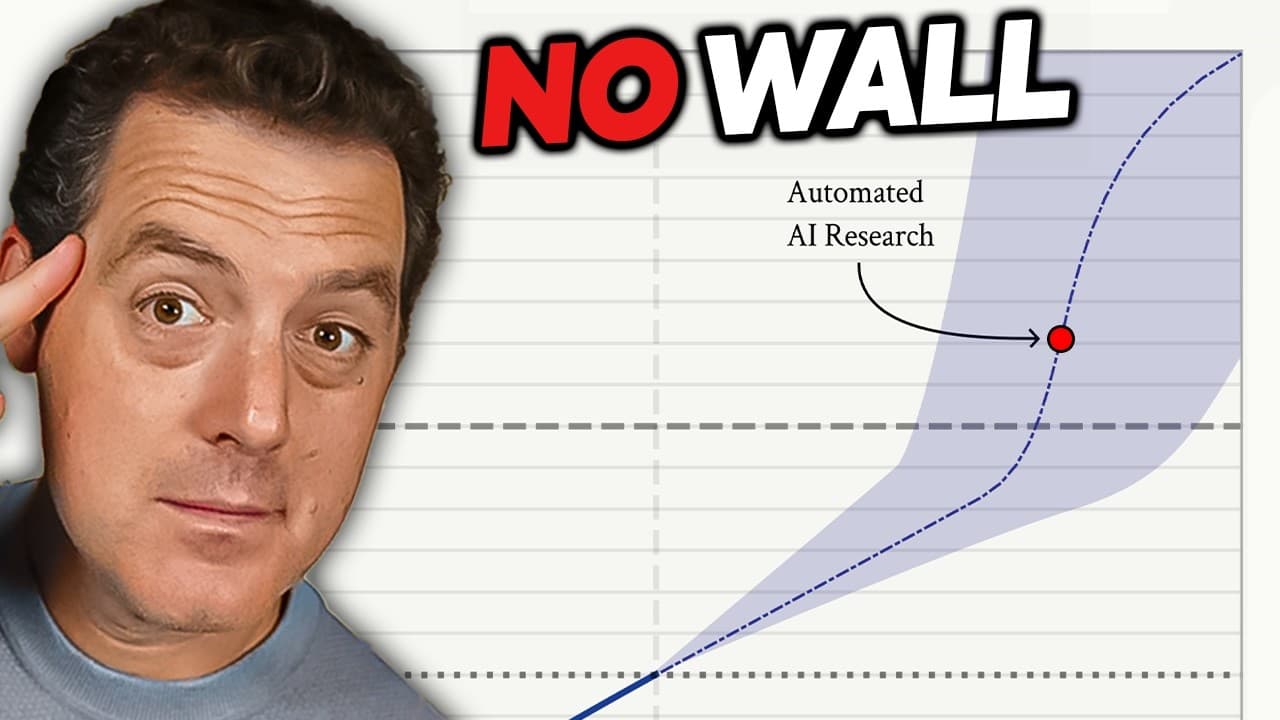
- An intelligence explosion is described as a recursive cycle in which AI discovers more efficient ways to operate, applies those discoveries to itself, and becomes more capable of producing subsequent advances. The transcript identifies mathematical and scientific discovery as an important step in that proposed cycle.
- AI systems can operate continuously and be replicated across many parallel instances, unlike an individual human researcher. The transcript argues that this enables large-scale exploration of difficult problems, with the supply of GPUs and the energy available to power them becoming the main stated constraints.
Install to Summarize YouTube Videos and Get Transcripts
Explore YouTube Video Summarizer or Get YouTube Transcript Extractor
Questions & Answers
Q: How did AI help solve Erdős problem 397?
The process described combined human direction with machine-generated mathematics. Neil Somani prompted GPT 5.2, the AI generated a proof, and the result was submitted to Terence Tao, who accepted it according to the transcript. The account therefore presents the solution as AI-assisted rather than wholly autonomous, since a person selected and prompted the problem while an expert assessed the resulting proof.
Q: How quickly did GPT 5.2 solve the reported Erdős problem?
GPT 5.2 reportedly took around 15 minutes to solve the problem. The transcript emphasizes this duration because Erdős problems are characterized as exceptionally difficult open questions that very few people can solve. However, the reported time describes the model's solving stage, while the broader workflow also included human prompting, submission, expert acceptance, and, for some listed results, validation with Lean.
Q: How many open math problems were reportedly solved using AI?
The transcript states that six problems had been solved with the use of artificial intelligence over the preceding two weeks. It also describes a larger record containing full solutions, partial solutions, attempts, rediscoveries of earlier human work, and already solved problems that AI solved again. Those categories matter because the transcript does not claim that every recorded AI attempt represents a newly resolved open problem.
Q: What roles did ChatGPT and Aristotle play in solving math problems?
The described results used combinations of Aristotle, ChatGPT 5.2 Pro, and human thinking. ChatGPT generated mathematical work in response to prompts, while Aristotle appears in the listed solution workflows and in results described as verified or validated with Lean. The transcript does not provide a detailed technical breakdown of Aristotle's operation, so its exact contribution beyond participation in these workflows is not specified.
Q: Why could better matrix multiplication improve artificial intelligence?
Matrix multiplication is described as central to how contemporary artificial intelligence works. The transcript says AlphaEvolve found a small improvement to its algorithm, the first such improvement in 50 years. Because matrix multiplication is performed throughout the AI ecosystem, even a small efficiency gain could apply repeatedly, allowing computation to run more efficiently and potentially supporting additional mathematical, scientific, and engineering discoveries.
Q: What is an AI intelligence explosion?
An intelligence explosion is presented as a recursive process in which artificial intelligence makes scientific or mathematical discoveries that improve AI itself. Better algorithms, training methods, hardware designs, or operating procedures would make later AI systems more capable or efficient. Those stronger systems could then discover further improvements, creating a compounding cycle that the transcript describes as leading toward intelligence without a defined upper bound.
Q: What AI systems are cited as evidence of automated discovery?
The transcript cites GPT 5.2 solving Erdős problem 397, combinations of ChatGPT 5.2 Pro and Aristotle producing multiple solutions, Google's AlphaEvolve improving matrix multiplication and technical infrastructure, and Sakana AI's AI Scientist conducting scientific discovery. It also mentions ChatGPT receiving gold at the International Mathematical Olympiad as further evidence of advanced mathematical performance, though that competition is described inconsistently as a coding competition.
Q: What limits the scaling of parallel AI research?
The transcript identifies access to GPUs and the energy supplied to those GPUs as the principal constraints once AI research can be replicated at scale. An AI system can operate continuously without becoming tired, and the same capability can be copied into ten, a hundred, or a million parallel instances. This parallelism could expand the number of mathematical and scientific problems explored simultaneously, subject to computing resources.
Summary & Key Takeaways
-
Neil Somani reportedly used GPT 5.2 to help solve Erdős problem 397, with the proof prompted by a human, generated by AI, and accepted by Terence Tao. The transcript says the model took about 15 minutes and that six problems had been solved with artificial intelligence during the preceding two weeks.
-
The broader evidence presented includes ChatGPT's reported gold-level International Mathematical Olympiad performance and AlphaEvolve's improvement to matrix multiplication. AlphaEvolve also reportedly contributed improvements involving TPU circuit design, scheduling, server architecture, and Gemini training, illustrating how mathematical and engineering discoveries might make future AI computation more efficient and capable over time.
-
The intelligence explosion argument depends on recursive improvement: AI discovers better algorithms or infrastructure, those advances improve AI systems, and stronger systems generate further discoveries. The transcript argues that continuous operation and massive parallel replication could accelerate this cycle, while available GPUs and the energy supplied to them become its principal practical constraints.
Read in Other Languages (beta)
Share This Summary 📚
Summarize YouTube Videos and Get Video Transcripts with 1-Click
Try YouTube Summary with ChatGPT & Claude or YouTube Transcript Generator
Explore More Summaries from Matthew Berman 📚






Summarize YouTube Videos and Get Video Transcripts with 1-Click
Try YouTube Summary with ChatGPT & Claude or YouTube Transcript Generator