How to build AI agents for real time lead generation
TL;DR
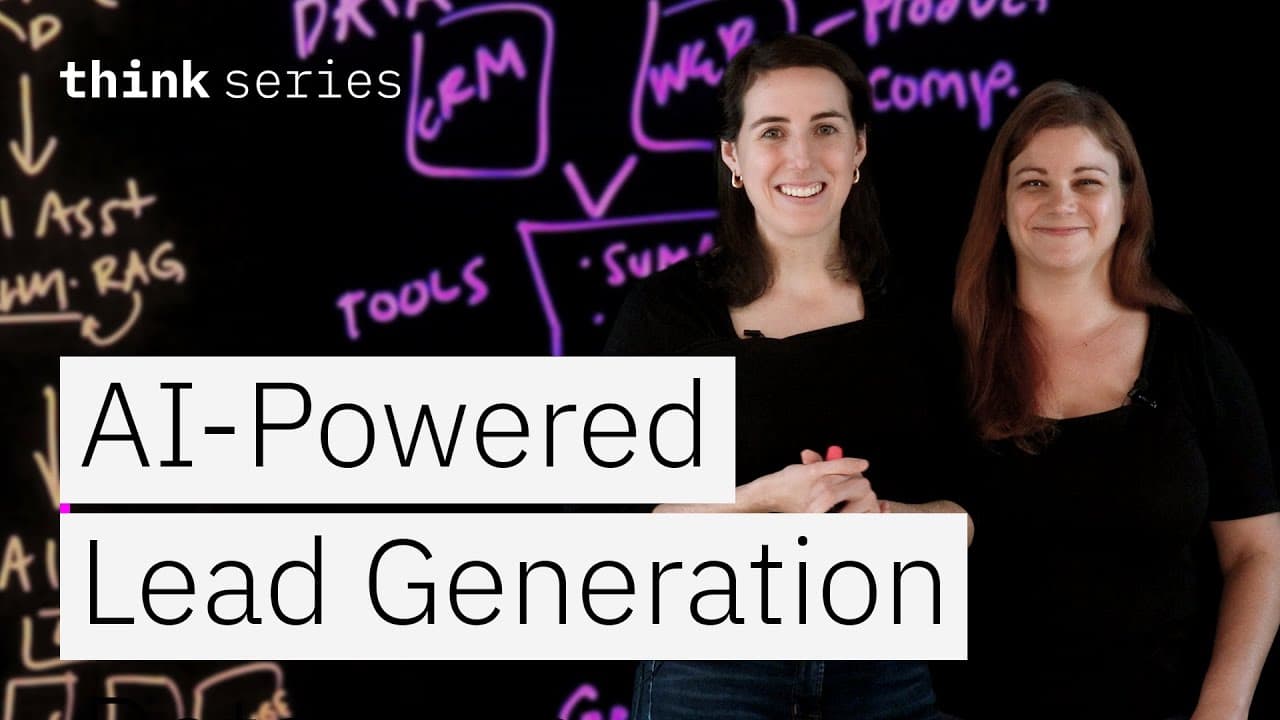
AI agents can monitor data in real time, identify promising leads, and generate personalized outreach. The key is combining tools, memory, and knowledge to automate data collection, analysis, and outreach while applying guardrails and testing before production. Frameworks like LangChain, LangGraph, Crew AI, and Llama Index help implement modular agent workflows.
Transcript
As developers and tech practitioners. you know, we're often tasked with solving complex problems like automating workflows and building tools that can process and act on vast amounts of data. One challenge that I think we know spans many industries is how to efficiently identify and act on potential opportunities based on that data. And in this cas... Read More
Key Insights
- AI agents are built on three blocks: tools, memory, and knowledge, which together allow actions, context retention, and data freshness.
- RAG, or Retrieval Augmented Generation, is used to pull information from knowledge bases to inform responses.
- LangChain offers a simple modular workflow with memory support and vector database integration for lead data handling.
- LangGraph focuses on non-linear, multi-agent workflows for complex use cases.
- Crew AI provides strong support for RAG tools and multiple LLM connections.
- Llama Index extends the Llama ecosystem with actionable steps and memory capable features.
- Data integration is crucial for connecting CRMs, emails, and external sources to enrich leads and enable real-time processing.
- Guardrails and testing are essential to ensure the agent operates within defined scope and safety boundaries.
Install to Summarize YouTube Videos and Get Transcripts
Explore YouTube Video Summarizer or Get YouTube Transcript Extractor
Questions & Answers
Q: How can an AI agent continuously monitor data for lead generation?
An AI agent can continuously monitor data by integrating with data sources like CRMs and external databases, then using the tools block to fetch and process data in real time or on a schedule. Memory stores context so the agent recalls past interactions and leads, while knowledge sources keep the data fresh for accurate analysis and outreach.
Q: What is RAG and how does it fit into AI agents for lead gen?
RAG stands for Retrieval Augmented Generation. It enables the agent to retrieve information from a knowledge base and generate responses based on that data. This approach powers accurate lead insights, contextual outreach content, and informed decision making, reducing generic, misaligned communications and improving relevance in outreach strategies.
Q: Which frameworks are suggested for starting an AI lead generation agent?
Open source frameworks mentioned include LangChain, LangGraph, Crew AI, and Llama Index. LangChain provides a simple, modular workflow with memory support. LangGraph supports complex multi-agent architectures. Crew AI offers strong RAG tooling and multi-LLM connections. Llama Index adds structured actions and memory features, useful for looping processes.
Q: How should you define the scope for an AI lead generation agent?
Define if the agent operates autonomously or with user input, decide whether to use a single agent or multiple specialized agents, and determine the data collection, analysis, and outreach roles. Consider reusability so one agent can support multiple tasks, and set clear boundaries to prevent scope creep and ensure security and privacy compliance.
Q: What data sources are important for enriching lead information?
Important sources include CRM systems for customer data, company pages and product information for context, and external data sources for enrichment. The goal is to provide the agent with a complete view of potential leads, enabling accurate analysis and personalized outreach without manual data gathering.
Q: How does memory improve AI agent performance in lead generation?
Memory stores prior conversations and lead context, enabling the agent to reference past interactions without re-fetching data. This leads to more coherent outreach, continuity in conversations, and quicker follow-ups. It also supports personalization by retaining user preferences and prior engagement history.
Q: What considerations drive choosing an AI framework for building an agent?
Consider complexity, data privacy, integration capabilities, performance, and team skill level. Low code or no code options are suitable for rapid prototyping, while high code frameworks offer deeper customization. The chosen framework should align with existing tech stacks and long-term maintenance needs.
Q: Why is testing and guardrails critical before production deployment?
Testing ensures the agent adheres to defined scope, avoids risky actions, and maintains data integrity. Guardrails prevent off-target activities, ensure compliance with privacy rules, and help catch edge cases. A thorough test plan and staged rollout reduce operational risk and build trust in automated lead workflows.
Summary & Key Takeaways
-
Agents enable continuous lead data monitoring and automatic outreach creation, reducing manual data handling and enabling faster, more targeted engagement.
-
A three-layer architecture is used: tools for actions, memory for context, and knowledge for up-to-date data sources, all underpinning the agent’s decisions.
-
Framework choices depend on needs including simplicity, reuse, data privacy, and integration capabilities, with open source options like LangChain and LangGraph guiding initial setups.
Read in Other Languages (beta)
Share This Summary 📚
Summarize YouTube Videos and Get Video Transcripts with 1-Click
Try YouTube Summary with ChatGPT & Claude or YouTube Transcript Generator
Explore More Summaries from IBM Technology 📚



Summarize YouTube Videos and Get Video Transcripts with 1-Click
Try YouTube Summary with ChatGPT & Claude or YouTube Transcript Generator