How to Get Smarter Using AI Training Stages
TL;DR
Intelligence can be trained deliberately by copying the stages AI researchers used to make LLMs smarter, since those architectures were inspired by biological neurons. Start with wide pre-training (read broadly, travel, diverse experiences), then add step-by-step reasoning and judgment, tool use, multimodal learning, and few-shot adaptation. Each stage transfers because your brain's 100 billion neurons work on a similar architecture.
Transcript
This is an AI. No, no, no. Not the one that you're afraid of. Not the one that's threatening to take your job. This one is stupid. It's dumb. But how did we go from this all the way to this in a span of 3 years? Well, there are about a series of 10 techniques used to make LLM smarter in the last 3 years. Turns out those same techniques can also app... Read More
Key Insights
- LLM architectures were originally inspired by how biological neurons work, so the techniques that made AI smarter tend to transfer to humans, whose brains have around 100 billion neurons and 100 trillion synaptic connections.
- Pre-training for humans means childhood through your 20s: reading widely, having diverse experiences, and traveling to build a rich, wide foundation rather than specializing too early on a single domain.
- The common mistake is specializing too early; minds like Leonardo da Vinci, Franklin, and Feynman were pre-trained across dozens of domains before they ever went deep on one thing.
- Chain-of-thought reasoning is the human difference between knowing facts and having judgment: breaking problems down, using first-principles thinking, and evaluating trade-offs instead of reacting on gut.
- Steelmanning means constructing the strongest possible version of an opponent's argument before you argue against it, a reasoning muscle most people never develop because they react instead of reason.
- RLHF in AI maps to having a mentor in humans: someone who watches your decisions and gives an honest good-or-bad signal, calibrating your judgment over many repetitions.
- Tool use separates a theoretically smart person from an effective one; the effective person knows when to use a calculator, open Photoshop, or write code rather than deriving everything from first principles.
- Multimodal learning works because different formats reinforce each other, and output matters as much as input, so making videos or teaching others builds richer understanding than only reading and writing text.
Install to Summarize YouTube Videos and Get Transcripts
Explore YouTube Video Summarizer or Get YouTube Transcript Extractor
Questions & Answers
Q: Why can AI training techniques make humans smarter?
The techniques transfer because the underlying architecture of large language models was originally inspired by how biological neurons work, so it is not just a loose metaphor. The human brain has about 100 billion neurons and 100 trillion synaptic connections that function like a neural network. Because the base architecture is shared, the same series of roughly 10 techniques that made LLMs smarter over the last 3 years can apply to people too.
Q: What is the pre-training stage for humans?
Pre-training in AI is where the model reads the entire internet with no specific goal, just absorbing everything and building a map of the world. For humans this is childhood through your 20s: reading widely, having diverse experiences, traveling, and talking to people who are nothing like you. The goal is not to become an expert but to build a rich, wide foundation so you can later make connections no one else can see. The suggested practice is reading 50 books a year across 10 categories.
Q: Why is specializing too early a mistake?
Most people go deep on one thing before they have gone wide on everything, which limits their ability to connect ideas across domains. The best minds in history, including Leonardo da Vinci, Franklin, Feynman, and Demis, were all pre-trained across dozens of domains before they ever specialized. To avoid the mistake, you should maximize the diversity and quality of your training data by reading across many categories, having conversations outside your job industry, and traveling to places that challenge your worldview.
Q: How do you build reasoning and judgment like chain-of-thought AI?
Chain of thought taught AI models to think step by step, break the problem down, evaluate trade-offs, and check their own logic. For humans this is the difference between knowing facts and having judgment. You build it by doing weekly postmortems, journaling your decisions and what you would do differently, and studying mental models like first principles, inversion, and second-order thinking. Surrounding yourself with people who challenge your logic rather than just agree with your conclusions also strengthens this muscle.
Q: What is steelmanning and why does it matter?
Steelmanning is the ability to see the other side before you argue your own, a debating technique that constructs the strongest possible version of an opponent's argument before you start arguing against it. Most people never develop this muscle and instead react instead of reason, going with their gut when their gut has not been calibrated. The video notes you see this all over Twitter and Reddit as people react to news, whereas steelmanning forces genuine reasoning.
Q: How does tool use make a person more effective?
When AI models learned to use tools such as searching the web, writing code, and calling APIs, they went from smart to superhuman, learning the lesson that made humans the dominant species. For humans there is a difference between a theoretically smart person and an effective one: the effective person knows when to use a calculator or open Photoshop rather than figuring everything out from first principles. You build your toolset through end-to-end projects, mastering one tool at a time before combining multiple tools and learning which to use for each task.
Q: Why is multimodal learning better than only reading text?
Multimodal AI went from processing text to understanding images, audio, video, and code all at once, and it got better at everything because different modalities reinforce each other. Humans who only learn from books have a one-dimensional understanding, while a founder who understands their product through spreadsheets, customer calls, prototypes, and watching users struggle has a richer 4D mental model. A video animation of Bernoulli's principle is better than reading it as text, so you should immerse yourself across as many input formats as possible.
Q: How does creating content help you learn?
Multimodal systems are not just about input but also output, so you should learn to output in multiple formats rather than only writing text. The video encourages making videos because you learn more from an audio recording than writing, and even more from making a video, since it is higher bandwidth. People who make videos generally understand a topic better than people who write text. This mirrors how the class topper who teaches everyone else reinforces the concept in their own brain through the act of teaching.
Summary & Key Takeaways
-
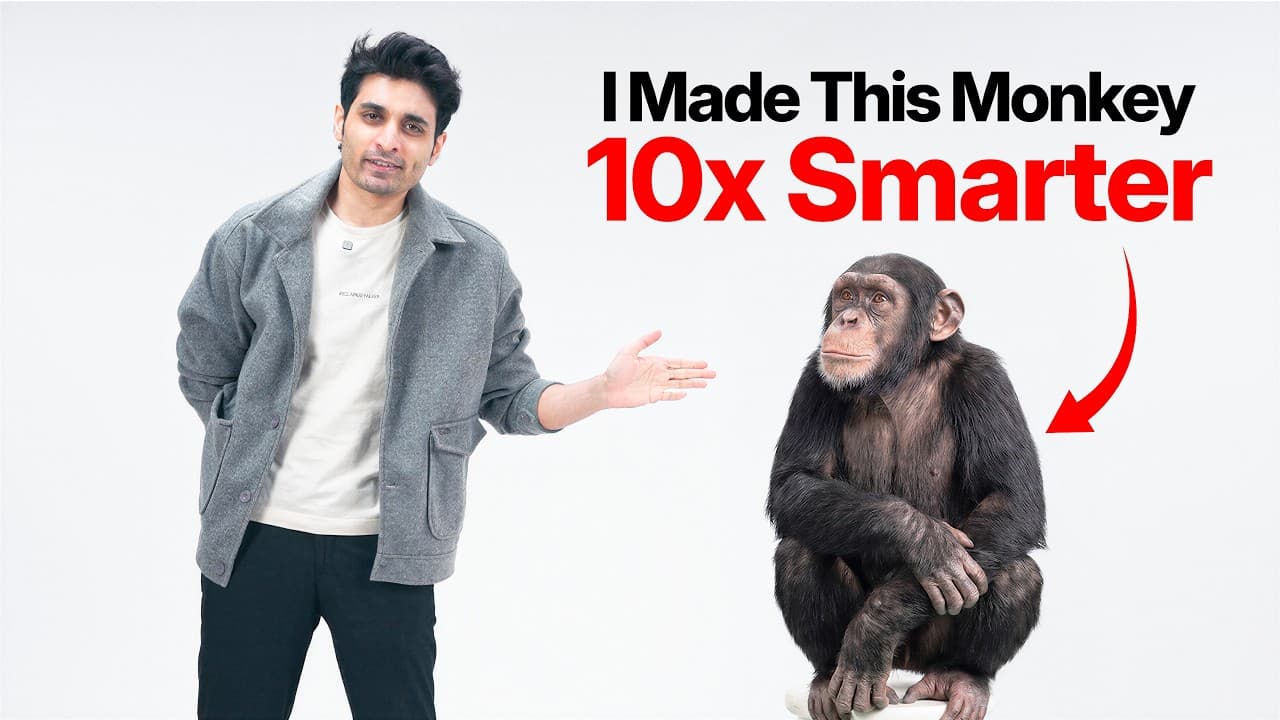
The video argues that the roughly 10 techniques used to make LLMs smarter over the last 3 years can also make humans smarter, because LLM architectures were inspired by biological neurons. A dim monkey called Mr. Dimwos is used as the subject to demonstrate each stage of developing intelligence.
-
Stage one is pre-training: absorbing broad information with no specific goal, which for humans is childhood through the 20s spent reading widely and having diverse experiences. Stage two is chain-of-thought reasoning and judgment, built through postmortems, journaling decisions, studying mental models, and getting honest feedback from mentors.
-
Stage three is tool use, learned through end-to-end projects on single tools then combining them. Stage four is multimodal learning, consuming and creating across text, audio, and video since different modalities reinforce each other. The final discussed stage is few-shot learning, where models learn new tasks from just a few examples.
Read in Other Languages (beta)
Share This Summary 📚
Summarize YouTube Videos and Get Video Transcripts with 1-Click
Try YouTube Summary with ChatGPT & Claude or YouTube Transcript Generator
Explore More Summaries from Varun Mayya 📚

Summarize YouTube Videos and Get Video Transcripts with 1-Click
Try YouTube Summary with ChatGPT & Claude or YouTube Transcript Generator