What is the Battle of Forms in Contract Law?
TL;DR
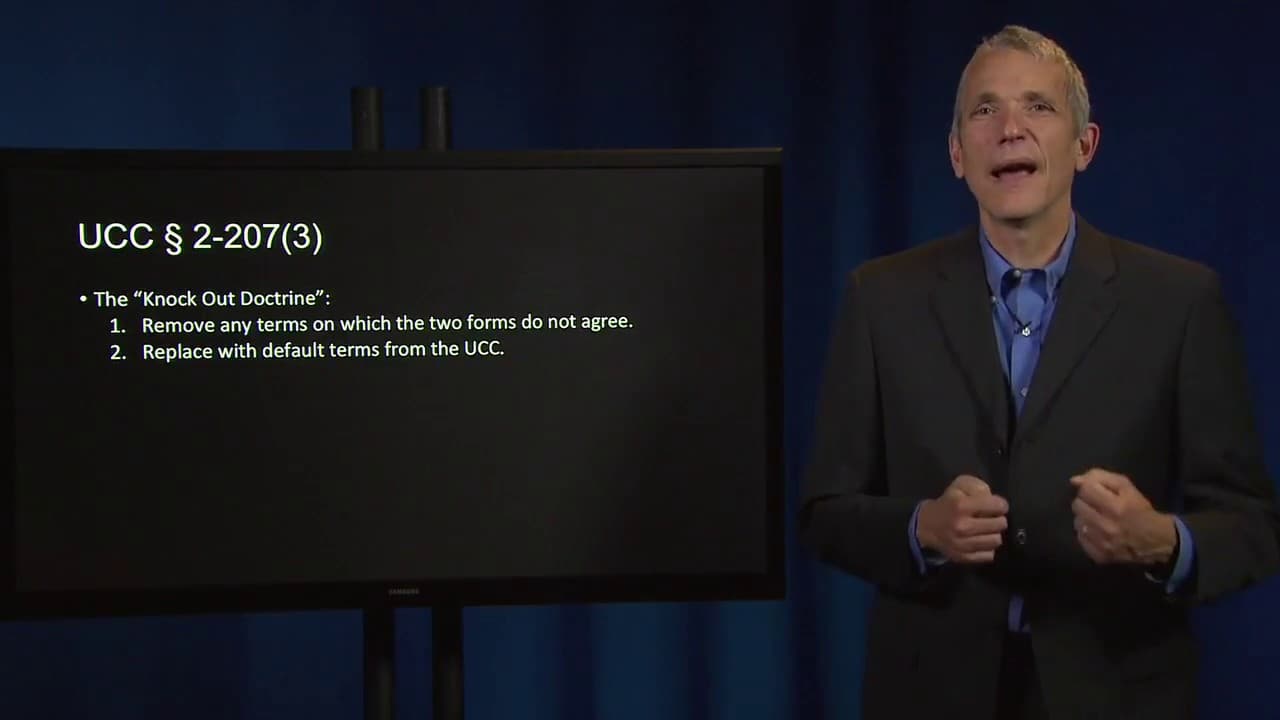
The Battle of Forms refers to a situation in contract law where parties exchange documents with conflicting terms. Under Section 2-207 of the Uniform Commercial Code, contracts may still be formed despite non-matching terms, unless the acceptance is expressly conditional. The knock-out doctrine removes conflicting terms, leaving only those mutually agreed upon along with default UCC rules.
Transcript
the next case delves into one of the most opaque sections of the Uniform Commercial Code in his pun filled opinion in textile Unlimited versus a BMH judge Thomas of the Ninth Circuit had to grapple with the Battle of the forms in which two companies send each other form documents with incompatible terms and conditions the case involved textile Unli... Read More
Key Insights
- 💁 Section 2-207 of the Uniform Commercial Code governs the Battle of Forms, where companies exchange form documents with conflicting terms.
- 👻 The UCC allows non-matching acceptances and confirmations to form contracts, rejecting the common law's mirror image rule.
- 🥳 Terms from non-matching forms become part of the contract unless they materially alter the agreement or the other party objects.
- 🥳 The knock-out doctrine applies when the parties' conduct indicates a contract formation, removing conflicting terms and relying on default UCC rules.
Install to Summarize YouTube Videos and Get Transcripts
Explore YouTube Video Summarizer or Get YouTube Transcript Extractor
Questions & Answers
Q: Why did Textile Unlimited refuse to pay ABMH and initiate a lawsuit?
Textile Unlimited claimed that it received defective yarn and refused to pay ABMH. It sued in federal court to prevent arbitration from proceeding, as ABMH had set up an arbitration in Atlanta.
Q: What does Section 2-207 of the Uniform Commercial Code address?
Section 2-207 deals with the formation of contracts and the inclusion of terms when companies exchange non-matching form documents.
Q: How does Section 2-207 define the acceptance of non-matching terms?
Section 2-207(1) states that non-matching acceptances can operate as acceptances, even if they contain additional or different terms from the offer. The UCC rejects the common law's mirror image rule in this context.
Q: How does the knock-out doctrine determine the terms of a contract?
Under the knock-out doctrine, conflicting terms are removed, and the contract is supplemented with default rules from the UCC. The actual contract terms consist of those that appear on both forms.
Summary & Key Takeaways
-
Textile Unlimited and ABMH, two companies engaged in the yarn business, exchanged form documents with conflicting terms and conditions.
-
The case involved the enforceability of an arbitration clause in the form documents sent by ABMH to Textile Unlimited.
-
The analysis focuses on Section 2-207 of the Uniform Commercial Code, which addresses the formation of contracts and the inclusion of terms in situations involving non-matching forms.
Read in Other Languages (beta)
Share This Summary 📚
Summarize YouTube Videos and Get Video Transcripts with 1-Click
Try YouTube Summary with ChatGPT & Claude or YouTube Transcript Generator
Explore More Summaries from YaleCourses 📚

Summarize YouTube Videos and Get Video Transcripts with 1-Click
Try YouTube Summary with ChatGPT & Claude or YouTube Transcript Generator