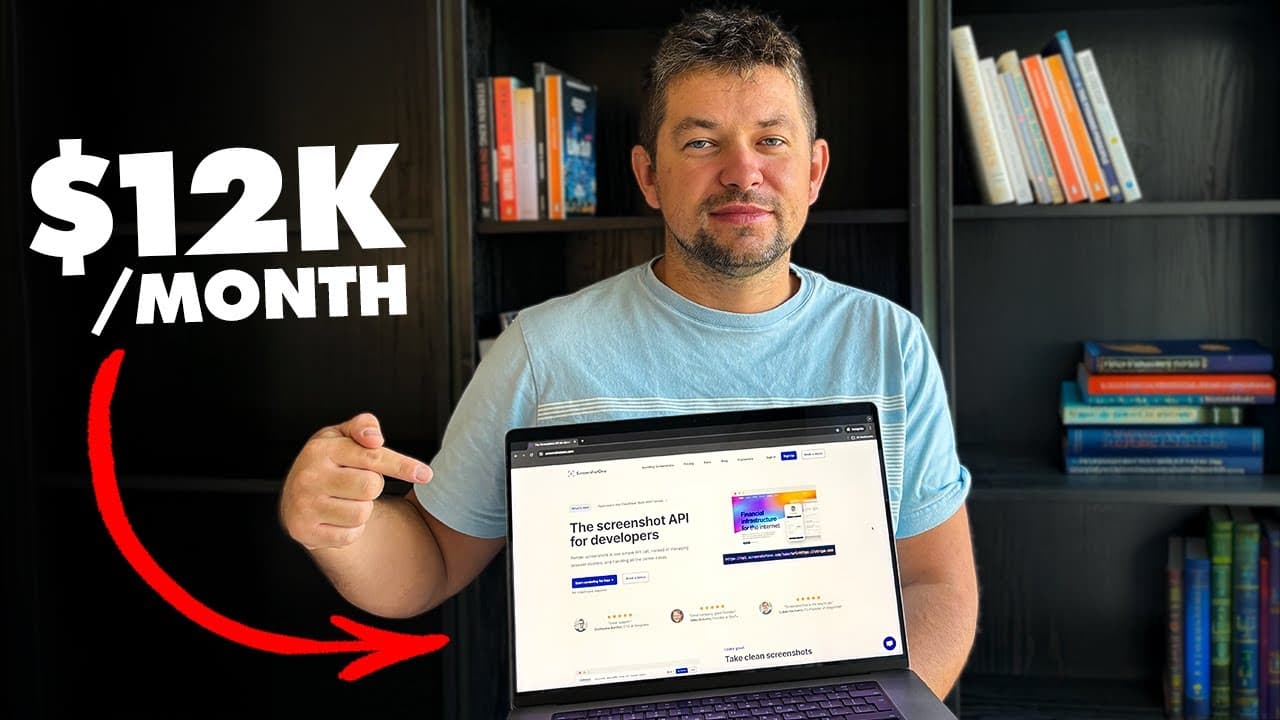
How Dmytro Built Screenshot One to $12K/Month
TL;DR
Dmytro built Screenshot One to about $12,000 in monthly recurring revenue by choosing a niche that matched his backend API skills, launching a focused product, and validating it with unfamiliar paying customers. The service reached 280 customers, while growth came through channels including Twitter and Google. Read on for his specific approach to idea selection, validation, faster launches, acquisition, retention, pricing, and infrastructure.
Transcript
two years ago I quit my job I started building trying uh experimenting and uh just recently I reached the Milestone of thinkk Mr how does this guy make over $10,000 a month with screenshots well it's because he works within the niche he knows best I knew how to build like it was kind of my super skill you know before becoming an indie hacker demitr... Read More
Key Insights
- Product selection is stronger when it matches the founder’s proven capabilities. Dmytro reduced a large collection of ideas to API products because backend development was his strongest skill, making it more realistic for him to deliver a reliable product independently.
- Existing competition is evidence that a market may contain paying customers. Dmytro viewed competing screenshot services positively because they showed that companies already purchased this type of software, while a completely original idea would still require proof that anybody needed it.
- Reliable product validation is demonstrated by unfamiliar customers who independently discover, purchase, and use the product. Friendly opinions or supportive early payments can be misleading because they do not necessarily show that the product solves a recurring problem for its intended market.
- Fast launches work by limiting the first release to one functional feature. Dmytro now tests the basic experience with close friends, launches publicly, contacts likely customers directly, and adds payments, notifications, and refinements as usage and feedback reveal what matters.
- Customer acquisition is diversified across Twitter, Google, Product Hunt, automation platforms, and YouTube. Integrations with tools such as Zapier and Make create discovery opportunities, while tutorials can attract technical users through both YouTube and Google search results.
- Churn research is more useful when cancellation follow-up is personal and specific. Dmytro reviews the customer’s profile, company, use case, and stated reason, forms a likely explanation, and asks a focused yes-or-no question that makes responding easier.
- Marketing copy is part of retention because it determines which expectations customers bring into the product. When some users expected a no-code service, Dmytro emphasized that Screenshot One is built for developers who must write code to integrate it.
- Pricing is a signal of product fit as well as a source of revenue. Dmytro raised prices and reduced the free plan after discovering that very cheap pricing left little margin, then balanced perceived customer value, profitability, and room for growth.
Install to Summarize YouTube Videos and Get Transcripts
Explore YouTube Video Summarizer or Get YouTube Transcript Extractor
Questions & Answers
Q: How did Dmytro build Screenshot One to $12K per month?
Dmytro chose screenshot automation because it matched his strongest skill, building backend APIs, and competitors showed that companies already paid for similar products. He then grew Screenshot One through channels including Twitter, Google, Product Hunt, Zapier, Make, and YouTube while improving retention, messaging, pricing, support, and infrastructure. The subscription business reached 280 customers and around $12,000 in monthly recurring revenue.
Q: How can a developer choose a viable micro SaaS idea?
Start by narrowing ideas to products that match a proven technical strength. Dmytro focused on API products because backend development was his strongest skill, then selected screenshot automation after finding competitors whose presence indicated that customers already paid for this kind of software.
Q: How should a founder validate a micro SaaS product?
Dmytro considers at least 10 paying customers from outside the founder’s network the strongest validation. These customers should independently find, buy, and use the product, because friendly opinions or supportive payments do not show whether it solves a recurring problem.
Q: How can a founder launch a SaaS product faster?
Build one small core feature, let close friends test that it works, and launch publicly before adding a complete system. Dmytro now aims to launch within one month or less, adding payments, notifications, and improvements after reaching potential customers and receiving feedback.
Q: Which customer acquisition channels worked for Screenshot One?
Twitter and Google became Screenshot One’s major acquisition channels. Product Hunt, Zapier, Make, and YouTube also created discovery opportunities, while technical tutorials could reach users through both YouTube and Google results.
Q: How can a SaaS founder learn why customers cancel?
Dmytro examines a departing customer’s company, use case, and stated cancellation reason before following up. He forms a likely explanation and asks a focused yes-or-no question, making it easier for the customer to respond and helping him understand pricing concerns, poor fit, and unmet expectations.
Q: How should a founder price a micro SaaS product?
Pricing should reflect customer value while leaving enough margin to operate and grow. After very low pricing left little margin because of server expenses, Dmytro reduced the free plan and raised later plan prices; Screenshot One subscriptions include an example price of $17 per month, with extra charges for additional screenshots or features.
Q: What technology and tools support Screenshot One?
Screenshot One uses TypeScript and Puppeteer to manage headless browsers, Go for rate limiting and API keys, and Cloudflare for screenshot storage and API access. Dmytro also uses Google Search Console and Google Keyword Planner for search analysis, PostHog for funnels and attribution, and Crisp for live-chat support.
Summary & Key Takeaways
-
Dmytro Krasun left employment after years of developing products for startups and companies. He narrowed his many business ideas to API products because backend development was his strongest skill. After rejecting an email validation concept as uninteresting, he chose screenshot automation because competitors demonstrated that companies already paid for similar solutions.
-
Screenshot One began with an overly long development process because Dmytro wanted the first release to feel perfect. His later approach became faster and smaller: build one core feature, let trusted friends test whether it works, launch publicly, contact potential customers directly, and add payments, notifications, and improvements as genuine feedback arrives.
-
Customer acquisition came from Twitter, Google, Product Hunt, automation platforms, and YouTube tutorials. Retention improved when Dmytro personally investigated cancellations and asked focused questions based on each customer’s company and use case. Pricing changes, clearer developer-focused messaging, responsive support, analytics, and careful infrastructure management helped strengthen the business.
-
The business uses TypeScript and Puppeteer to manage headless browsers, Go for rate limiting and API keys, and Cloudflare for screenshot storage and API access. Dmytro also uses search, keyword, product analytics, attribution, and live-chat tools to understand acquisition, product behavior, customer questions, and opportunities for immediate support.
Read in Other Languages (beta)
Share This Summary 📚
Summarize YouTube Videos and Get Video Transcripts with 1-Click
Try YouTube Summary with ChatGPT & Claude or YouTube Transcript Generator
Explore More Summaries from Starter Story 📚

Summarize YouTube Videos and Get Video Transcripts with 1-Click
Try YouTube Summary with ChatGPT & Claude or YouTube Transcript Generator