How a grandmother ends a lease after a graduation insult
TL;DR
The narrator withdraws the renewal offer and ends the lease with a simple written notice, prompting a family fallout. She explains the decades of sacrifice, the value of earned degrees, and the balance between politeness and standing up for herself. The twist comes when a hidden support system surfaces.
Transcript
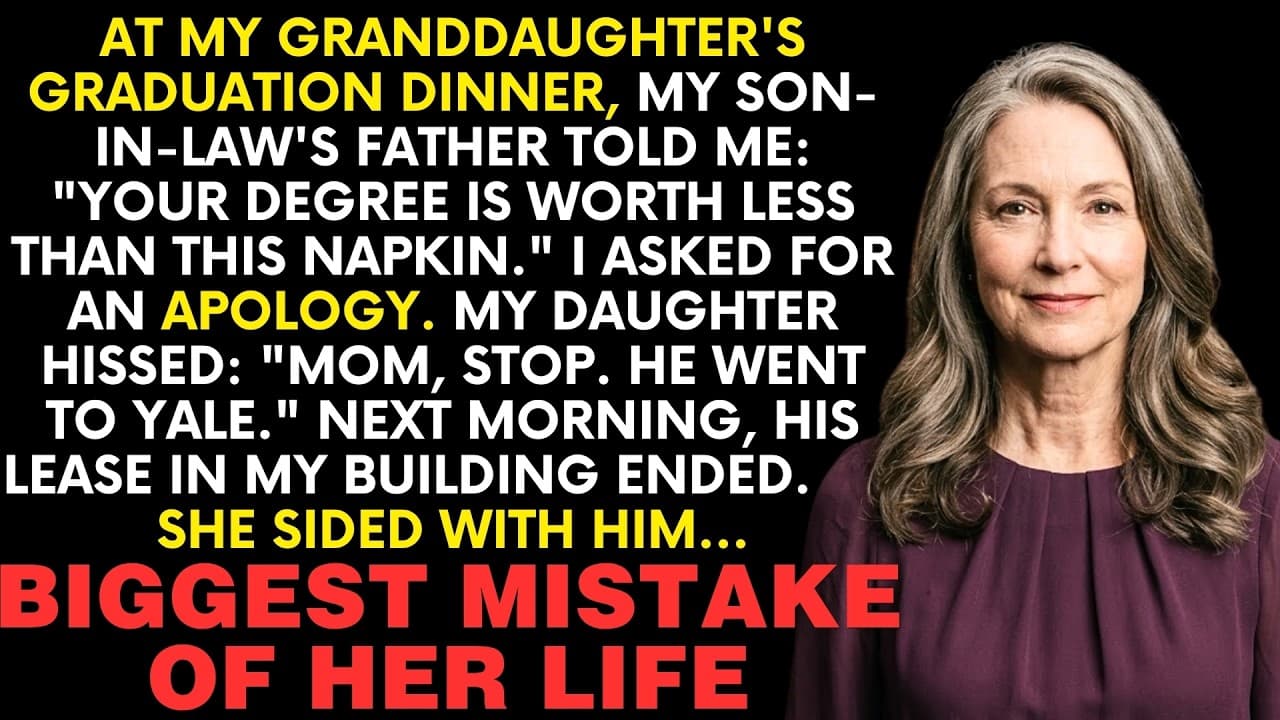
My name is Miranda Farwell and I'm 71 years old. On a Saturday night in May at my granddaughter's graduation dinner, my son-in-law's father lifted a linen napkin off his lap and held it up so the whole table could see it. Your degree is worth less than this napkin. I set down my fork. I asked him for an apology quietly. My daughter leaned toward me... Read More
Key Insights
- A degree cost is defined by what it took to earn, not the name on the diploma.
- The quietest voice in a room can become the most persuasive when someone finally speaks up.
- A written lease renewal acts as a boundary and a formal assertion of terms in a personal conflict.
- Loyalty can be transactional, but debt can be termed as a consequence rather than cash paid.
- Sacrifices remembered and acknowledged can change family dynamics and loyalties.
- A single insult can illuminate long buried grievances and trigger a reassessment of relationships.
- Clearing a misperception with clear boundaries can alter how others value your achievements.
- Respect can be demanded through calm, precise actions rather than loud confrontation.
Install to Summarize YouTube Videos and Get Transcripts
Explore YouTube Video Summarizer or Get YouTube Transcript Extractor
Questions & Answers
Q: What started the conflict at the graduation dinner?
The conflict began when Courtland, the Yale graduate, publicly belittled the narrator’s degree by saying it was worth less than a napkin. This insult at the table triggered long simmering grievances about respect, earned hard work, and how family members prioritize money and status over personal history and achievements.
Q: How does the narrator respond to the insult?
In the immediate moment, she quietly observes and does not escalate. The turning point comes when she drafts a firm renewal offer that withholds a rent reduction and insists on the original terms. She communicates this in a four sentence email to the involved parties, thereby asserting boundaries without immediate confrontation.
Q: What is revealed about the narrator’s history and sacrifice?
The narrator recounts eight years of night classes, a late start in engineering, and a rise from drafting technician to professional engineer. She emphasizes the sacrifices made, including time, money, and focus away from family, to illustrate the value of the degree and the perseverance required to earn it.
Q: What does the renewal action signify in the story?
The renewal action serves as a formal boundary and a test of loyalty within the family. By withdrawing the renewal offer and ending the lease, the narrator demonstrates that respect for achievement has tangible consequences. It also signals independence and a refusal to be treated as less capable.
Q: How does the daughter respond to the mother's action?
The daughter initially sides with the son-in-law’s father, defending the insult as if it were a harmless joke. This response reveals underlying tensions about money, status, and who gets to define family narrative. The conversation eventually deepens the rift and prompts further introspection.
Q: What later context about finances changes the family dynamic?
It is revealed that Courtland has been helping the daughter and son-in-law with their mortgage payments since February. This information reframes the conflict by showing that there were hidden supports and obligations, complicating perceptions of who “owes what” in the family and who benefits from whom.
Q: What is the central lesson about respect and boundaries?
The central lesson is that respect must be earned and clearly communicated. The narrator demonstrates that a degree is not just a credential but a life commitment, and boundaries must be explicit. Silence about sacrifices allows others to define the story, so speaking up is essential even within a family.
Q: How does the ending reframe the narrator’s actions?
The ending reframes the narrator’s actions as a principled assertion of self and family history. By ending the lease rather than evicting, she maintains dignity, protects her boundaries, and invites reflection on the true cost of respect, while leaving space for eventual reconciliation if it occurs.
Summary & Key Takeaways
-
A grandmother reflecting on decades of work and sacrifice uses a formal lease renewal as a turning point in a family dispute.
-
The story contrasts polite restraint with a decisive act that reclaims dignity and boundaries, revealing the cost of respect and the power of a quiet confrontation.
-
Ultimately the narrative reframes an insult as a catalyst for accountability, generosity, and the redefinition of family loyalties through a consequential, measured response.
Read in Other Languages (beta)
Share This Summary 📚
Summarize YouTube Videos and Get Video Transcripts with 1-Click
Try YouTube Summary with ChatGPT & Claude or YouTube Transcript Generator
Explore More Summaries from Alpha Mom Stories 📚





Summarize YouTube Videos and Get Video Transcripts with 1-Click
Try YouTube Summary with ChatGPT & Claude or YouTube Transcript Generator