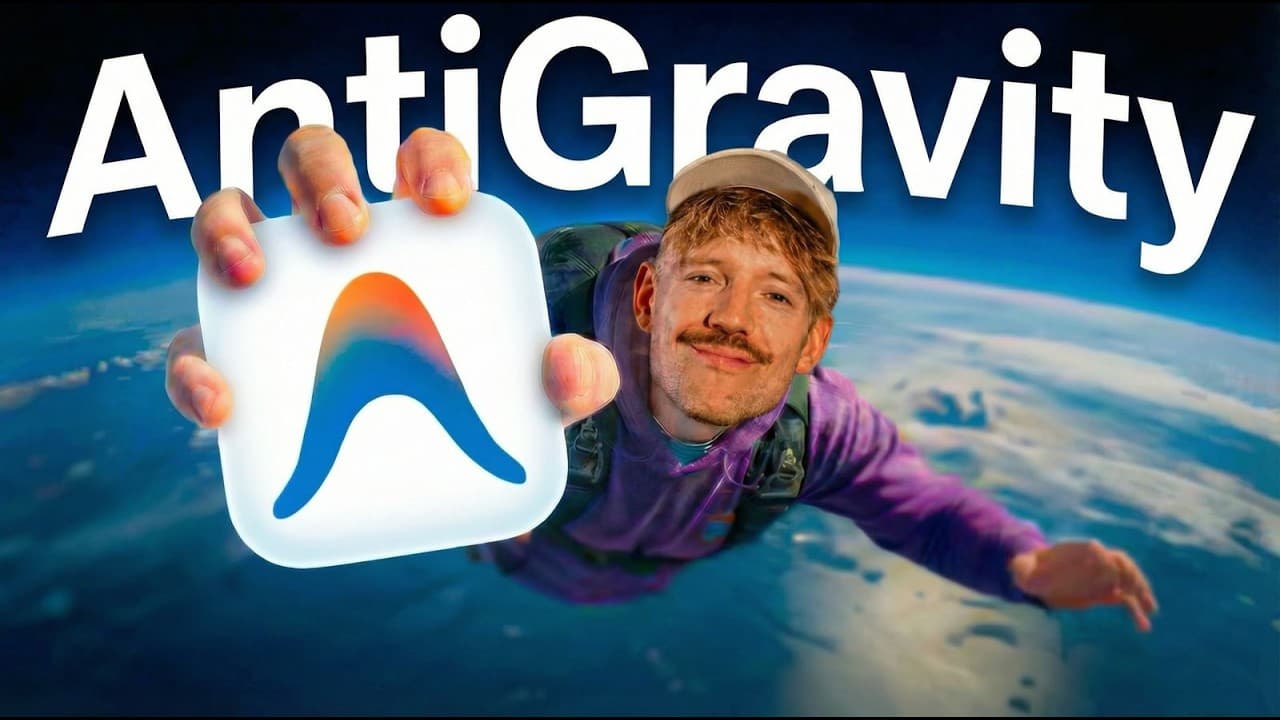
What Can 100 Hours of AntiGravity Teach You in 47 Minutes?
TL;DR
Build better software with AntiGravity by organizing each URL as its own project, importing a shared skills folder, and separating permanent global rules from on-demand workflows. Reference files directly, use extensions when helpful, plan complex builds through a structured initialization framework, and commit working versions to GitHub regularly. Read on for eight practical answers covering setup, context management, planning, and recovery.
Transcript
Google's anti-gravity has changed everything about building beautiful software, but most people use it just like a chatbot, meaning you don't get the full benefit of its capabilities. And in this video, I'm going to show you everything that I've learned from spending hundreds of hours in anti-gravity so you can save weeks of time, build things that... Read More
Key Insights
- One project folder per URL is the recommended organizational rule for Antigravity builds. A dashboard or website using one URL belongs in one project, while software using a separate URL should receive a separate project that remains accessible through the agent manager.
- A shared Antigravity skills folder is a practical repository for reusable capabilities. Design skills, audit skills, and other repeatable instructions can be saved there and imported into each new project, making them reliably available during different stages of a build.
- Extensions expand Antigravity's development environment and presentation options. The extensions panel can install tools such as Claude Code, change how code is displayed, and provide visualization support when Antigravity determines that a visual representation would help.
- Global rules are persistent instructions that govern Antigravity across projects. They are suitable for coding styles, brand colors, and other requirements that should always apply, but every global rule enters the context window for every message and therefore increases token usage.
- Workflows are reusable procedures that remain outside the active context until requested. A debugging workflow, for example, can be stored as a workspace customization and summoned with a slash command when problems arise, avoiding the continuous context cost of global instructions.
- Direct file references give Antigravity precise working context. Typing an at sign in the chat and selecting a named file explicitly identifies the material the agent should read or modify, and multiple relevant files can be referenced within the same request.
- GitHub version control protects working software from damaging changes. Regular commits create recoverable checkpoints, and asking Antigravity to push changes and confirm completion helps ensure that a known working state can be restored if later development breaks the project.
- The initialization framework is a staged system for planning and executing builds. It creates task, findings, progress, and project-constitution documents, then moves through requirements, data, integrations, architecture, interface refinement, operational triggers, repair loops, tests, results, and final deliverables.
Install to Summarize YouTube Videos and Get Transcripts
Explore YouTube Video Summarizer or Get YouTube Transcript Extractor
Questions & Answers
Q: How should AntiGravity projects be organized?
Use one project folder for each URL. A dashboard or website with one URL belongs in one project, while software with a separate URL should have a new project; the agent manager lets you access and chat with each project.
Q: How can reusable skills be shared across AntiGravity projects?
Create a dedicated folder called “AntiGravity skills” and store reusable capabilities such as design and audit skills inside it. Import that folder into every new or existing project so those skills remain accessible throughout each build.
Q: What should be included in AntiGravity global rules?
Global rules should contain instructions that must apply everywhere, such as coding style or fixed brand colors. Keep them concise because the global document is added to the context window for every message and increases token usage.
Q: What is the difference between AntiGravity workflows and global rules?
Global rules are persistent instructions included in every message context. Workflows are reusable procedures, such as debugging instructions, that remain outside the active context until invoked from the agent with a slash command.
Q: How do direct file references work in AntiGravity chat?
Type an at sign in the chat and select the file that AntiGravity should read or modify. Multiple relevant files can be referenced in the same request, giving the agent precise context for the task.
Q: Why should AntiGravity projects be committed to GitHub regularly?
Regular GitHub commits create recoverable checkpoints in the project’s version history. If later changes damage a working build, an earlier successful state can be restored.
Q: What documents does the AntiGravity initialization framework create?
The framework creates task, findings, and progress documents, along with a project constitution. Together they record phases and goals, research and constraints, completed work, errors, tests, results, and the persistent principles guiding the build.
Q: What phases are included in the structured AntiGravity build framework?
The framework starts with requirements, desired outcomes, integrations, data sources, delivery payloads, and behavioral rules. It then covers integration verification, minimum viable architecture, interface refinement, operational triggers, repair loops, testing, results, and final deliverables.
Summary & Key Takeaways
-
The recommended setup assigns one Antigravity project folder to each URL and uses the agent manager to move between projects. A separate Antigravity skills folder stores reusable design, audit, and other capabilities that can be imported into future projects, making those resources consistently accessible throughout different software builds.
-
Antigravity customizations include global rules and workflows. Global rules permanently communicate essential preferences, coding conventions, and brand requirements, but consume context with every message. Workflows hold reusable procedures, such as debugging instructions, outside the permanent context and can be loaded on demand from the agent with a slash command.
-
A structured initialization framework creates task, findings, and progress documents, plus a project constitution. Development then moves through requirements and data, integration verification, architecture, interface refinement, operational triggers, repair loops, testing, and deliverables. Frequent GitHub commits provide version history that can restore a project after damaging changes.
Read in Other Languages (beta)
Share This Summary 📚
Summarize YouTube Videos and Get Video Transcripts with 1-Click
Try YouTube Summary with ChatGPT & Claude or YouTube Transcript Generator
Explore More Summaries from Jack Roberts 📚



Summarize YouTube Videos and Get Video Transcripts with 1-Click
Try YouTube Summary with ChatGPT & Claude or YouTube Transcript Generator