Why Does an Average American Income Fall Short?
TL;DR
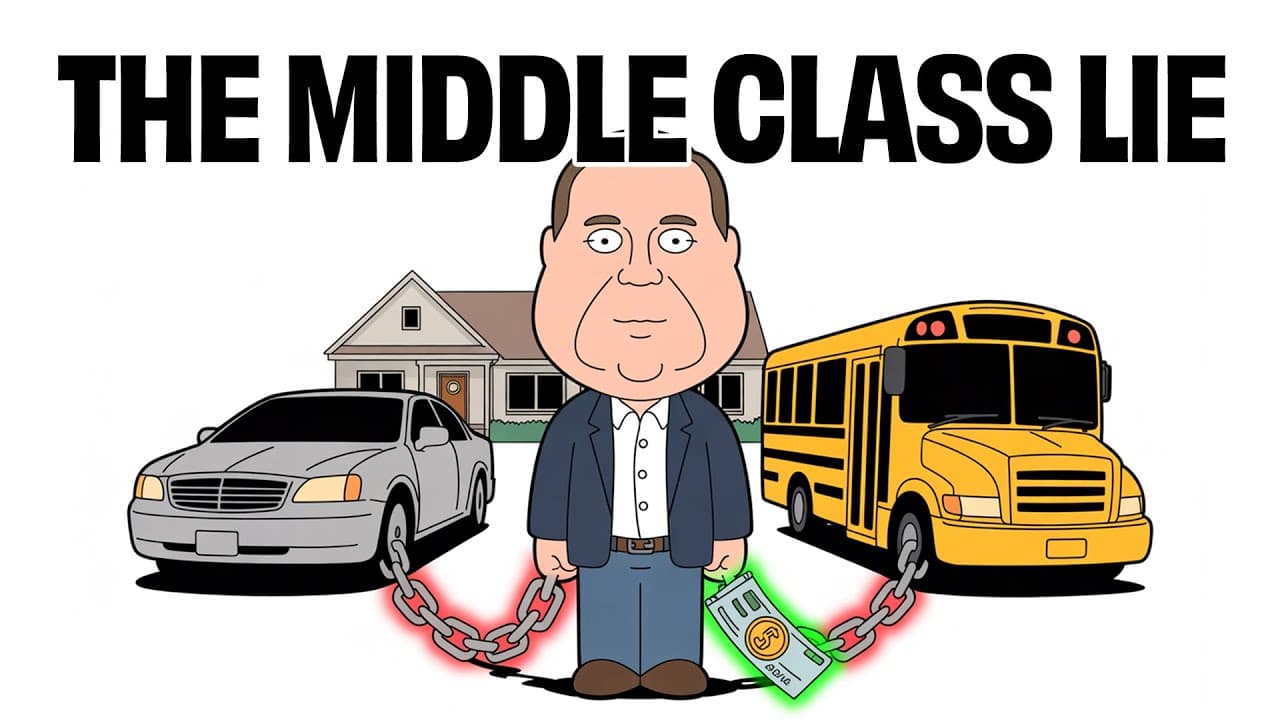
An $84,000 household income can shrink to about $5,460 in monthly take-home pay, leaving only a $460 buffer after the basic expenses estimated in the transcript. Earning more may not create security if housing, transportation, child care, debt, and social expectations expand alongside income, as illustrated by a family earning $130,000 but running a monthly deficit. Read on to see where the money goes and what actually determines financial security.
Transcript
Your credit card just got declined at the grocery store. You're standing there with a cart full of the basics. Nothing fancy, just chicken, rice, some vegetables, maybe a box of cereal for the kids. The cashier is staring at you. Uh the people behind you are pretending not to notice and your face is burning. You mumble something about the wrong car... Read More
Key Insights
- An $84,000 household income is estimated to produce about $5,460 in monthly take-home pay after taxes and a modest retirement contribution. The transcript uses this amount to show how quickly an apparently middle-class income can be consumed by ordinary monthly expenses.
- Housing is budgeted at $2,100 per month, equal to the commonly cited limit of 30% of an $84,000 gross income. After paying that amount from the estimated take-home pay, the household has roughly $3,360 left for every other need.
- Transportation is estimated at $1,300 monthly, including a car payment above $700, approximately $200 for insurance, $250 for gas, and $150 for maintenance. The calculation highlights the financial burden of needing a vehicle to reach work in many American communities.
- Basic monthly expenses leave only an estimated $460 buffer in the $84,000-income example. That remainder appears before clothing, emergency savings, additional retirement savings, entertainment, dental work, registration, haircuts, children, and the many smaller expenses that arise during ordinary life.
- The baseline cost of normal life has risen faster than wages according to the transcript. It states that housing has increased 400% since 1990, wages about 180%, college tuition more than 500%, and health care costs have tripled.
- A $130,000 household income can still produce a monthly deficit when expenses rise with family needs and lifestyle expectations. The Parkers receive an estimated $7,053 in monthly take-home pay, but listed costs leave them $77 below zero before several routine expenses.
- Financial security is defined by the gap between income and the cost of maintaining a household's expected lifestyle. A larger salary may fail to improve resilience when it is accompanied by a larger mortgage, multiple vehicles, child care, student loans, and pressure to appear successful.
- Consumer financing can make unaffordable commitments appear manageable by emphasizing monthly payments and technical approval guidelines. The transcript cites a 41% debt-to-income mortgage approval and 72-month car financing as examples of transactions optimized for completing sales rather than protecting long-term household stability.
Install to Summarize YouTube Videos and Get Transcripts
Explore YouTube Video Summarizer or Get YouTube Transcript Extractor
Questions & Answers
Q: Why can an $84,000 household income fall short in America?
The transcript estimates that taxes, FICA, and a modest retirement contribution reduce an $84,000 household income to about $65,500, or $5,460 per month. After the listed costs for housing, transportation, food, utilities, health insurance, and student loans, only about $460 remains.
Q: How is the monthly budget for an $84,000 household calculated?
The calculation starts with approximately $5,460 in monthly take-home pay. It subtracts $2,100 for housing, $1,300 for transportation, $700 for food, $350 for utilities and essentials, $200 for health insurance, and $350 for student loans, leaving an estimated $460.
Q: What makes transportation cost an estimated $1,300 per month?
The transcript budgets more than $700 for a car payment, about $200 for insurance, $250 for gas, and $150 for maintenance. Together, those costs total approximately $1,300 per month for the vehicle needed to reach work.
Q: Which expenses are excluded from the remaining $460 buffer?
The $460 does not account for clothing, emergency savings, additional retirement savings, entertainment, hobbies, dental work, car registration, haircuts, or other recurring small expenses. It also excludes children, while the transcript says child care can cost more than rent in some states.
Q: Why has an average lifestyle become harder to afford?
The transcript says the baseline cost of normal life has risen faster than wages. It states that housing costs have increased 400% since 1990, wages about 180%, college tuition more than 500%, and health care costs have tripled.
Q: Why does earning more money not always create financial security?
Higher income can be accompanied by more expensive housing, multiple vehicles, child care, student loans, and social pressure to display success. If those costs expand with earnings, the household may still have little room for emergencies or lost income.
Q: How can a household earning $130,000 run a monthly deficit?
The Parkers' $130,000 combined income produces an estimated $7,053 in monthly take-home pay after taxes and a 6% retirement contribution. Their housing, two cars, groceries, health costs, child care, student loans, and utilities leave them $77 below zero before clothing, maintenance, dental work, gifts, and other routine expenses.
Q: What determines financial security according to the transcript?
Financial security depends on the gap between income and the cost of maintaining a household's expected lifestyle, not on salary alone. When required spending consumes nearly all take-home pay, even a higher-income household remains vulnerable to an unexpected bill.
Summary & Key Takeaways
-
The transcript estimates that an $84,000 median household income becomes roughly $65,500 after taxes and a modest retirement contribution, or about $5,460 monthly. Housing, transportation, food, utilities, health insurance, and student loans then reduce the available money to approximately $460 before clothing, emergencies, entertainment, dental care, and other irregular expenses.
-
The Parkers illustrate why a higher income may not guarantee financial security. Their $130,000 combined income produces estimated take-home pay of $7,053 per month. Housing, two cars, groceries, health costs, child care, student loans, and utilities push their budget $77 below zero before routine costs such as clothing and maintenance are included.
-
The central argument is that security depends on the gap between income and required spending, not income alone. Higher earners may adopt costlier housing, transportation, schools, and social expectations. Lenders and sellers can reinforce the pattern by structuring affordable-looking monthly payments without prioritizing a household's resilience against emergencies or lost income.
Read in Other Languages (beta)
Share This Summary 📚
Summarize YouTube Videos and Get Video Transcripts with 1-Click
Try YouTube Summary with ChatGPT & Claude or YouTube Transcript Generator
Explore More Summaries from Nick Invests 📚






Summarize YouTube Videos and Get Video Transcripts with 1-Click
Try YouTube Summary with ChatGPT & Claude or YouTube Transcript Generator