What Is Retrieval-Augmented Generation (RAG) Method?
TL;DR
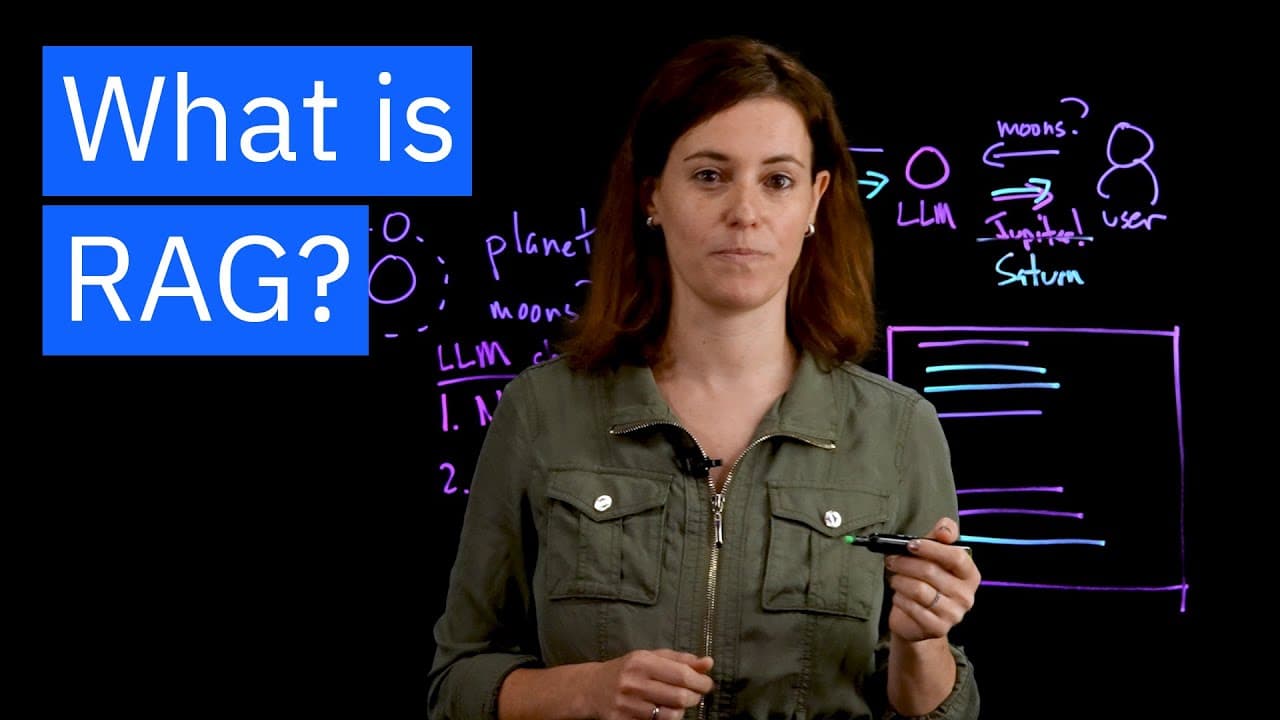
Retrieval-Augmented Generation (RAG) enhances large language models by allowing them to access a data source for accurate and current information before responding. This method improves reliability, reduces errors, and enables the model to acknowledge when it lacks sufficient information to provide an answer.
Transcript
Large language models. They are everywhere. They get some things amazingly right and other things very interestingly wrong. My name is Marina Danilevsky. I am a Senior Research Scientist here at IBM Research. And I want to tell you about a framework to help large language models be more accurate and more up to date: Retrieval-Augmented Generation, ... Read More
Key Insights
- 🌥️ RAG combines retrieval and generation in large language models to enhance accuracy and reliability.
- 💁 Grounding responses in a content store improves the sourcing and up-to-dateness of information.
- 🖤 RAG helps address challenges of outdated answers and lack of sourcing in LLMs.
- ❓ The framework encourages admitting uncertainty and saying "I don't know" when appropriate.
- 👻 Augmenting the data store with new information allows quick updates without retraining the model.
- ❓ RAG highlights the importance of improving both retriever and generative components for optimal results.
- 🖐️ Primary source data plays a crucial role in enhancing the reliability and believability of LLM responses.
Install to Summarize YouTube Videos and Get Transcripts
Explore YouTube Video Summarizer or Get YouTube Transcript Extractor
Questions & Answers
Q: What is the goal of Retrieval-Augmented Generation (RAG)?
RAG aims to improve the accuracy and up-to-dateness of large language models by combining retrieval of relevant information with the generative text response.
Q: How does RAG address the problem of outdated information?
RAG allows for the augmentation of the data store with new and updated information, enabling the model to retrieve the most up-to-date data when generating responses.
Q: What issue does RAG solve regarding sourcing of information?
RAG instructs the model to pay attention to primary source data, reducing the likelihood of the model hallucinating or leaking data and allowing it to provide evidence to support its responses.
Q: What happens when the retrieval part of RAG is not sufficiently accurate?
Insufficient retrieval performance can lead to unanswered questions, highlighting the need for improvements in both the retriever and generative parts of the model to provide high-quality responses.
Key Insights:
- RAG combines retrieval and generation in large language models to enhance accuracy and reliability.
- Grounding responses in a content store improves the sourcing and up-to-dateness of information.
- RAG helps address challenges of outdated answers and lack of sourcing in LLMs.
- The framework encourages admitting uncertainty and saying "I don't know" when appropriate.
- Augmenting the data store with new information allows quick updates without retraining the model.
- RAG highlights the importance of improving both retriever and generative components for optimal results.
- Primary source data plays a crucial role in enhancing the reliability and believability of LLM responses.
- RAG aims to reduce problematic behaviors in LLMs and create more accurate and informed conversational agents.
Summary & Key Takeaways
-
Large language models (LLMs) generate text responses to user queries but can exhibit problematic behaviors such as lack of sourcing and being out-of-date.
-
RAG introduces a retrieval-augmented approach where LLMs first retrieve relevant information from a content store before generating a response, improving accuracy and grounding the answer.
-
RAG addresses challenges like outdated answers and lack of sourcing, making the model more reliable and capable of admitting when it doesn't have an answer.
Read in Other Languages (beta)
Share This Summary 📚
Summarize YouTube Videos and Get Video Transcripts with 1-Click
Try YouTube Summary with ChatGPT & Claude or YouTube Transcript Generator
Explore More Summaries from IBM Technology 📚


Summarize YouTube Videos and Get Video Transcripts with 1-Click
Try YouTube Summary with ChatGPT & Claude or YouTube Transcript Generator