How to Handle High Conflict Personalities
TL;DR
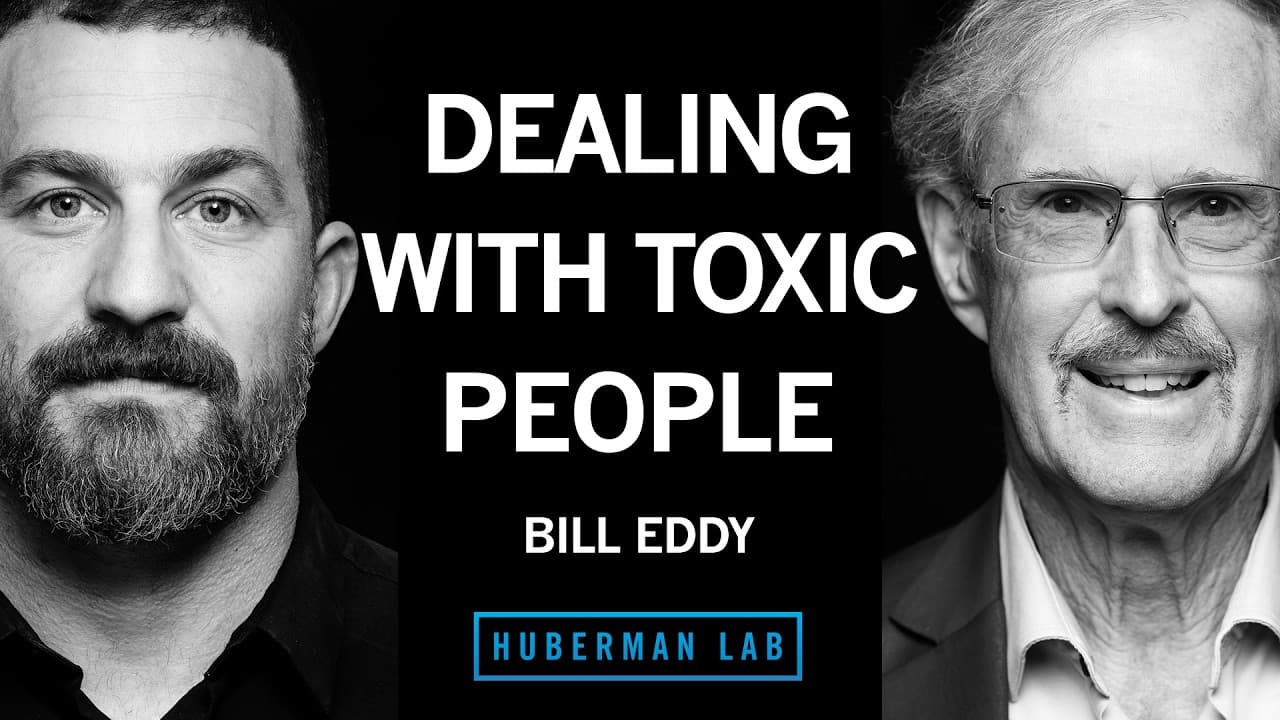
High conflict personalities are characterized by a cycle of blame and drama, impacting relationships and environments. Strategies for managing these individuals include recognizing specific communication patterns and employing the 'WEB method' to navigate interactions effectively. Empathy and problem-solving are essential in mediating conflicts and disengaging gracefully.
Transcript
welcome to the huberman Lab podcast where we discuss science and science-based tools for everyday life I'm Andrew huberman and I'm a professor of neurobiology and Opthalmology at Stanford School of Medicine my guest today is Bill Eddie Bill Eddie is a practicing lawyer a professional mediator a licensed therapist and on the faculty ... Read More
Key Insights
- High-conflict personalities are not necessarily linked to personality disorders, but they often involve blame and drama in relationships.
- These individuals can be overtly combative or passive, often playing the victim to create conflict.
- Identifying high-conflict individuals can be done through specific criteria such as blaming language and disproportionate emotional responses.
- Disengaging from high-conflict people should be done gradually, avoiding blame and focusing on changes in personal goals.
- The 'WEB method'—Words, Emotions, Behavior—can help identify high-conflict personalities by observing their communication patterns.
- High-conflict personalities thrive in environments where drama is rewarded, such as politics and media.
- Effective communication strategies include empathy and problem-solving, which can help mediate conflicts with high-conflict individuals.
- Understanding the emotional contagion effect is crucial, as high-conflict personalities can easily influence others emotionally.
Install to Summarize YouTube Videos and Get Transcripts
Explore YouTube Video Summarizer or Get YouTube Transcript Extractor
Questions & Answers
Q: What distinguishes high-conflict personalities from personality disorders?
High-conflict personalities are characterized by a preoccupation with blame and drama in relationships, whereas personality disorders involve a narrow range of interpersonal behaviors. Not all high-conflict individuals have personality disorders, but they often exhibit similar patterns, such as blaming others and avoiding responsibility.
Q: How can one identify a high-conflict personality?
High-conflict personalities can be identified through their use of blaming language, all-or-nothing thinking, unmanaged emotions, and extreme behaviors. The WEB method—focusing on Words, Emotions, and Behavior—can help in recognizing these individuals by observing their communication and interaction patterns.
Q: What is the recommended approach for disengaging from a high-conflict individual?
To disengage from a high-conflict individual, it is advised to avoid direct blame and instead frame the decision as a change in personal goals or directions. Gradual disengagement allows the individual to adjust, minimizing potential backlash. Avoiding emotional outpourings and maintaining consistency in communication are also key.
Q: Why is empathy important in dealing with high-conflict personalities?
Empathy is crucial because it helps to de-escalate conflicts and fosters a problem-solving approach. High-conflict individuals often react defensively, so demonstrating understanding without blame can reduce tension and facilitate more constructive interactions. Empathy also helps in maintaining a level of detachment necessary for effective conflict resolution.
Q: How does the emotional contagion effect relate to high-conflict personalities?
High-conflict personalities often have heightened emotions that are contagious, influencing those around them. This emotional contagion can escalate conflicts as others become emotionally involved. Understanding this effect is important for maintaining objectivity and preventing the spread of conflict within groups or organizations.
Q: What role does societal context play in the prevalence of high-conflict personalities?
Societal contexts that reward drama, such as media and politics, can amplify the behaviors of high-conflict personalities. These environments often provide attention and validation for dramatic actions, reinforcing the individual's patterns. Recognizing these dynamics can help in understanding and mitigating the impact of high-conflict individuals in such settings.
Q: What is the significance of the 'first-year rule' in relationships?
The 'first-year rule' suggests avoiding major commitments, such as marriage or having children, within the first year of a relationship. This period allows individuals to observe patterns of behavior that may indicate high-conflict tendencies, providing an opportunity to assess compatibility and avoid entanglement with high-conflict personalities.
Q: How can the WEB method be applied to professional settings?
In professional settings, the WEB method can be used to evaluate colleagues or partners by observing their words for blame, their emotional responses for disproportionate reactions, and their behaviors for extremes. This approach helps in identifying high-conflict individuals and adapting interactions to minimize conflict and enhance collaboration.
Summary & Key Takeaways
-
Bill Eddy, an expert in conflict resolution, discusses how to identify and manage high-conflict personalities, which are distinct from personality disorders. He explains that these individuals often engage in cycles of blame and drama, affecting their relationships and environments.
-
The podcast provides tools for recognizing high-conflict individuals, such as the WEB method, and offers strategies for disengaging from them without escalating conflict. Eddy emphasizes the importance of empathy and problem-solving in mediating conflicts involving these personalities.
-
Listeners learn about the societal impact of high-conflict personalities, particularly in media and politics, where drama is often rewarded. Eddy highlights the emotional contagion effect, which can amplify conflicts, and offers insights into navigating these challenging interactions.
Read in Other Languages (beta)
Share This Summary 📚
Summarize YouTube Videos and Get Video Transcripts with 1-Click
Try YouTube Summary with ChatGPT & Claude or YouTube Transcript Generator
Explore More Summaries from Andrew Huberman 📚
Summarize YouTube Videos and Get Video Transcripts with 1-Click
Try YouTube Summary with ChatGPT & Claude or YouTube Transcript Generator