How to Scale Profitable Faceless YouTube Channels
TL;DR
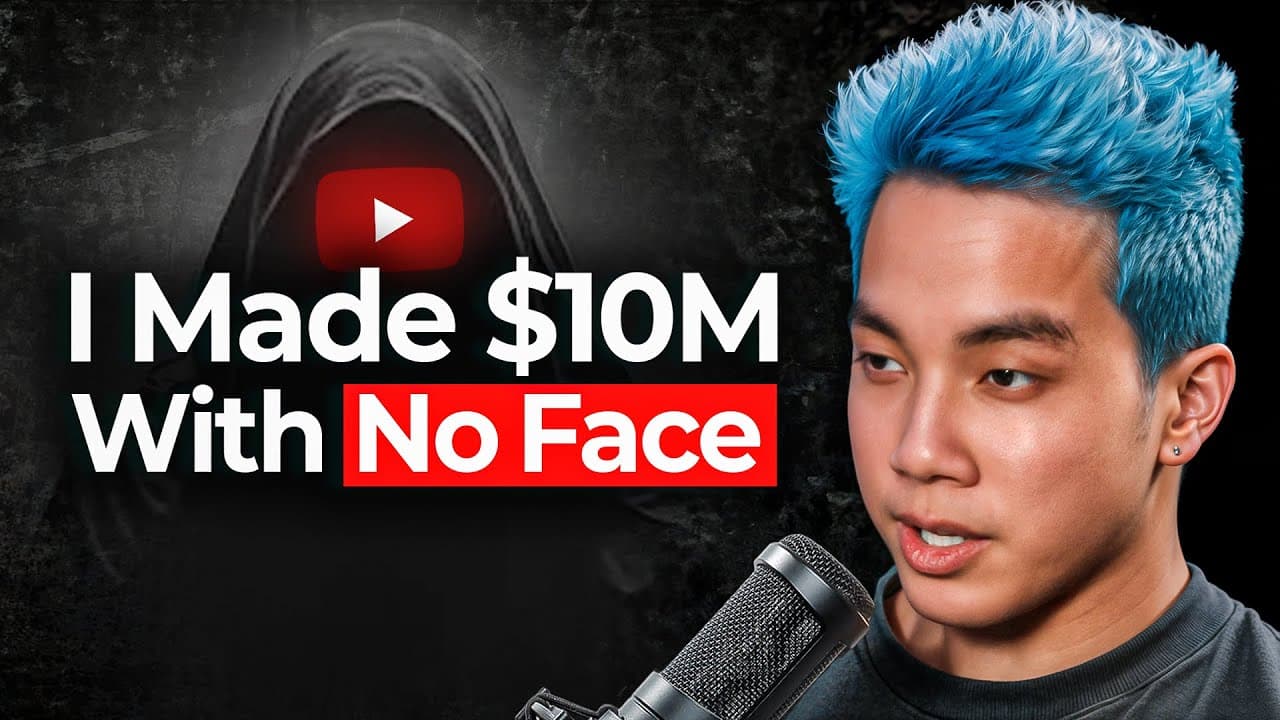
Scaling a faceless YouTube channel requires separating income from personal labor by gradually outsourcing production while preserving quality. Start with simple tasks, document acceptable standards, and expand delegation from the least important sections toward writing, editing, and thumbnails. Growth then comes from publishing more proven content while aligning channel positioning, ideas, packaging, hooks, and retention.
Transcript
today's guest makes $250,000 a month doing pretty much nothing some months I was making like 200k a month 300K a month but if you want to get past that you really need like something else born in Vietnam he immigrated to the US with hopes of chasing the American dream but after finding a stable job with an $80,000 a year salary he abandoned everyth... Read More
Key Insights
- YouTube channel growth is constrained when one creator personally handles research, writing, voiceover, editing, thumbnails, and administration. Jake Tran reached a ceiling near $20,000 to $25,000 per month while working 10 to 12 hours each day.
- Gradual outsourcing is a way to preserve quality while reducing personal production work. Tran began with a virtual assistant and audio editor, then delegated the final 30 to 60 seconds of videos before expanding an editor's responsibility.
- The creator's role can shift from production to quality control after a reliable team is established. Tran compares his position to a master chef who approves what comes out while specialists complete writing, editing, audio preparation, and thumbnail production.
- YouTube performance begins with channel positioning and video selection before production quality becomes relevant. Tran describes a chain consisting of the channel idea, individual video ideas, title and thumbnail, opening hook, successive sections, and a possible call to action.
- Titles and thumbnails work together as a single offer that persuades viewers to click. A strong thumbnail can fail with the wrong title, while an acceptable thumbnail paired with the right title can present an idea viewers strongly want to explore.
- The opening 30 to 60 seconds must raise interest and give viewers a reason to continue. Tran recommends creating an open loop, where the introduction reveals enough information to generate excitement while postponing the conclusion or full explanation.
- Each section of a YouTube video should motivate viewers to watch the next section. The title and thumbnail create the first unanswered question, the hook sustains it, later segments continue the chain, and the ending may direct viewers to another upload.
- Increasing output can raise revenue when each additional video maintains the established quality and economics. Tran describes moving from four monthly videos earning about $5,000 each to approximately eight uploads, which increased monthly revenue from around $20,000 to $40,000.
Install to Summarize YouTube Videos and Get Transcripts
Explore YouTube Video Summarizer or Get YouTube Transcript Extractor
Questions & Answers
Q: How do you scale a faceless YouTube channel?
Scale a faceless YouTube channel by gradually transferring repeatable production tasks to specialists while retaining control of ideas and quality. Jake Tran started with administrative duties and audio cleanup, then assigned an editor the final 30 to 60 seconds of each video. Once the work met his standards, he expanded the assignment until the editor handled complete videos, followed by thumbnails and writing.
Q: What should a YouTube creator outsource first?
A creator with an established style can begin by outsourcing the simplest and least sensitive tasks. Tran first used a virtual assistant for minor administrative work and an audio editor to trim raw voiceover recordings. He then delegated the easiest portion of video editing, starting near the ending, before gradually handing over more important sections after confirming that the editor could maintain his standards.
Q: Why should YouTube creators stop doing everything themselves?
Doing every task personally creates a ceiling because publishing capacity remains tied to the creator's available hours. Tran says he worked 10 to 12 hours daily and struggled to move beyond roughly $20,000 to $25,000 per month. His mentor warned that without separating labor from income, the channel would function like another job and could eventually produce the same burnout he had experienced before.
Q: How important are YouTube titles and thumbnails?
Titles and thumbnails operate together as the offer that earns a viewer's click. Tran says a strong thumbnail paired with the wrong title can fail, just as a strong title can fail with an unsuitable thumbnail. He therefore evaluates thumbnails with the proposed title already in place. Even an acceptable thumbnail can work when the title clearly presents an idea that viewers want to investigate.
Q: How do you write an effective YouTube video hook?
An effective YouTube hook uses the first 30 to 60 seconds to increase emotional interest and create an unanswered question. Tran calls this an open loop because viewers must continue watching to understand the outcome. The introduction should provide enough information to validate the promise made by the title and thumbnail, then establish another reason to watch the following section.
Q: What work remains for a faceless channel owner after outsourcing?
After outsourcing production, the channel owner can concentrate on editorial direction and quality control. Tran chooses upcoming video ideas, reviews writers' outlines, checks whether the intended subjects are covered, and reviews final scripts. For his main channel, he also records the voiceover, evaluates the completed edit, gives direction on titles and thumbnails, and approves the final package before publication.
Q: How can publishing more YouTube videos increase revenue?
Publishing more videos can increase revenue when existing videos already have reliable economics and added output does not reduce quality. Tran recalls earning about $5,000 in revenue per video while releasing four videos monthly, producing roughly $20,000. Outsourcing helped him increase output to around eight videos per month, and maintaining comparable quality allowed monthly revenue to rise to approximately $40,000 without doubling his own hours.
Q: What is the correct order for planning a YouTube video?
Tran treats YouTube performance as a connected chain. The process starts with how the channel is positioned, followed by selecting a compelling video idea. The title and thumbnail must then work together to earn the click. Afterward, the opening hook must retain attention, each subsequent section must lead naturally into the next, and the ending can invite viewers to watch another channel video.
Summary & Key Takeaways
-
Jake Tran says his channels have generated multiple millions of dollars, while his current involvement can require only two to four hours per day. His responsibilities center on choosing ideas, reviewing outlines and scripts, recording voiceovers for his main channel, checking final edits, and directing titles and thumbnails.
-
His early growth stalled around $20,000 to $25,000 per month because he personally handled every production task and worked 10 to 12 hours daily. A business mentor helped him recognize that tying revenue directly to his own labor would create another demanding job and eventually cause burnout.
-
Tran delegated production gradually, beginning with administrative work and audio cleanup before assigning editors the least important video sections. After confirming that quality remained acceptable, he expanded their responsibilities into complete edits, thumbnails, and writing. This system allowed him to increase publishing frequency without doubling his personal workload.
Read in Other Languages (beta)
Share This Summary 📚
Summarize YouTube Videos and Get Video Transcripts with 1-Click
Try YouTube Summary with ChatGPT & Claude or YouTube Transcript Generator
Explore More Summaries from Jack Neel 📚


Summarize YouTube Videos and Get Video Transcripts with 1-Click
Try YouTube Summary with ChatGPT & Claude or YouTube Transcript Generator