Andrew Tate on Masculinity, Power, and Politics
TL;DR
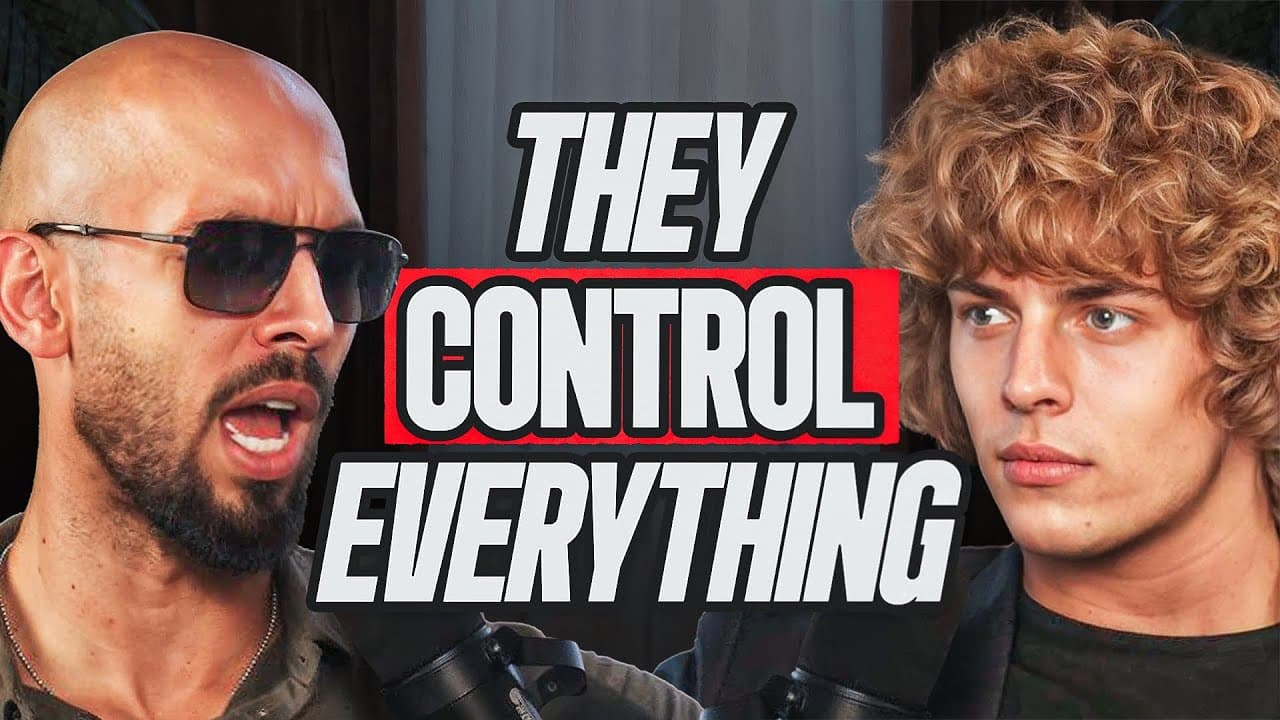
Andrew Tate says his central mission is restoring traditionally masculine traits because he believes men should protect families, enforce boundaries, and resist social pressure. He also argues that governments use prosecution and financial pressure to weaken influential opponents, while acknowledging that his legal cases remain unresolved and presenting these ideas as his personal interpretation of events.
Transcript
first they try and cancel you they can't call me stupid and they can't call me unsuccessful and they can't call me the things they want to call me so instead they have to say I'm a bad person then they put you in jail if you ever have anything people are going to come and try and take it which is why they put me in jail in the first place I have in... Read More
Key Insights
- Tate's explanation of his legal troubles is that governments target influential people by damaging their reputations, pursuing criminal proceedings, and imposing expensive legal burdens. He presents this as his interpretation of events and repeatedly maintains that he has done nothing wrong.
- Tate's financial argument is that prolonged prosecution can indirectly benefit the state because wealthy defendants spend heavily on legal representation, while a substantial portion of that spending returns through taxation. He uses this reasoning to question the incentives surrounding extended investigations and proceedings.
- Tate's account of Romania is that it served as a proxy for Western authorities seeking action against him. He says the Romanian judiciary appears partly fair because cases are gradually being rejected, but he believes Romania would not protect him if external pressure became sufficiently strong.
- Tate's cultural identity is primarily English despite his connection to America. He describes English culture as difficult to explain without growing up in it, contrasting English mockery and reserve with what he sees as the friendlier, more openly concerned manner of Americans.
- Tate's stated mission is to restore traditionally masculine traits among men. He defines men as protectors who establish boundaries, challenge encroachment, and defend families and communities from ideas or pressures they consider harmful.
- Tate's theory of social decline is that weakening masculinity removes a logical barrier against emotional arguments and propaganda. He claims that societies become easier to influence when men are less willing to reject prevailing messages or accept social disapproval.
- Tate's view of conformity is that many people prefer systems that reduce independent thought and personal responsibility. He argues that such people readily adopt rapidly changing political messages because belonging to an established system feels safer than judging claims independently.
- Tate's geopolitical concern is that Western societies are debating basic questions about identity while countries he considers more masculine remain focused and cohesive. He argues that the West will need stronger masculine qualities as international divisions become more pronounced.
Install to Summarize YouTube Videos and Get Transcripts
Explore YouTube Video Summarizer or Get YouTube Transcript Extractor
Questions & Answers
Q: Why does Andrew Tate believe authorities are prosecuting him?
Tate claims authorities are pursuing him because he has influence that they want to remove. He describes prosecution as part of a progression that begins with reputational attacks and advances to imprisonment when cancellation fails. He also suggests that prolonged cases impose major legal costs and generate tax revenue. These are Tate's allegations and interpretations, not conclusions established within the interview.
Q: What does Andrew Tate claim about Romania's role in his legal cases?
Tate claims Romania acted as a proxy after Western powers requested action against him. In his account, a Romanian prosecutor investigated him and assembled a case, but the country's judiciary has shown some independence by gradually rejecting parts of it. He says Romania itself has no problem with him, yet he doubts it would protect him when facing strong external pressure.
Q: How does Andrew Tate describe the British allegations against him?
Tate says British authorities raised allegations involving tax avoidance and money laundering after Romanian proceedings failed to produce the outcome he believes Western officials wanted. He recalls previously predicting that the British state would pursue him next. He denies wrongdoing and says the outcome remains uncertain, so his comments represent his defense and theory about the authorities' motives.
Q: Why does Andrew Tate identify more strongly as English than American?
Tate says he sees himself as more English because he grew up with a culture that is difficult to understand from the outside. He contrasts friendly American reactions with an English tendency toward reserve, mockery, and dark humor, using a crashed-car joke as an example. He says he misses England but worries that the Western world is becoming increasingly dystopian.
Q: What is Andrew Tate's stated mission regarding masculinity?
Tate says his mission is to restore traditionally masculine traits in men. He views men as protectors who enforce boundaries, defend their families, and resist harmful social or political pressures. Although he says he did not initially think of this work as a formal mission, he chose to become a visible example after concluding that declining masculinity underlies many Western problems.
Q: How does Andrew Tate connect masculinity with resistance to propaganda?
Tate argues that masculine leadership creates a logical barrier against emotional messaging, fear, and rapidly changing political narratives. He believes men are generally more prepared to risk hurting feelings when they think a position is correct. In his view, societies become easier to influence when fewer men are willing to pause, question prevailing claims, or reject socially approved conclusions.
Q: What does Andrew Tate say about personal responsibility and conformity?
Tate argues that many people prefer being directed by a larger system because it removes the burden of independent thought and personal responsibility. He says this mindset allows people to avoid blaming themselves for personal failures and makes them more receptive to repeated political messaging. He uses changing public attitudes toward political figures as his example of how quickly conformity can operate.
Q: Why does Andrew Tate think masculinity matters geopolitically?
Tate believes masculinity matters because he expects the world to divide into competing political blocs. He portrays China, Russia, and aligned countries as masculine societies, while describing the West as distracted by disputes over the meanings of manhood and womanhood. His conclusion is that Western countries will need stronger, more decisive men to remain cohesive and respond effectively to international competition.
Summary & Key Takeaways
-
Tate portrays his legal difficulties as attempts by governments to remove his influence. He claims Romania acted under pressure from Western powers and says British authorities later pursued allegations involving taxation and money laundering. He maintains that he committed no wrongdoing and interprets the continuing proceedings as politically and financially motivated.
-
Discussing national identity, Tate says he feels more English than American because he grew up with English culture and identifies with its less openly friendly humor. Although he misses England, he describes the Western world as increasingly dystopian and questions where a politically controversial public figure could live securely.
-
Tate defines his broader purpose as encouraging traditionally masculine qualities in men. He argues that men historically protected families, enforced social boundaries, favored logic over emotional pressure, and confronted uncomfortable issues. His account connects declining masculinity with political persuasion, disputed ideas about sex and gender, migration, public health, and geopolitical weakness.
Read in Other Languages (beta)
Share This Summary 📚
Summarize YouTube Videos and Get Video Transcripts with 1-Click
Try YouTube Summary with ChatGPT & Claude or YouTube Transcript Generator
Explore More Summaries from Jack Neel 📚




Summarize YouTube Videos and Get Video Transcripts with 1-Click
Try YouTube Summary with ChatGPT & Claude or YouTube Transcript Generator