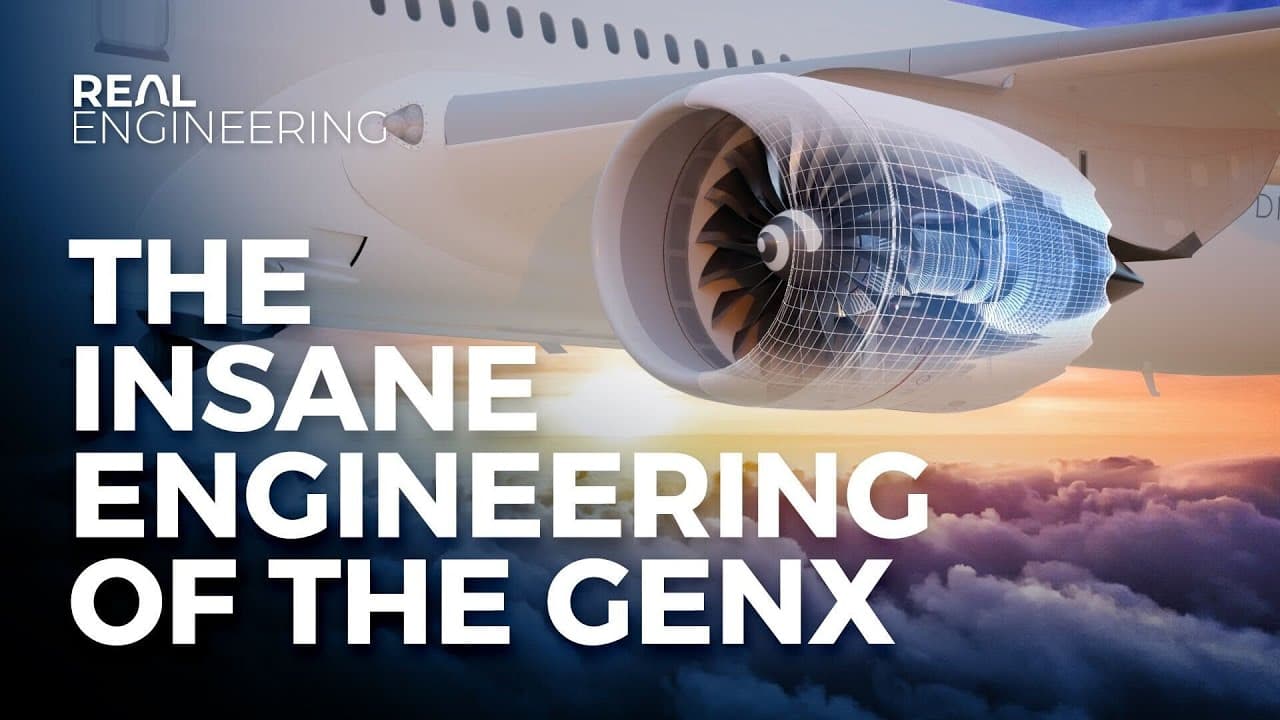
The Insane Engineering of the GEnX
TL;DR
The GEnX engine revolutionizes aviation with efficiency and power.
Transcript
Jet engines are a marvel of engineering. From precisely controlling the internal atomic structure of metals to create turbine blades that are just one single crystal to delicate robotic machining that humans could only have dreamed of a decade ago. The jet engines of today are barely recognisable to those of 1940. They’re bigger, they’re more power... Read More
Key Insights
- The GEnX engine on the 787 Dreamliner is a significant technological advancement, offering 15% better fuel efficiency compared to previous engines.
- The 787's no-bleed air architecture uses electric power for systems traditionally run on compressed air, enhancing efficiency and reducing weight.
- The GEnX engine features a high bypass ratio of 9 to 1, significantly improving fuel efficiency by moving more air through the bypass duct.
- Innovative carbon fiber fan blades reduce weight and allow for higher rotational speeds, improving engine performance and fuel efficiency.
- Advanced 3D printing technology enabled the development of the TAPS fuel injector, reducing nitrogen oxide emissions by 60%.
- The 787's electric braking system eliminates hydraulic components, reducing weight and maintenance complexity.
- Engine chevrons on the GEnX reduce noise pollution by controlling air vortices, allowing for less fuselage insulation and weight reduction.
- The GEnX engine's high compression ratio of 58 to 1 maximizes energy extraction from fuel, contributing to its superior performance.
Install to Summarize YouTube Videos and Get Transcripts
Explore YouTube Video Summarizer or Get YouTube Transcript Extractor
Questions & Answers
Q: How does the GEnX engine improve fuel efficiency?
The GEnX engine improves fuel efficiency through a high bypass ratio, advanced materials like carbon fiber fan blades, and a high compression ratio. These features reduce fuel consumption by 15% compared to previous engines, allowing for greater thrust with less fuel usage.
Q: What is unique about the 787's no-bleed air architecture?
The 787's no-bleed air architecture is unique as it uses electric power instead of hot compressed air to run systems like cabin pressurization and air conditioning. This design reduces the aircraft's weight and increases overall efficiency, as electric systems are lighter and more efficient.
Q: How do carbon fiber fan blades benefit the GEnX engine?
Carbon fiber fan blades benefit the GEnX engine by reducing the weight of the blades, allowing them to spin faster and be longer. This results in a higher bypass ratio, which increases fuel efficiency. The blades are also more rigid, providing better performance and durability.
Q: What role do engine chevrons play in noise reduction?
Engine chevrons on the GEnX play a crucial role in noise reduction by controlling the mixing of fast-moving exhaust air with ambient air. This design reduces turbulence and noise, allowing for less sound insulation in the fuselage, which decreases the aircraft's weight.
Q: How does the TAPS fuel injector reduce emissions?
The TAPS fuel injector reduces emissions by ensuring a lean air-fuel mixture, avoiding the high-temperature stoichiometric zone that produces nitrogen oxides. This is achieved through complex internal air channels, made possible by 3D printing, which allows for precise fuel-air mixing.
Q: What advancements in material science are used in the GEnX engine?
The GEnX engine uses advancements in material science, such as gamma titanium aluminide for turbine blades, which combines heat resistance with reduced weight. This material, along with carbon fiber composites, contributes to the engine's efficiency and performance improvements.
Q: Why is the 787's electric braking system significant?
The 787's electric braking system is significant because it replaces traditional hydraulic systems, reducing weight and maintenance complexity. Electric brakes are easier to install and maintain, and they contribute to the overall efficiency and reduced weight of the aircraft.
Q: What future advancements could further improve jet engine efficiency?
Future advancements in jet engine efficiency could include higher bypass ratios achieved through speed reduction gears, improved materials for higher pressure and temperature tolerances, and more sophisticated fuel injection technologies to further reduce emissions and increase fuel efficiency.
Summary & Key Takeaways
-
The GEnX engine on the 787 Dreamliner represents a breakthrough in aviation technology, providing significant fuel savings and reduced emissions. Its high bypass ratio and innovative materials contribute to its efficiency.
-
The 787 Dreamliner utilizes a no-bleed air system, relying on electric power to operate systems traditionally powered by compressed air, which reduces weight and increases efficiency.
-
Advanced engineering features, such as carbon fiber fan blades and 3D-printed fuel injectors, enhance the GEnX engine's performance, making it quieter and more efficient than previous models.
Read in Other Languages (beta)
Share This Summary 📚
Summarize YouTube Videos and Get Video Transcripts with 1-Click
Try YouTube Summary with ChatGPT & Claude or YouTube Transcript Generator
Explore More Summaries from Real Engineering 📚





Summarize YouTube Videos and Get Video Transcripts with 1-Click
Try YouTube Summary with ChatGPT & Claude or YouTube Transcript Generator