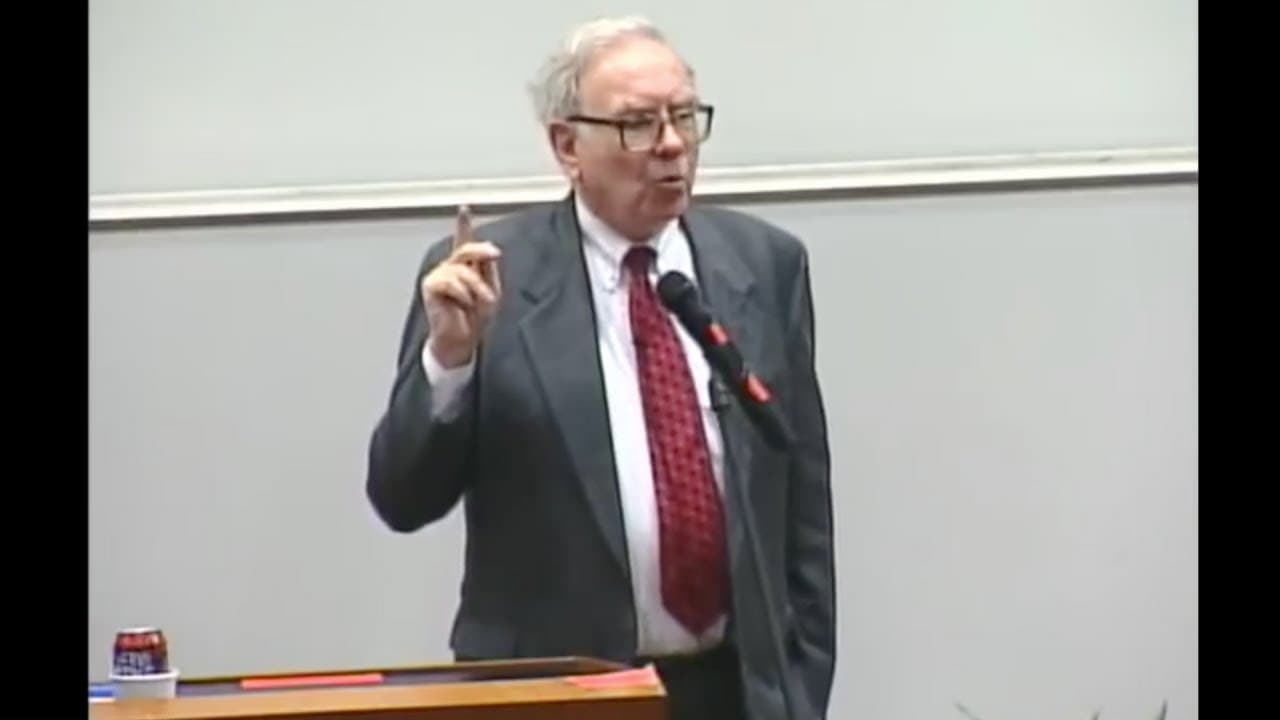
Warren Buffett | Lecture | University Of Georgia | 2001
TL;DR
Integrity, initiative and intelligence drive lasting investing success. Buffett stresses choosing an admirable employer or mentor, forming strong habits early, and avoiding errors like taking the easy resume route. The talk blends practical career guidance with value investing principles and the importance of learning from mistakes.
Transcript
well good morning and welcome what a nice crowd you certainly got quiet quickly kind of surprised me can you hear me all right yeah thank you well for a business school you know it doesn't get much better than this having the world's greatest investor come to your campus is quite an honor warren buffett is chairman of berkshire hathaway a holding c... Read More
Key Insights
- Integrity is a foundational trait for long term success in any field.
- Initiative or energy amplifies talent but must be guided by honesty to be effective.
- Intelligence alone cannot compensate for lack of integrity in high stakes roles.
- Habits formed in youth determine future behavior and outcomes more than innate talent alone.
- Choosing mentors or employers you admire leads to more fulfilling and successful work.
- Avoiding shortcuts and acknowledging mistakes builds credibility and resilience.
- Self improvement comes from deliberate self assessment and consistent ethical behavior.
- Character can be developed through intentional choices about actions and priorities, not just talent or luck.
Install to Summarize YouTube Videos and Get Transcripts
Explore YouTube Video Summarizer or Get YouTube Transcript Extractor
Questions & Answers
Q: What three qualities does Buffett say he looks for when hiring, and why are they important?
Buffett says he looks for intelligence, initiative or energy, and integrity. The third quality, integrity, is essential because without it the first two can lead to harmful outcomes; you would prefer someone who is lazy and dumb over someone smart and energetic but lacking integrity. Integrity acts as a guardrail ensuring effort and intellect are used ethically and reliably. This combination makes a person trustworthy, responsible, and capable of sustained success.
Q: How does Buffett describe the impact of habits on long term success?
Buffett explains that habits are like chains that may be light and barely felt when formed, but can become heavy and irreversible later. He emphasizes forming positive, self controlled habits early, because those patterns shape decision making, credibility, and performance over decades. The message is to consciously cultivate habits that support integrity and productive work, since they determine outcomes more than raw talent.
Q: What is the thought experiment Buffett uses about choosing a classmate, and what is it meant to illustrate?
He asks you to pick a classmate to receive ten percent of their future earnings for life, then to determine who you would choose and why while also identifying who you would short financially. The exercise is designed to reveal what you value in a person beyond grades or wealth, highlighting the importance of character traits such as honesty, reliability, and willingness to do more than others. It demonstrates that long term success hinges on solid character.
Q: What advice does Buffett give about choosing where to work after graduation?
Buffett suggests working for an institution or individual you admire rather than chasing a bigger paycheck or a more prestigious resume. He argues that enthusiasm and purpose from working with trusted mentors lead to better learning and eventual success. When you enjoy your work and are aligned with someone you respect, you will naturally perform better and sustain long term motivation.
Q: Why does Buffett call Berkshire Hathaway’s history of performance notable, according to the talk?
The talk notes Berkshire Hathaway’s share price started around 18 in 1965 and later rose substantially, indicating a long term record of outperformance relative to the S&P 500. This is used to illustrate the power of patient, value oriented investing and disciplined capital allocation, as well as Berkshire’s ability to generate cash streams for further investments.
Q: How does Buffett view the dot com hysteria and market excitement of his era?
Buffett states that Berkshire Hathaway was absent from the dot com hysteria and that this selective restraint is part of his investment discipline. He implies that ignoring hype and focusing on durable business value rather than fashionable trends is more reliable for long term wealth creation, underscoring a cautious, evidence driven approach to investing.
Q: What does Buffett say about reading his shareholder letters and what value do they provide?
Buffett mentions that his shareholder letters contain wisdom and insights that are valued by investors, describing them as a form of learning material that can be absorbed carefully. He suggests reading them to gain practical business lessons and to understand his approach to investing and corporate decisions, which have guided Berkshire Hathaway’s strategy for years.
Q: What is the core message about personal development that Buffett conveys to students?
The core message is that personal development hinges on selecting the right values and habits, such as integrity, honesty, and generosity, rather than merely chasing intelligence or external rewards. By shaping character and choosing mentors wisely, individuals can become the kind of person others would want to invest in and emulate, leading to lasting success.
Summary
Warren Buffett, the renowned investor, visited a business school and shared his insights and wisdom. He discussed the importance of working for institutions or individuals that one admires, rather than focusing on short-term gains or prestigious resumes. Buffett emphasized the value of integrity, honesty, and generosity in achieving success. He also discussed the concept of intrinsic value and explained his investment philosophy. In addition, Buffett shared his biggest mistakes and the importance of learning from them.
Questions & Answers
Q: How does Warren Buffett define intrinsic value?
Intrinsic value, according to Buffett, is the number that represents the total cash that a business will generate over its lifespan, discounted by the appropriate interest rate. It is determined by understanding the future cash flows of the business and assessing the company's competitive position and economic characteristics. Buffett uses this concept to evaluate potential investments.
Q: Why does Warren Buffett focus on purchasing businesses with durable economic characteristics?
Buffett believes that the key to successful investing is to buy wonderful businesses at fair prices rather than fair businesses at wonderful prices. He highlights the importance of time and compounding in generating wealth. Wonderful businesses have the ability to generate increasing cash flows over time, while lousy businesses can stagnate or decline. Buffett's goal is to find businesses that will compound his investment over the long term.
Q: Can Warren Buffett predict which businesses will succeed in the future?
Buffett admits that he cannot predict which businesses will be successful in the future, particularly in rapidly changing industries like technology. He advises investors to stay within their circle of competence and only invest in businesses they understand. While the potential of certain industries may be exciting, if Buffett doesn't understand the economic characteristics of a business, he won't invest in it.
Q: What are some of Warren Buffett's biggest mistakes?
Buffett acknowledges several mistakes he has made in his investing career. One significant mistake was buying Berkshire Hathaway, a struggling textile mill, which turned out to be a poor investment. He also admits that he made a mistake by investing in the airline industry, particularly with U.S. Air, which resulted in losses. Additionally, Buffett regrets not investing in Fannie Mae when he had the opportunity, which would have been a profitable decision.
Q: What is Warren Buffett's approach to selling stocks?
Buffett's approach to selling stocks has evolved over time. In the past, when he had more investment ideas than available funds, he would sell stocks he liked the least to make room for new investments. However, due to the abundance of funds at Berkshire Hathaway's disposal, the company's current approach is to hold onto businesses and not sell, unless there are significant changes in management or the business's economic characteristics. Buffett wants his partners (shareholders) to have low expectations and believes in long-term partnerships rather than short-term gains.
Q: What is Warren Buffett's view on tax shelters?
Buffett distinguishes between legal tax benefits and illegal tax evasion. He acknowledges that there are legal ways for businesses to reduce their tax liability, such as participating in low-income housing tax credits. However, he condemns tax evasion and believes those engaging in such practices should face legal consequences. Buffett mentions that some insurance companies have reincorporated in Bermuda to save on taxes, but he emphasizes that Berkshire Hathaway would not consider such actions due to the additional requirements and restrictions.
Takeaways
Warren Buffett's visit to the business school provided valuable insights for the students. He emphasized the importance of choosing institutions or individuals admired by the individual as a career path rather than focusing solely on short-term gains or prestigious resumes. Buffett's investment philosophy revolves around understanding intrinsic value and investing in businesses with durable economic characteristics that will compound over time. He acknowledges his past mistakes and emphasizes the learning opportunities they provided. Buffett also emphasizes the importance of integrity, honesty, and generosity in achieving long-term success.
Summary & Key Takeaways
-
Buffett argues that the right personal qualities matter more than raw grades or looks, and that integrity is essential because it keeps the other strengths in check, especially when facing tempting shortcuts. He emphasizes habits formed in youth as lifelong determinants of success.
-
The talk reframes career choices as opportunities to align with mentors or institutions you admire, rather than chasing prestige or pay. He uses a thought experiment about selecting a classmate to earn ten percent of their future earnings to illustrate character and long term consequences.
-
Buffett highlights investing excellence as a function of character, energy, and honest behavior. He notes the importance of candid self assessment, learning from mistakes, and staying grounded in practical, real world business knowledge instead of hype or aggressive shortcuts.
Read in Other Languages (beta)
Share This Summary 📚
Summarize YouTube Videos and Get Video Transcripts with 1-Click
Try YouTube Summary with ChatGPT & Claude or YouTube Transcript Generator
Explore More Summaries from Investor Archive 📚
Summarize YouTube Videos and Get Video Transcripts with 1-Click
Try YouTube Summary with ChatGPT & Claude or YouTube Transcript Generator