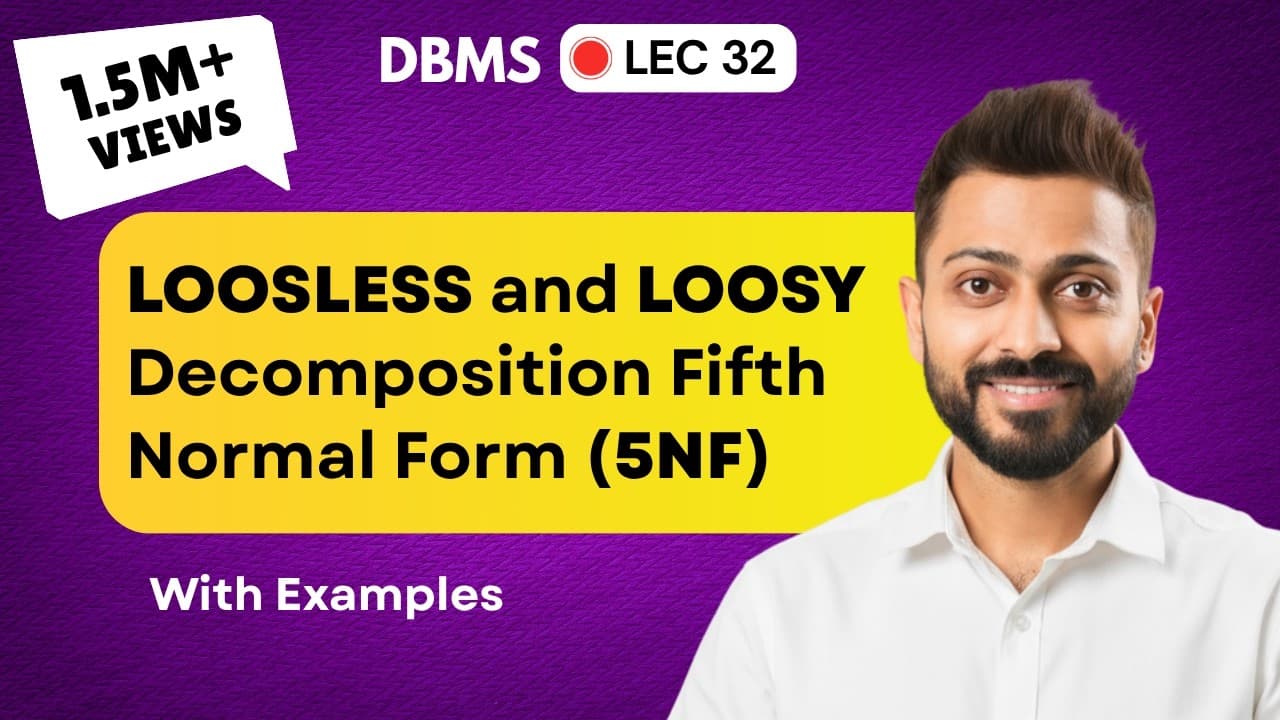
What Is Lossless vs Lossy Decomposition in Databases?
TL;DR
Lossless decomposition involves splitting a database table into sub-tables and recombining them without losing data integrity or introducing inconsistencies. In contrast, lossy decomposition can lead to duplication and issues with data accuracy. Ensuring the common attributes in decomposed tables are candidate keys or super keys is essential for maintaining a lossless approach.
Transcript
Lossless Vs Lossy decomposition Whenever we normalize the table. Means we need to decompose the table. That means whenever we normalize the table, like. First, second, third. Take it to BCNF So the means i have to decompose the table. Now whenever we decompose the table So there is audit, EF codd, there are two rules which we have to follow These r... Read More
Key Insights
- 🚰 Lossless decomposition ensures the preservation of data integrity during table splitting and joining.
- 🤩 Common attributes between decomposed tables should be candidate keys or super keys to maintain consistency.
- 🥺 Lossy decomposition may result in duplication and inconsistency, leading to data integrity issues.
- 🚰 The criteria for determining the common attribute in decomposed tables is crucial for achieving a lossless decomposition.
- 🌸 Incorrectly chosen common attributes can result in spurious tuples and a loss of data accuracy.
- 🛟 Lossy decomposition should be avoided in database design to prevent data inconsistencies and preserve data integrity.
Install to Summarize YouTube Videos and Get Transcripts
Explore YouTube Video Summarizer or Get YouTube Transcript Extractor
Questions & Answers
Q: What is lossless decomposition in a database?
Lossless decomposition refers to the splitting of a table into multiple sub-tables and joining them again without losing any data or introducing inconsistency. It ensures that the original data is preserved throughout the decomposition process.
Q: What are the conditions for a lossless decomposition?
The conditions for lossless decomposition are:
- The union of the attributes in the sub-tables should be equivalent to the attributes in the original table.
- The intersection of the attributes in the sub-tables should not be an empty set.
- The common attribute between the sub-tables should be a candidate key or super key of either one or both tables.
Q: What is lossy decomposition?
Lossy decomposition occurs when a table is split into sub-tables and joined again, resulting in data duplication and inconsistency. It can lead to the presence of spurious tuples and a loss of data accuracy.
Q: Why is lossy decomposition undesirable in a database?
Lossy decomposition is undesirable because it introduces redundancy and inconsistency in the joined tables. It deviates from the original data and can lead to incorrect query results and database anomalies.
Key Insights:
- Lossless decomposition ensures the preservation of data integrity during table splitting and joining.
- Common attributes between decomposed tables should be candidate keys or super keys to maintain consistency.
- Lossy decomposition may result in duplication and inconsistency, leading to data integrity issues.
- The criteria for determining the common attribute in decomposed tables is crucial for achieving a lossless decomposition.
- Incorrectly chosen common attributes can result in spurious tuples and a loss of data accuracy.
- Lossy decomposition should be avoided in database design to prevent data inconsistencies and preserve data integrity.
- The conditions for lossless decomposition are related to the equivalence of attributes and the presence of a non-empty intersectio
Summary & Key Takeaways
-
Lossless decomposition involves splitting a table into multiple sub-tables and joining them again without any loss of data or inconsistency.
-
Lossy decomposition, on the other hand, can result in duplication and inconsistency in the joined tables.
-
The common attribute between the decomposed tables must be a candidate key or super key of either one or both tables.
Read in Other Languages (beta)
Share This Summary 📚
Summarize YouTube Videos and Get Video Transcripts with 1-Click
Try YouTube Summary with ChatGPT & Claude or YouTube Transcript Generator
Explore More Summaries from Gate Smashers 📚




Summarize YouTube Videos and Get Video Transcripts with 1-Click
Try YouTube Summary with ChatGPT & Claude or YouTube Transcript Generator