Why Is Self-Modifying Code a Bad Idea?
TL;DR
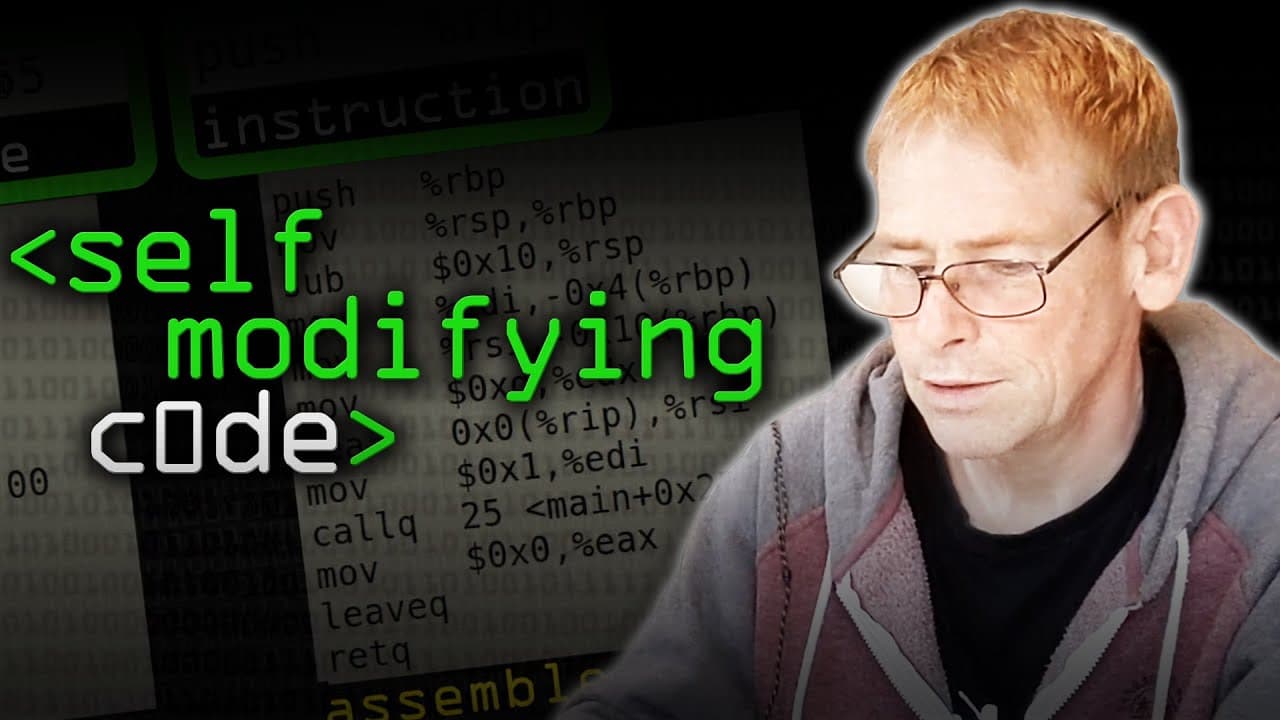
Self-modifying code allows a program to alter its own instructions during execution, which poses significant risks. It complicates debugging, is often restricted by modern operating systems for security, and can lead to unpredictable performance issues. Generally, sticking to more predictable coding practices is advisable.
Transcript
okay so today we're going to follow a little ball about uh this item about mel and about real programming what i should have said at the very start is that uh these techniques of real programming and real programming is in quotes here is really very bad it will get you fired from most companies these days because most people could probably write th... Read More
Key Insights
- 🙈 Self-modifying code can be a powerful programming technique but is generally seen as bad practice in modern programming environments.
- 🖱️ The use of self-modifying code is primarily found in bootstrapping processes and malicious activities like computer viruses.
- 🤳 Debugging self-modifying code is extremely challenging as the running program constantly changes.
- 👨💻 Modern operating systems often limit the ability to modify code for security reasons, making self-modifying code impractical in many cases.
- 🥺 Self-modifying code can disrupt the execution pipeline, leading to performance issues.
- 👋 Following a more traditional programming approach, where the instructions are not modified during runtime, is generally considered the best practice.
- 🤳 Self-modifying code is like a recipe that constantly changes its ingredients and instructions, making it difficult to understand and unpredictable in its outcome.
Install to Summarize YouTube Videos and Get Transcripts
Explore YouTube Video Summarizer or Get YouTube Transcript Extractor
Questions & Answers
Q: What is self-modifying code?
Self-modifying code refers to a programming technique where a program modifies its own instructions while executing.
Q: In what scenarios might self-modifying code be used?
Self-modifying code is commonly used during bootstrapping processes and by computer viruses and trojan horses to hide their actions and evade detection.
Q: What are the main challenges of self-modifying code?
One major challenge is the difficulty in debugging self-modifying code, as the running program may bear no resemblance to the original program. Modern operating systems also often limit the ability to modify code for security reasons. Additionally, self-modifying code can disrupt the efficiency of the execution pipeline.
Q: Why is self-modifying code generally discouraged in programming?
Self-modifying code is discouraged due to its potential for introducing bugs, difficulty in debugging, limitations imposed by modern operating systems, and disruption to the execution pipeline, which can lead to performance issues.
Summary & Key Takeaways
-
The content discusses the concept of self-modifying code, which allows a program to change its own instructions while running.
-
Self-modifying code is commonly used in bootstrapping scenarios and by computer viruses and trojan horses to hide their actions.
-
However, self-modifying code presents numerous challenges, including difficulty in debugging, restrictions imposed by modern operating systems, and disruption to the execution pipeline.
Read in Other Languages (beta)
Share This Summary 📚
Summarize YouTube Videos and Get Video Transcripts with 1-Click
Try YouTube Summary with ChatGPT & Claude or YouTube Transcript Generator
Explore More Summaries from Computerphile 📚



Summarize YouTube Videos and Get Video Transcripts with 1-Click
Try YouTube Summary with ChatGPT & Claude or YouTube Transcript Generator