How to Validate an App Idea With Viral Content
TL;DR
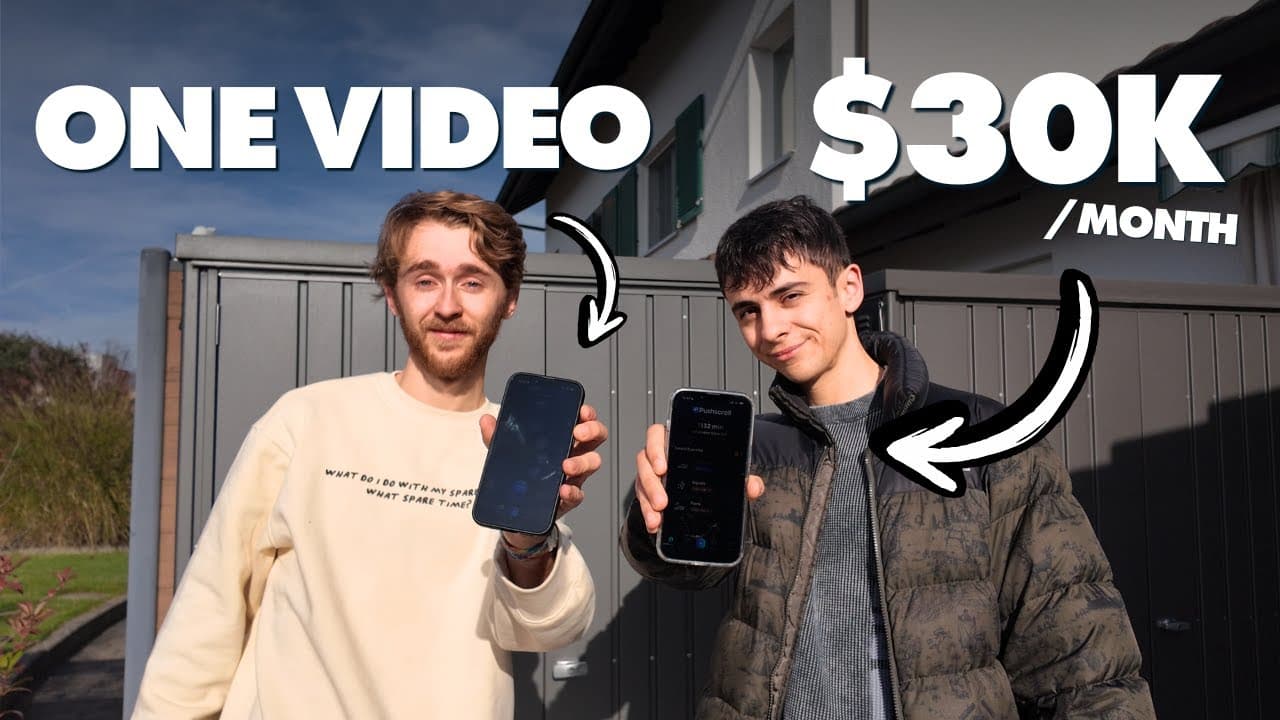
Validate a consumer app by publishing a clear, visually compelling concept video before writing code, then build only after viewers demonstrate demand. Pushscroll used this content-first approach to attract 80,000 views, gather hundreds of comments, launch a simple three-screen MVP in roughly two weeks, and grow through organic viral videos to more than $30,000 in monthly revenue.
Transcript
This is Alejandro and Mario, two founders who built an app that makes $30,000 a month. But here's what's crazy. They did not actually build the app first. >> I basically made a fake product demo and it got 80K views. >> They made a video using fake footage, posted it on TikTok, it blew up, and only then did they actually build it. The biggest mista... Read More
Key Insights
- Content can serve as the first MVP for a consumer app because a concept video tests whether the problem, proposed outcome, and presentation attract attention before development begins. This approach helped the founders separate early distribution testing from the time and effort required to build software.
- Pushscroll is an app that requires a short workout, such as push-ups, squats, or a plank, before users can open social media. Its intended value is easy to visualize because it directly connects the familiar problem of doom scrolling with the visible action of exercising.
- The initial validation video received 80,000 views and around 500 comments before the app existed. Viewers asked the founders to build the product, giving them evidence of demand and urgency that was stronger than developing an app first and searching for an audience afterward.
- A strong short-form hook is clear, creates curiosity, and introduces something novel. The founders used the question of whether 20 push-ups could stop doom scrolling, making the problem immediately recognizable while creating curiosity about how exercise and social media access would connect.
- A fake product demonstration can communicate value without functioning software when it shows the desired experience honestly as a concept. Alejandro combined AI push-up detection footage, a phone positioned against a wall, and a scrolling scene so viewers could understand the proposed app in practical terms.
- The first Pushscroll MVP contained only three screens and took around two weeks to build. Because demand had already been demonstrated through content, the founders could launch a deliberately simple product quickly and use the response to continue validating the idea instead of expanding its initial scope.
- The launch offer produced roughly 20,000 to 30,000 downloads by promising free access to users who downloaded during the first week. This offer was communicated through another TikTok video, connecting the audience gathered through validation content directly to the newly available product.
- A repeatable content-first process begins by studying and interacting with niche content, identifying visually strong and easily explained app ideas, and posting daily tests. The founders recommend focusing on ideas tied to fundamental human problems or desires and continuing until one concept gains traction.
Install to Summarize YouTube Videos and Get Transcripts
Explore YouTube Video Summarizer or Get YouTube Transcript Extractor
Questions & Answers
Q: How can content validate an app idea before development?
Content can validate an app idea by presenting the problem, proposed outcome, and user experience in a compelling concept video before any software is written. Alejandro used existing footage to simulate push-up detection, phone placement, and social media scrolling. The resulting TikTok received 80,000 views and around 500 comments, including people asking him to build the app. That response provided evidence that the concept could attract attention and potential users.
Q: What does the Pushscroll app do?
Pushscroll requires users to complete a short exercise before they can access social media. Its exercise options include push-ups, squats, and a plank. The founders describe the product as a way to address doom scrolling by replacing immediate social media access with fitness. The app had around 300,000 downloads across the App Store and Play Store, approximately 4,000 paying customers, and a hard paywall priced at around $30 per year.
Q: Why did Pushscroll's first concept video work?
The concept video worked because its hook was clear, novel, and built around a curiosity gap. It asked whether doing 20 push-ups could stop a doom-scrolling addiction, which connected two ideas viewers would not normally associate. The video then visualized the proposed benefit through push-up detection footage, a phone placed against a wall, and scrolling. It emphasized the outcome of exercising and reducing doom scrolling instead of explaining technical features.
Q: How do you demonstrate an app that has not been built?
An unbuilt app can be demonstrated by assembling visuals that communicate what users would do and what outcome they would receive. Alejandro used an AI push-up detection clip found on YouTube, showed how a phone could be placed against a wall, and added a social media scrolling scene. Together, those elements enabled viewers to imagine the product. The video concluded with a call to action asking whether the proposed app should be built.
Q: What should a viral app concept include?
A viral app concept should contain a visually strong element, be easy to explain, and address a fundamental human problem or desire. The founders argue that an idea that cannot be explained in three words may be too complex for the short attention span of TikTok users. Pushscroll fit these criteria because exercise is visually demonstrable, its access restriction is simple, and doom scrolling is a painful problem that many people recognize.
Q: How quickly was the first Pushscroll MVP built?
The founders built the initial Pushscroll MVP in around two weeks after their concept video demonstrated audience interest. The product had only three screens, but that limited scope was enough to validate the idea further. Rather than delaying the launch to add more features, they responded quickly to comments from people asking for the app. The sequence was concept video first, simple software second, and additional validation through the launch response.
Q: How did Pushscroll get its first downloads and revenue?
Pushscroll launched through another TikTok video that promised free access to everyone who downloaded the app during its first week. That campaign generated roughly 20,000 to 30,000 downloads. The founders then scaled organic video formats and reported that all early revenue came from organic content. Four months after launch, the app was generating more than $30,000 per month, after which they also began scaling through advertisements.
Q: What is the content-first playbook for launching an app?
The content-first playbook starts by creating and warming up a TikTok account through watching niche videos, following creators, and interacting through comments, saves, shares, or reposts. Next, identify app ideas that are visually interesting, easy to explain, and connected to a fundamental problem or desire. Publish daily concept videos to test those ideas, study why successful content performs well, and build a simple MVP only after one idea attracts meaningful attention.
Summary & Key Takeaways
-
Alejandro and Mario created Pushscroll, an app that requires users to complete exercises before accessing social media. The product addresses doom scrolling by replacing immediate social media access with movement. Four months after launch, it had generated more than $30,000 per month, with around 300,000 downloads and approximately 4,000 paying customers.
-
The founders validated demand before developing the product. Alejandro assembled a concept video from existing footage, including AI push-up detection, a phone placed against a wall, and social media scrolling. The video received 80,000 views and about 500 comments, including requests to build the proposed app, before any code was written.
-
After confirming interest, the founders built a simple three-screen MVP in around two weeks. A launch video promised free access to people downloading during the first week, producing roughly 20,000 to 30,000 downloads. They then repeated successful organic content formats, reaching $30,000 in monthly revenue before beginning to scale with advertising.
Read in Other Languages (beta)
Share This Summary 📚
Summarize YouTube Videos and Get Video Transcripts with 1-Click
Try YouTube Summary with ChatGPT & Claude or YouTube Transcript Generator
Explore More Summaries from Starter Story 📚
Summarize YouTube Videos and Get Video Transcripts with 1-Click
Try YouTube Summary with ChatGPT & Claude or YouTube Transcript Generator